

Most churches don't have an operations problem. They have a sequencing problem. Something feels off — reconciliation takes too long, volunteers keep no-showing, nobody's sure who owns the member database — but the response is to fix whatever hurts most that month. A new fire starts, attention shifts, and the half-built system quietly rots.
The fixes are usually not that complicated. What's hard is knowing which one comes first, which ones depend on others, and which ones you're not actually ready for yet. A finance dashboard is useless if your giving data is scattered across three tools. A volunteer scheduler collapses if nobody's been assigned to own it.
That's what a maturity model is for. Not as a grade — nobody needs another way to feel behind — but as a map. This assessment is built specifically around how small congregations actually run: thin staff, heavy volunteer dependence, seasonal spikes, and budgets that don't leave much room for mistakes.
The four stages, and what actually separates them
Every church lands somewhere between doing things by memory and running things by design. The four stages below aren't rigid — most churches are Stage 2 in finance and Stage 1 in volunteer coordination at the same time. That's normal. You assess each area separately, then decide where to invest.
The thing people miss: the stages aren't about how big you are. A 900-person church can be stubbornly Ad-hoc if everything lives in the executive pastor's head. A 120-person church can be Measured if the administrator built clean systems early. Maturity is really just about how much of your operation survives a key person taking a two-week vacation.
| Stage | How work gets done | What breaks | Staff-hour signal | Cost signal (annual ops tooling) |
|---|---|---|---|---|
| 1. Ad-hoc | Memory, texts, one heroic volunteer | Anything the "hero" doesn't touch | 30–45% of admin time is rework/searching | Under $1k, mostly free tools stitched together |
| 2. Managed | Written processes, shared files, assigned owners | Coordination between teams; data drift | Rework drops to ~20%, but coordination overhead rises | Roughly $2k–$6k |
| 3. Measured | Owners + basic metrics + review cadence | Analysis paralysis; metrics nobody acts on | Admin time steadies, planning improves | Roughly $5k–$12k |
| 4. Optimized | Systems feed decisions; work is designed, reviewed, improved | Complacency; over-engineering | Staff shift from doing to overseeing | Varies — spend is deliberate, not reactive |
The cost bands above are wide on purpose. A church that runs lean but intentionally can be more mature than one spending three times as much on tools nobody fully uses. Spending isn't maturity. Alignment is.
Stage 1 — Ad-hoc
Everything works until it doesn't. The children's check-in runs smoothly because Denise has done it for six years and knows every family. Giving gets recorded because the treasurer remembers to. There's real competence here — it's just not transferable competence.
The tell: when someone asks "how do we do X?" the answer is a person's name, not a document or a system.
Stage 2 — Managed
Processes exist and are written down. Owners are named. You've got a shared drive instead of files scattered across personal laptops. This is a huge leap, and most small churches that get serious about operations land here and stay here for years.
The new problem at this stage is coordination. Finance has its process. Volunteers have theirs. Communications has theirs. But they don't talk to each other, so the same member gets entered three different ways in three different tools. Building a shared operating language across teams is exactly what a cross-functional church operations playbook starts to solve — clean, consistent data is the foundation everything else at higher stages depends on.
Stage 3 — Measured
Now you're not just running processes — you're watching them. A handful of numbers get reviewed on a cadence: giving trends, first-time visitor follow-up rate, volunteer fill rate. Decisions start referencing data instead of gut feel.
The trap here is measuring things nobody acts on. A dashboard with 22 metrics is a Stage 2 church cosplaying as Stage 3. Measured means every number has an owner and a "so what."
Stage 4 — Optimized
Systems don't just report — they inform decisions automatically. Follow-ups trigger without someone remembering. Capacity plans adjust to seasonal patterns you've documented over years. Staff spend their time on judgment and relationships, not data entry and chasing.
Very few small churches need to be fully Optimized across every area, and chasing it everywhere is a waste. You optimize the two or three areas that carry the most risk or eat the most hours. The rest can happily stay Managed.
A short self-assessment
Score each area 1–4 using the stage descriptions above. Be honest — the point is a useful map, not a good-looking one.
Simplify your church’s day-to-day operations.
Parshly helps you organize events, track donations, and engage your congregation—all in one place.
- Centralized member management
- Donation tracking & reporting
- Volunteer scheduling & notifications
No credit card required
For each of these, ask: does this survive the owner being out for two weeks?
-
Member data — Is there one source of truth, or several competing versions?
-
Finance & giving — Can you produce an accurate month-end without heroics?
-
Volunteer coordination — Are roles filled by system or by last-minute texts?
-
Communications — Is there a defined channel and owner for routine vs. urgent messages?
-
Safety & compliance — Are check-in, screening, and access controls documented and followed?
-
Decision-making — Do leaders review numbers on a cadence, or react to whatever surfaces?
Add up your scores:
-
6–10 points — Mostly Ad-hoc. Your priority is documentation and ownership, not new tools.
-
11–16 points — Mostly Managed. Your priority is coordination between teams and reducing data drift.
-
17–20 points — Approaching Measured. Your priority is a review cadence and killing metrics nobody uses.
-
21–24 points — Measured to Optimized. Your priority is selective automation in your highest-risk areas.
One pattern worth naming: churches almost always score higher on the things that scare them (safety, finance) and lower on the things that quietly bleed time (volunteer coordination, communications). The quiet bleeders are usually where the fastest wins hide.
The stage-gated 18-month roadmap
The word "gated" matters. You don't move to the next phase until the current one holds. A church that jumps to dashboards before its data is clean just builds a prettier version of chaos.
Here's the roadmap visual:
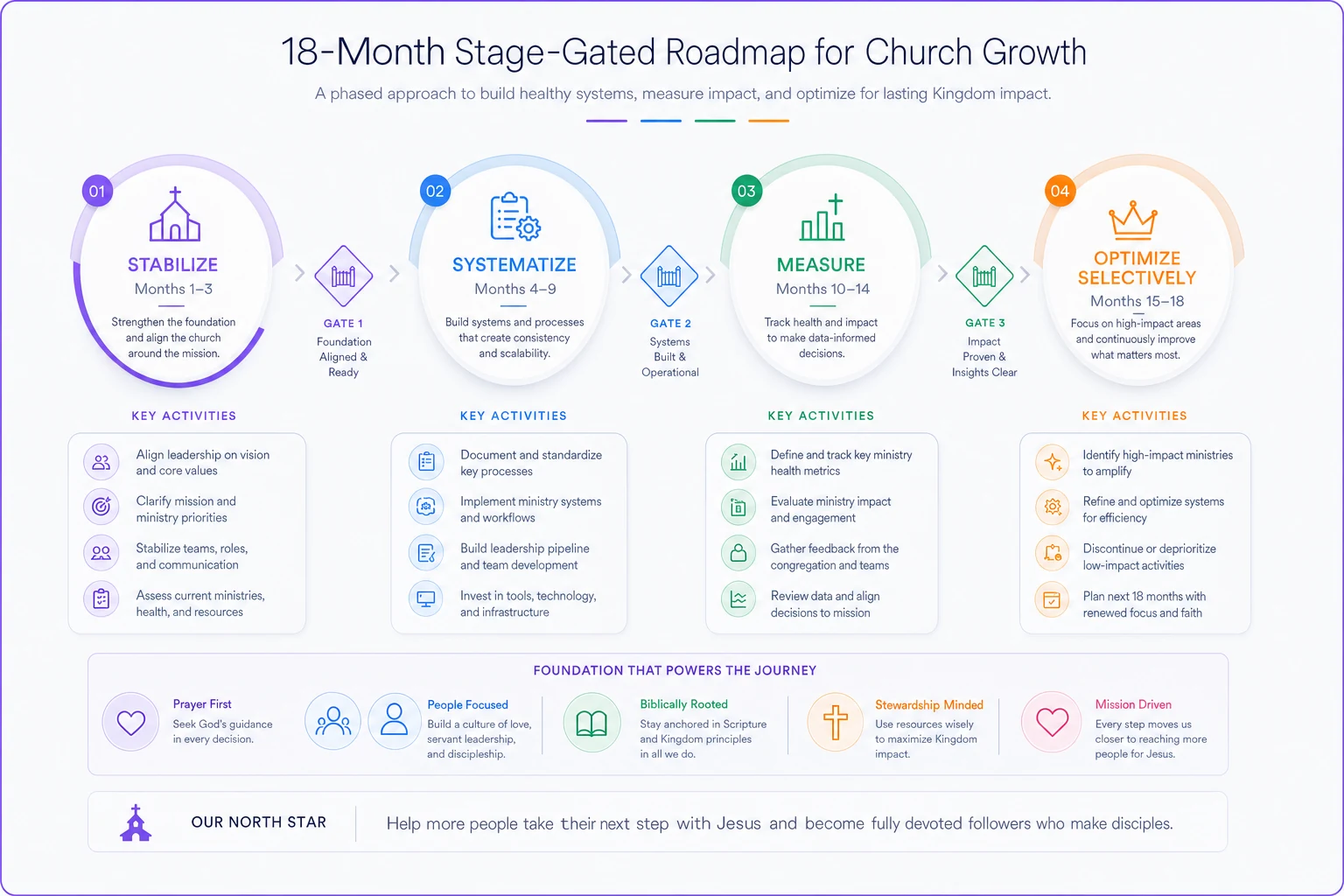
Resist rushing Stabilize — if your data and owners aren't real by month three, later stages fail.
Months 1–3: Stabilize (get out of Ad-hoc)
-
Pick your single source of truth for member data and stop entering it anywhere else.
-
Document your three highest-risk workflows — check-in, giving handling, and urgent communications — as simple step-by-step guides.
-
Assign a named owner to each core area. One name, not a committee.
-
Write down your basic finance approvals
who can spend what, and who checks it.
If finance is your weakest area, this is where a non-accountant finance governance playbook earns its keep — approval thresholds and a year-end calendar turn "the treasurer handles it" into something anyone can pick up.
Stabilize is also the phase most churches try to rush. Resist that. If your data isn't clean and your owners aren't real by month three, everything you build in month four is just a more organized mess.
Months 4–9: Systematize (settle into Managed)
-
Consolidate tools where it reduces duplicate data entry. Fewer, connected tools beat many disconnected ones.
-
Build a shared calendar and intake process so ministries stop double-booking rooms and volunteers.
-
Establish handoffs between teams — when a visitor comes in, who does what, in what order.
-
Start a light change log so you know what changed and who changed it.
This is the stage where rollouts go to die. New processes get announced, half the staff adopts them, the other half quietly reverts, and three months later you're back to square one. A structured approach to change management with pilots and adoption tracking is the difference between a system that sticks and one that evaporates. Don't skip this — it's the most common failure point on the entire roadmap.
Months 10–14: Measure (move toward Measured)
-
Pick 4–6 numbers total, each with an owner and a decision it informs.
-
Set a monthly review that takes under an hour.
-
Kill any metric that hasn't changed a decision in three months.
Tool sprawl tends to surface hard at this stage, because measurement exposes how badly your systems talk to each other. If you're staring at a tangle of integrations that cost more than they return, working through a small-church technology strategy with API priorities will save you from paying for connections you don't actually need.
Months 15–18: Optimize selectively (targeted Optimized)
-
Pick your top two risk-or-time areas and go deeper. Automate the repetitive parts — follow-up triggers, seasonal volunteer surge alerts, month-end checklists.
-
Leave everything else at Managed. Trying to optimize the whole operation at once is how 18-month plans become 4-year plans.
Seasonal load is usually one of the smartest places to invest late-stage effort. If program overload is a recurring pain, a seasonal ministry prioritization framework with an intake form and scorecard keeps your calendar from filling up with things nobody had capacity to run.
The ceiling here isn't ambition — it's bandwidth. Two well-optimized areas beat six halfway-improved ones every time.
How the stages connect (the part that trips people up)
Maturity isn't a straight line you walk once. It's a set of dependencies. Volunteer coordination can't reach Stage 3 if your member data is still Stage 1 — you can't measure fill rates when you're not sure who your volunteers even are. Finance dashboards mean nothing if giving records live in two systems.
The logic in plain terms: data feeds coordination, coordination feeds measurement, measurement feeds optimization. Skip a layer and the layer above it wobbles. This is why churches that buy the shiny reporting tool first almost always end up frustrated — they built the roof before the walls.
The other under-appreciated dependency is people. A Stage 3 system run by a Stage 1 team reverts fast. Every stage gate should include a check: does the team actually know how to run this, and does someone own it when the person who built it leaves? Systems don't maintain themselves, and in small churches, that question matters more than the system itself.
A realistic scenario
A church running around 240 on Sundays — one full-time administrator, two part-timers — was losing roughly a full day of admin time every week to reconciliation and "where's that info" searches. Member data lived in a spreadsheet, a giving platform, and the check-in app. Three versions of the same families, none of them agreeing.
They didn't buy anything new for the first quarter. They picked the giving platform as the single source of truth, documented three workflows, and named owners. Month-end went from a two-evening ordeal to a couple of focused hours. In months four through nine they consolidated their calendar and built visitor handoffs. By month eleven they were reviewing five numbers monthly.
The shift wasn't dramatic-sounding, but it was real: admin rework dropped from around a third of the week to maybe 12–15%, first-time visitor follow-up went from hit-or-miss to consistently within 48 hours, and the administrator stopped being the single point of failure. The church didn't get bigger. It just got steadier.
When to push forward — and when to stop
When moving up a stage makes sense: a key person is stretched thin or about to leave, growth is exposing cracks, or you're repeatedly making decisions blind. Pain plus capacity to change is the green light.
When it's a bad idea: right before a major season (don't reorganize check-in in mid-December), during a leadership transition with no bandwidth, or when the current stage isn't actually holding yet. Building the next floor on a shaky foundation just gives you more to rebuild.
Who should NOT chase Stage 4: most small churches, across most areas. Optimized everywhere is expensive to build and maintain. Pick the two areas where failure is most costly — usually safety and finance — and let the rest live comfortably at Managed.
Where this leaves you
The value of a maturity model isn't the label. It forces sequence onto something churches usually treat as a pile of unrelated fixes. When you can see that clean data has to come before coordination, and coordination before measurement, the endless firefighting starts to have an order to it.
Run the self-assessment honestly, find the one area that's both weak and costly, and start there — not with the flashiest problem, but with the one blocking everything downstream. Good church operations aren't about doing more. They're about building systems that keep working when the people who built them are out sick, on vacation, or gone entirely. That's the real test, and it's the one every stage of this model is quietly pointing toward.
Run the self-assessment honestly, find the one area that's both weak and costly, and start there — not with the flashiest problem, but with the one blocking everything downstream. Good church operations aren't about doing more. They're about building systems that keep working when the people who built them are out sick, on vacation, or gone entirely. That's the real test, and it's the one every stage of this model is quietly pointing toward.
Ready to transform your church management?
Join 500+ churches using Parshly to enhance community engagement, streamline administration, and grow their ministries.