



Most small churches don't lose money to fraud. They lose it to fog. Nobody's exactly sure who approved the new sound board, the bookkeeper who "handled everything" retired, and the treasurer discovers in March that three ministries have been quietly overspending since last summer. There's no villain — just a system that was never actually designed, only inherited.
That's the real problem with church finance governance at small scale. When you have two or three staff plus a rotating cast of volunteers, financial control tends to live inside one person's head. It works fine until that person leaves, gets sick, or makes an honest mistake that nobody catches for four months. And because churches run on trust, the instinct is to avoid structure, as if approval thresholds and named owners somehow signal suspicion. The opposite is true. Clear rules protect the people you trust most. This playbook is written for the church that doesn't have a CFO and never will. No accounting degree required. The goal is a system a volunteer treasurer can actually run, a new administrator can inherit without a three-week handoff, and a board can trust without micromanaging.
Start by naming who owns what — before you touch a single number
The most common failure isn't a bad budget. It's a budget with no owners. A line item that says "Youth Ministry — $8,400" tells you a target but not who's responsible when it drifts. So when the youth pastor books a retreat that runs $1,100 over, there's genuinely no clear answer to "who was supposed to catch this?"
Named budget ownership fixes that. Every meaningful budget line gets exactly one human attached to it — not a committee, not "the office," a person. That owner is accountable for staying within the line, flagging problems early, and approving spending against it up to a limit. It's the single highest-leverage move in the whole system, and it costs nothing.
-
The owner sees their line every month, not once a year at budget time
-
The owner initiates spending or approves requests against their line
-
The owner explains variances — over or under — in plain language
-
The owner cannot approve their own reimbursements (more on that below)
Churches that skip this step almost always end up with the treasurer or lead pastor as the de facto owner of everything. That's how you get a bottleneck where one person is signing off on the coffee order and the roof repair with the same level of attention — which is to say, not enough attention on either.
| Role | Owns | Does NOT own |
|---|---|---|
| Lead Pastor | Vision-level budget priorities, cross-ministry tradeoffs | Day-to-day approvals, cutting checks |
| Treasurer (often volunteer) | Reconciliation, month-end close, financial reporting to board | Individual ministry spending decisions |
| Administrator / Office Manager | Vendor payments, payroll processing, expense logging | Approving spend above threshold, signing checks alone |
| Ministry Leads | Their specific line items, requests within threshold | Anything outside their assigned budget |
| Finance Committee / Board | Policy, thresholds, annual budget approval, oversight | Operational approvals, weekly transactions |
The table looks obvious once it's written down. The reason it matters is that most small churches have never written it down, so these roles blur constantly. The administrator quietly starts approving things because it's faster. The pastor signs checks because "it's always been that way." Blurred roles are exactly where mistakes hide.
Approval thresholds: the rule that prevents most of the awkward conversations
Once you know who owns what, you need to answer: at what dollar amount does someone else need to sign off? Without thresholds, you get two bad extremes — either everything requires the treasurer's approval (bottleneck, resentment, delays) or nothing does (surprises, overspending, no paper trail).
Simplify your church’s day-to-day operations.
Parshly helps you organize events, track donations, and engage your congregation—all in one place.
- Centralized member management
- Donation tracking & reporting
- Volunteer scheduling & notifications
No credit card required
-
Under ~$250 — Budget owner approves alone, logs the receipt. No second signature needed.
-
~$250 to ~$1,500 — Budget owner approves, plus one additional approver (usually administrator or treasurer). Two names on the record.
-
~$1,500 to ~$5,000 — Requires treasurer plus lead pastor, or two board members if it's outside an existing budget line.
-
Over ~$5,000 — Requires finance committee or board approval, documented in meeting minutes.
-
Anything unbudgeted, any amount over ~$1,000 — Automatically escalates one tier regardless of the number.
Adjust the actual dollar figures to your size. A church with a $120k budget might set the top tier at $2,500. The structure matters more than the specific numbers. The principle: routine spending shouldn't need a meeting, and no single person should be able to move large amounts alone.
One rule that quietly prevents a lot of grief — nobody approves their own reimbursement. The youth pastor submitting a $340 retreat expense gets it approved by the administrator or treasurer, never by themselves. This isn't about distrust. It's about removing the situation entirely, so no one ever has to wonder. When someone eventually asks "who checks the checker?" you already have an answer.
When strict thresholds are a bad idea
If you're a church plant with one paid staff member and a $40k budget, a five-tier approval system is overkill that nobody will follow. At that scale, a single rule works: any two of three designated people (pastor, treasurer, one board member) must approve anything over $500, and the treasurer reconciles monthly. Add tiers as you add staff and volume, not before. Governance that's heavier than the organization will simply be ignored — which is worse than having none, because now you have rules on paper that everyone quietly breaks.
The monthly close: the habit that makes everything else trustworthy
What separates churches with clean books from churches with anxious treasurers is a repeatable monthly close. Not a heroic year-end scramble — a boring, predictable checklist run every month that takes a couple hours and keeps small errors from compounding into year-end nightmares.
Monthly close gets skipped because it feels optional when things seem fine. But "seems fine" is exactly the problem. A miscoded donation in February that isn't caught until December has had ten months to distort every report in between, and untangling it means re-examining nearly a year of records.
Your close is really just a coordination checkpoint between three things that must agree: what the bank says, what your records say, and what actually happened. When those three diverge and nobody notices, that's where reconciliation headaches live. If you want the deeper mechanics on catching giving and deposit errors before they snowball, this walkthrough on building an end-to-end secure donation workflow pairs directly with the close process below.
The monthly close checklist
-
- [ ] Reconcile every bank and credit card account against the statement
-
- [ ] Confirm all deposits recorded match actual bank deposits (dates and amounts)
-
- [ ] Verify restricted gifts landed in the correct restricted funds, not general
-
- [ ] Match every expense to a receipt and a budget line
-
- [ ] Confirm each expense had the right approval for its threshold
-
- [ ] Review each budget owner's line for variances over ~10%
-
- [ ] Flag and note any variance for the owner to explain
-
- [ ] Confirm payroll and required tax withholdings posted correctly
-
- [ ] Update the board-facing summary
-
- [ ] Save a dated snapshot of the reconciled reports
The restricted-fund line deserves special attention because it's where well-meaning churches get into actual legal and ethical trouble. Money given for the building fund or the missions trip cannot quietly fund the general budget — even temporarily, even with good intentions. If your fund tagging and chart of accounts aren't set up to keep those separate from the start, the monthly check becomes nearly impossible. The groundwork for that lives in this piece on simple tagging and a basic chart of accounts for restricted donations — get that structure right and the close checklist above becomes a ten-minute verification instead of a forensic investigation.
Pro-tip: Put the monthly close checklist on a shared calendar with recurring tasks so it's not dependent on one person's memory.
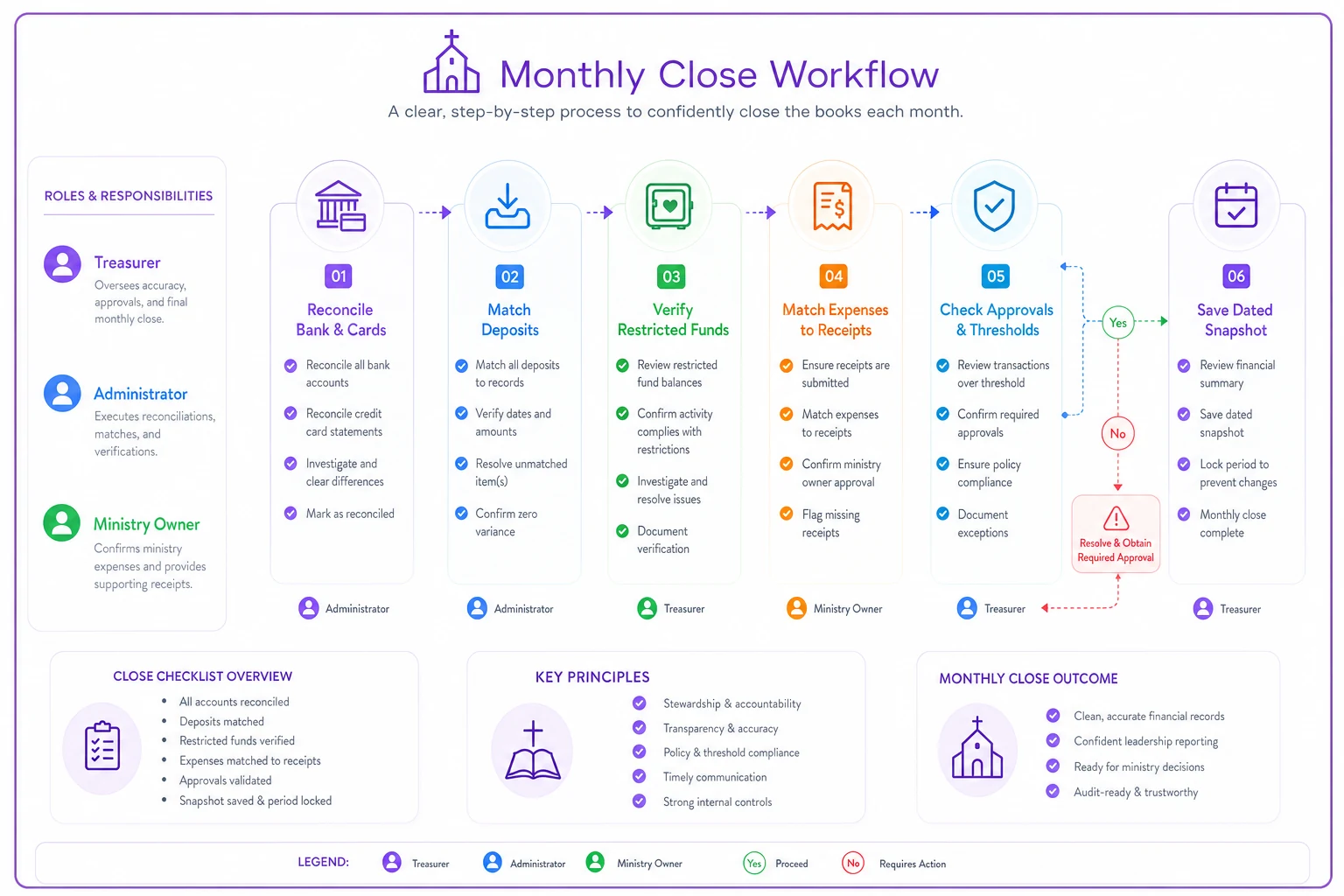
The checklist above is straightforward. The trouble is that at small scale it usually lives in one person's routine, and manual routines break in predictable ways.
Where manual close processes actually break
The single-person dependency. When the volunteer treasurer does the close from memory, there's no close at all during the two months they're traveling. Nothing gets reconciled, and the backlog quietly grows.
The spreadsheet drift. Someone keeps the "real" budget in a personal spreadsheet that slowly diverges from the accounting system. Two sources of truth means no source of truth.
The receipt black hole. Expenses get approved verbally, receipts arrive weeks later or never, and by close time nobody remembers what the $430 charge at the hardware store was for.
The silent threshold breach. Without a system that flags when spending crosses a tier, threshold rules only get enforced when someone happens to remember them — which means they mostly don't.
This is where lightweight financial and operational software earns its place. Not to replace the treasurer's judgment, but to make the routine parts automatic: flagging transactions that need a second approver, catching a restricted gift that landed in the wrong fund, generating the same reconciliation report every month without anyone rebuilding it from scratch. AI-assisted tools are genuinely useful here for the tedious pattern-matching — spotting a duplicate deposit, noticing a vendor charge that doesn't match any approved request, surfacing the variances that need a human to explain. The point isn't automation for its own sake. It's removing the single-person dependency and the silent threshold breaches so the close happens whether or not one specific person is having a good week.
The year-end calendar: work backward from the deadline, not toward it
Year-end is where churches without a system pay for a year of shortcuts all at once. Contribution statements have to go out, the board wants annual reports, budgets for next year need approval, and if you have paid staff, tax documents have deadlines that don't move.
The fix is to treat year-end as a calendar you build backward from fixed dates, not a pile of tasks you attack in January. Here's a realistic sequence for a church on a calendar fiscal year:
| Timeframe | What happens | Owner |
|---|---|---|
| October | Draft next year's budget; each owner submits their line requests | Ministry leads → Treasurer |
| November | Finance committee reviews and adjusts draft budget | Finance Committee |
| Early December | Board reviews proposed budget; final month's giving push communicated | Board / Lead Pastor |
| Mid-December | Verify all donor records and contact info are current | Administrator |
| Late December | Board approves next year's budget | Board |
| Early January | Final December close; lock the prior year's books | Treasurer |
| Mid-January | Generate and send annual contribution statements | Administrator / Treasurer |
| End of January | Issue required payroll tax documents to staff | Administrator |
| February | Present annual financial report to congregation/board | Treasurer |
Notice that the budget for next year gets approved before the current year even closes. That's deliberate. Churches that wait until January to start next year's budget spend the first quarter operating without one, which means Q1 spending happens with no approved framework behind it.
The annual report at the end is where all the quiet monthly work becomes visible. If you've closed cleanly every month, the annual report is basically twelve summaries stacked together — not a research project. And the board doesn't need forty pages; they need a clear, honest picture they can actually read. The format for that is worth getting right, which is exactly what this guide on board-ready dashboards and the minimal KPIs every small church needs walks through.
A real scenario: the treasurer handoff that didn't blow up
A congregation of around 180, one full-time pastor, a part-time administrator, and an annual budget in the $280k range. Their treasurer of nine years — the person who "just knew" where everything was — announced he was stepping down in six months.
Before: no written thresholds, no named budget owners, reconciliation done inconsistently (sometimes monthly, sometimes not for a quarter), and the entire budget living in the treasurer's personal spreadsheet. When they actually looked, they found two ministries that had each overspent by roughly $1,500–$2,000 over the year without anyone catching it in real time, plus a restricted memorial gift of about $600 that had accidentally been spent from the general fund and needed correcting.
They spent those six months building exactly what's in this playbook: assigned each budget line to an owner, set a four-tier threshold structure, and committed to a monthly close checklist run in the first week of every month. The outgoing treasurer trained the incoming one using the checklist rather than trying to transfer nine years of institutional knowledge through conversation.
The outcome wasn't dramatic in the way a turnaround story pretends to be. The handoff took about two weeks instead of the dreaded multi-month scramble, and the new treasurer — also a volunteer, also not an accountant — could actually do the job because the job was written down. Overspending got caught in the month it happened rather than at year-end. That's the whole win: not more money, just no more surprises.
Who should NOT build the full system yet
If you're running a genuinely tiny operation — one staff member, a budget under ~$60k, giving from a couple dozen households — resist the urge to install all of this at once. Start with three things: two-signature approval on anything over $500, a monthly reconciliation you actually do, and one written page naming who owns which decisions. That's enough governance for your size. The full threshold tiers and year-end calendar become worth the overhead as you grow past two or three staff and your budget clears roughly six figures.
The mistake goes both directions. Too little structure and you're one treasurer resignation away from chaos. Too much and you've built a bureaucracy your volunteers quietly abandon. Good church finance governance is proportional — it grows with you, tier by tier, owner by owner.
Bringing it together
Clean church finances aren't the product of a talented bookkeeper or a heroic treasurer. They're the product of a system that doesn't depend on any single person: every budget line has an owner, every dollar amount has a rule about who approves it, every month has a close that catches errors while they're small, and every year-end runs off a calendar built backward from real deadlines.
The churches that sleep well aren't the ones with the most money. They're the ones where any board member can answer "who approved this, and where's the record?" without hesitation — and where losing the treasurer means a two-week handoff, not a six-month crisis. Build the ownership, set the thresholds, run the close, follow the calendar. The trust you're trying to protect gets stronger when the system doesn't rely on trust alone.
Ready to transform your church management?
Join 500+ churches using Parshly to enhance community engagement, streamline administration, and grow their ministries.