


Most churches don't have a strategy problem. They have a saying yes problem.
Someone comes back energized from a conference and wants to launch a young-adults dinner. A longtime volunteer feels burdened to start a grief support group. The worship team wants a second midweek gathering. Each idea, taken alone, is good. Nobody in the room can find a reason to say no. So everything gets a soft "let's try it," and eighteen months later you're running 34 active programs with the same 40 volunteers and a staff that's quietly drowning.
The failure isn't the individual decisions. It's that there was never a system to weigh one against another. Ministry program prioritization breaks down not because leaders lack discernment, but because there's no shared, repeatable way to compare a new idea against everything already on the plate—and no rhythm for revisiting whether the old stuff still deserves the space it's taking up. This is a portfolio problem. Your ministries are a portfolio of investments competing for a fixed pool of money, volunteer hours, staff attention, and building space. Treat them that way and the fog clears fast.
Why program overload creeps in quietly
Nobody decides to overextend. It accumulates.
-
New programs get evaluated. Existing ones don't. A launch gets scrutiny, a budget line, a champion. Then it runs forever on autopilot. Nobody ever asks, "Is the Tuesday morning study still worth the room, the coffee budget, and the two volunteers?" So the plate only grows.
-
Approval is emotional, not comparative. When a beloved member pitches an idea in a leadership meeting, the real question—"what do we stop doing to make room?"—never gets asked because it feels like a personal rejection.
-
Resources are invisible until they crack. Volunteer capacity, in particular, is treated as infinite right up until the moment three ministries all need setup crews on the same Sunday. That's usually when the real cost of overload finally surfaces—as burnout and last-minute scrambling.
The deeper issue: the true cost of a program isn't its budget line. It's the coordination load it adds. Every active ministry needs a leader, a communication thread, a spot on the calendar, occasional facility use, and a slice of someone's attention. Ten small programs can quietly consume more staff bandwidth than three large ones, and none of that shows up in a budget spreadsheet.
What actually breaks as you scale
A church running 8–10 programs can hold everything in a few people's heads. The senior pastor knows who leads what. The administrator knows the calendar. Coordination happens in hallway conversations.
Simplify your church’s day-to-day operations.
Parshly helps you organize events, track donations, and engage your congregation—all in one place.
- Centralized member management
- Donation tracking & reporting
- Volunteer scheduling & notifications
No credit card required
Push past roughly 20 active programs and that informal system quietly stops working. Here's the sequence that tends to play out:
-
Double-booked resources. Two ministries assume they have the fellowship hall. Nobody wrote it down. It surfaces Saturday night.
-
Volunteer collision. The same reliable 15% of your congregation gets asked to serve everywhere, because leaders recruit from the same known pool. They burn out and leave, taking institutional memory with them.
-
Staff becomes a bottleneck. Every program routes small decisions and communications through one or two staff members. Response times slow. Volunteers feel unsupported. Quality drops across the board.
-
The mission blurs. With 30 things running, it's genuinely hard to answer "what are we actually about?" Resources spread thin means nothing gets done excellently.
The volunteer collision problem is worth sitting with, because it's the one that compounds. When you over-program, you don't just tire people out—you create the exact last-minute shortages that make every event feel chaotic. If that pattern sounds familiar, the underlying capacity mechanics are worth understanding on their own; we walked through them in detail in our capacity-planning lifecycle for ministries and event spikes.
The framework: four connected parts
The point of a prioritization system isn't to kill ideas. It's to make the trade-offs visible so decisions are objective, defensible, and calm. Four pieces, and they work together—each one feeds the next.
1. The intake form (kills the hallway "yes")
Every proposed program—new or an existing one up for renewal—goes through the same short intake. The form does one crucial thing: it moves the decision out of the emotional moment of the pitch and into a structured document.
-
The need it addresses. In one sentence, tied to a specific group of people—not "community" but "single parents in the Oakdale neighborhood."
-
How it connects to the church's stated mission. If someone can't draw that line, that's data.
-
Estimated volunteer hours per month to run it, including setup, comms, and follow-up—not just the event itself.
-
Staff hours required. Be honest here. This is the number people always lowball.
-
Facility and equipment needs, with days and times.
-
Budget, split into startup vs. ongoing.
-
A proposed owner. No named, committed leader means it's not ready. This single rule filters out a surprising amount of well-meaning but unsupported ideas.
-
A sunset date or review trigger. Every program gets a built-in "we'll revisit this in 12 months" so nothing runs forever unexamined.
The intake form's real job is to make the invisible costs—staff time, coordination load, facility conflicts—visible before approval, not after.
2. The prioritization scorecard
Now you score. Not to reduce ministry to math, but to force consistency. When you compare a children's program and a men's breakfast on the same criteria, you strip out favoritism and the volume-of-the-loudest-advocate effect.
| Criterion | Weight | What a 5 looks like | What a 1 looks like |
|---|---|---|---|
| Mission alignment | 3x | Directly advances a top priority | Tangential, "nice to have" |
| Reach / people served | 2x | Serves an underserved group or many people | Serves a handful already engaged |
| Volunteer sustainability | 3x | Has committed team, low ongoing load | Depends on one person, high load |
| Staff load | 2x | Runs with minimal staff involvement | Requires constant staff attention |
| Financial health | 1x | Self-funding or low cost | Ongoing significant cost |
| Uniqueness | 1x | Fills a real gap | Duplicates something we already do |
Multiply, add, and you get a comparable number. The scores don't make the decision for you—leadership still applies judgment. But when the young-adults dinner scores a 41 and the third midweek service scores a 22, the conversation gets a lot more honest.
One pattern worth naming: the criterion that surprises people most is volunteer sustainability, weighted heavily here on purpose. Programs die from lack of people far more than lack of money. Weight it accordingly.
3. The resource-impact assessment
The scorecard tells you if a program is worthy. The resource-impact assessment tells you if it's feasible right now—and that's a different question entirely.
-
Volunteer overlap. Does this pull from the same pool three other ministries already depend on? A program can look excellent on paper and still be a bad idea if it recruits from an exhausted pool.
-
Staff capacity. Which staff member absorbs the coordination? What are they dropping to make room?
-
Facility conflicts. Especially for multi-site churches, where a "yes" at one location can create shared-resource ripples across others. The logistics of that are their own discipline—our multi-site event logistics playbook covers how shared resources collide across campuses.
-
Timing. A great program launched during Advent, when your volunteer base is already maxed, will limp. Timing determines feasibility as much as merit does.
A high-scoring program with a red resource assessment doesn't get killed. It gets deferred—which brings us to the calendar.
4. The biennial calendar (approve / pause / defer, on a rhythm)
This is the piece most churches are missing entirely: a fixed rhythm for these decisions.
Run the full portfolio review on a two-year cycle, with a lighter check-in at the midpoint. Two years is long enough that programs get a fair run and short enough that dead weight doesn't linger for a decade. At each review, every active program gets one of three verdicts:
-
Approve / continue — still scores well, resourced, delivering.
-
Pause — worthy but currently un-resourced, or the need has temporarily faded. Not killed; shelved with a defined condition to restart.
-
Defer — approved in principle, but launch is scheduled for a specific future window when capacity exists.
The value of "pause" and "defer" is that they let you say no to now without saying no forever. That's what makes the framework politically survivable. The grief-support group champion doesn't hear "your idea is bad." She hears "this is a strong idea we're launching in the fall, once we've built the volunteer team it needs."
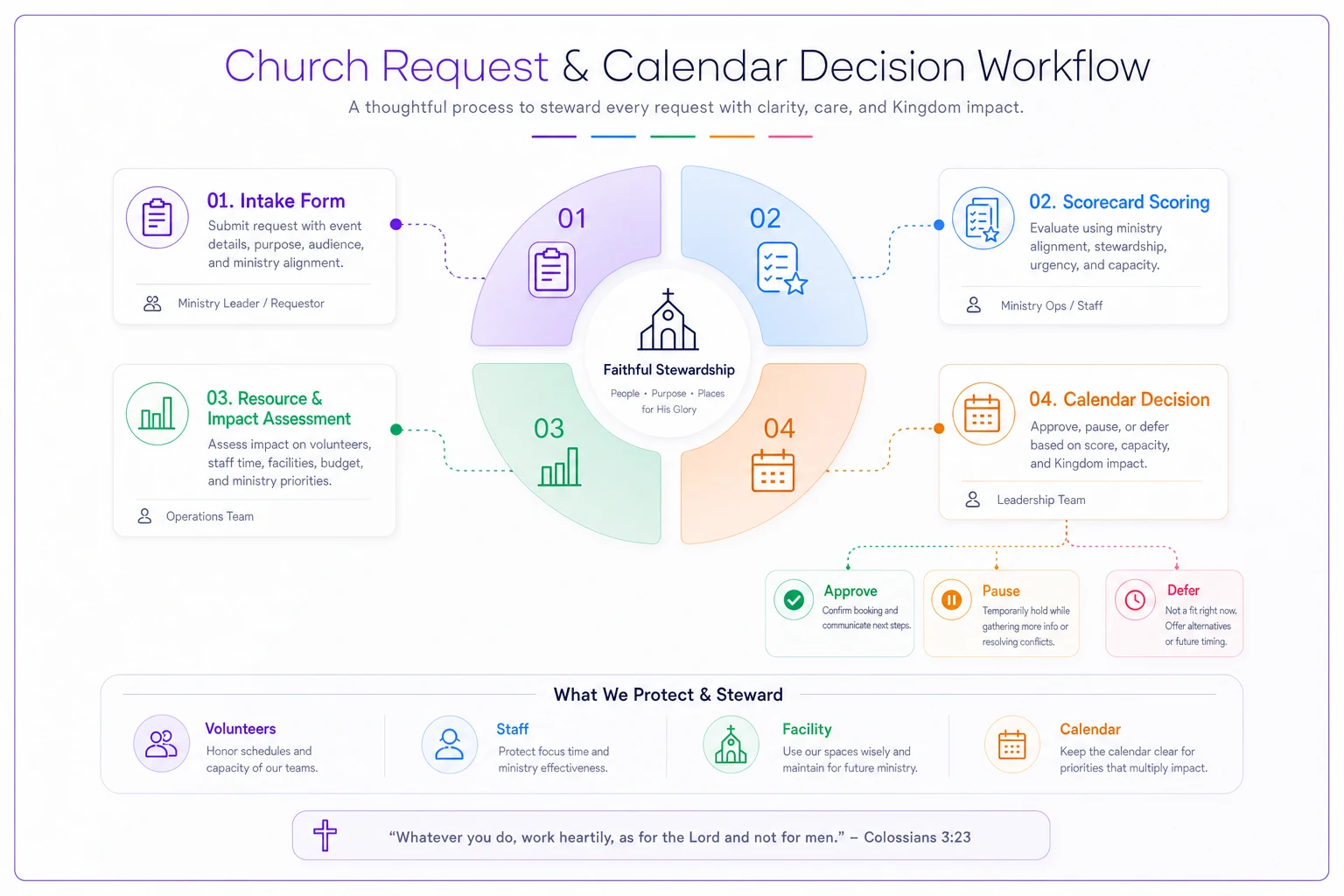
This flow visual helps leaders see how a proposal moves from pitch to calendar slot without relying on memory or hallway conversations.
A realistic scenario
A church of around 350 attendees had drifted to 28 active programs over about six years. Staff was three full-time and one part-time. The administrator described the calendar as "a game of Tetris nobody was winning."
They ran a first full portfolio review. The intake-and-scorecard process surfaced that:
-
Roughly a third of programs had no clearly committed owner—they were being propped up by staff.
-
Four programs were quietly duplicating each other's audiences.
-
The bottom-scoring five programs consumed an estimated 60+ volunteer hours a month between them while reaching very few people.
They paused three, deferred two ideas that had been verbally approved months earlier, and merged two overlapping groups. Net: from 28 down to about 20 active programs.
The measurable change wasn't dramatic on paper, but it was real. Volunteer no-shows dropped noticeably over the following two quarters. Two staff members reported getting a meaningful chunk of their week back. And—this is the part leaders didn't expect—the remaining programs got better, because freed-up attention actually flowed into them. Fewer things, done well.
Where software actually helps (and where it doesn't)
None of this requires software. You can run the intake form in a shared doc and the scorecard in a spreadsheet, and plenty of churches do exactly that at first.
Where a workflow platform earns its keep is at the coordination layer—once you're tracking 20+ programs, the manual version becomes its own part-time job. AI-assisted operational tools help mostly by keeping the picture current without someone constantly updating it: flagging when a proposed program's volunteer needs collide with existing commitments, surfacing facility conflicts before they hit the calendar, and rolling program data up into the kind of leadership summary you can actually make decisions from. If you're building toward that reporting layer, our guide to board-ready dashboards pairs naturally with this framework—the scorecard feeds the numbers your board sees.
Start with a shared doc and spreadsheet, and move to a workflow tool once program count and coordination needs consistently exceed what a person can track.
The tool doesn't make the decision. It just removes the excuse of "we didn't have the information in front of us."
When this framework makes sense—and when it doesn't
Do this if:
-
You're running more than 15–20 active programs.
-
Staff or volunteers are showing burnout signs.
-
You genuinely can't remember the last time you stopped doing something.
-
New ideas get approved faster than you can resource them.
Skip it (for now) if:
-
You're a plant or small church with under 8 programs. You don't need portfolio machinery to manage a handful of things—it'll feel like bureaucracy.
-
You're in the middle of a major transition (new senior pastor, building move). Wait until things stabilize; a portfolio review during upheaval will produce distorted scores.
Who should be careful: highly relational, small-town congregations where "programs" are really extensions of families. The scorecard is still useful, but apply the results with a heavy dose of pastoral judgment. A program that scores low on reach might be the entire social fabric for a handful of elderly members. The framework informs the decision; it doesn't overrule wisdom.
The mindset shift underneath all of this
The hardest part of ministry program prioritization isn't the forms or the scoring. It's accepting that a fixed team can only do a fixed number of things well—and that adding a good program to an overloaded plate makes everything a little worse, including the new thing.
Saying no, or "not yet," to a genuinely good idea feels like a failure of faith or generosity. Reframed correctly, it's the opposite. Protecting your people's capacity so the ministries you keep can actually thrive is stewardship. A church doing 15 things with excellence and margin will nearly always outlast one doing 35 things on fumes.
Build the intake form. Score honestly. Check resources against reality. Put it on a calendar you'll actually revisit. Then hold the line—kindly, but firmly—when the next great idea shows up. The framework isn't there to stop good ideas. It's there to make sure the good ideas you already said yes to don't quietly starve.
Ready to transform your church management?
Join 500+ churches using Parshly to enhance community engagement, streamline administration, and grow their ministries.