

Most churches don't lack policies. They have too many, sitting in too many places. There's a children's safety document a former volunteer wrote in 2019, a donation-handling note stapled inside a counting binder, a Google Doc about who can see member records, and a whole set of "we just know how we do it" rules that live entirely inside the office manager's head. Everything exists. Nothing connects.
That's the real problem with church operations, and it's almost never about the quality of any single policy. It's about fragmentation. When the finance procedure doesn't reference the role matrix, and the safety workflow doesn't say who escalates what, you get a governance system held together by two or three long-tenured people. When one of them leaves, a surprising amount of institutional knowledge walks out the door with them.
This is a blueprint for turning that scattered pile into one coherent church operations manual — chaptered, owned, and built so it survives staff turnover, growth, and the inevitable "wait, who approved that?" conversation.
Why policy fragments quietly accumulate
Fragmentation isn't a sign of a disorganized church. It's the natural result of how policies get created. Something goes wrong — a check-in mix-up, a reimbursement dispute, a data access question — and someone writes a rule to prevent it happening again. That rule solves the immediate problem and then gets filed wherever that person happens to work.
Over a few years you end up with policies that were each reasonable at the time but were never designed to live in the same house. They contradict each other. A safety document says two adults must be present in every children's room; the volunteer scheduling habits assume one is fine during low-attendance summer weeks. Nobody notices the conflict until an incident forces everyone to read both documents on the same day.
What you tend to see across small organizations is that the fragments also have wildly different lifespans. Some are living rules people follow daily. Others are ghosts — written once, never followed, never deleted. The dangerous part is that from the outside they look identical. A binder full of policies feels like governance. It's really just archaeology unless someone knows which layers are still active.
What breaks as the church grows
At 80 people on a Sunday, the informal system works. One administrator knows every rule, every exception, and every person who needs to approve something. Coordination happens in the hallway.
Simplify your church’s day-to-day operations.
Parshly helps you organize events, track donations, and engage your congregation—all in one place.
- Centralized member management
- Donation tracking & reporting
- Volunteer scheduling & notifications
No credit card required
The cracks show up somewhere around the point where you add a second service, a second campus, or a paid staff member who wasn't there when the unwritten rules were formed. Suddenly the "we just know" system has to be explained to someone, and nobody can find a version that's both complete and current.
-
Approval bottlenecks. Every non-routine decision routes back to one or two people because only they know the boundaries. They become the constraint on everything from a facility request to a benevolence payment.
-
Silent policy drift. New volunteers learn by watching whoever trained them, not by reading anything. Over two or three training generations, the actual practice diverges from the written rule, and no one can point to when it changed.
-
Escalation confusion. When something goes sideways — a suspected safety issue, a donation discrepancy — people don't know who to tell or how fast. The delay is often more damaging than the original problem.
-
Audit panic. An insurer, a denominational review, or a board question asks "show me your policy on X," and the scramble to assemble a coherent answer reveals how little was actually connected.
None of these are policy-quality failures. They're system failures. The individual documents might be excellent. The governance layer that's supposed to hold them together doesn't exist.
The shift: from a pile of documents to a governed system
A real operations manual isn't a bigger binder. It's a structure with a few non-negotiable features: every chapter has an owner, every process has an escalation path, and every change has a lightweight approval trail. Those three things — ownership, escalation, and change control — are what turn documents into governance.
Think of it in chapters rather than files. A workable structure for most churches looks something like this:
| Chapter | What it governs | Typical owner |
|---|---|---|
| People & Roles | Role matrix, access levels, temporary permissions | Administrator |
| Safety & Safeguarding | Children's check-in, two-adult rules, incident reporting | Safety lead / designated officer |
| Money & Giving | Counting, restricted-gift handling, reimbursement approvals | Treasurer / finance team |
| Data & Confidentiality | Member records, pastoral notes, retention schedules | Administrator + pastoral lead |
| Facilities & Events | Space requests, capacity rules, external bookings | Facilities coordinator |
| Communications | Approved channels, urgent-message escalation, public statements | Communications lead |
| Governance & Change | How the manual itself is updated and approved | Senior leader / board liaison |
The last chapter is the one most churches skip, and it's the one that keeps everything else alive. Without a chapter that governs how the manual changes, you're back to fragments within a year.
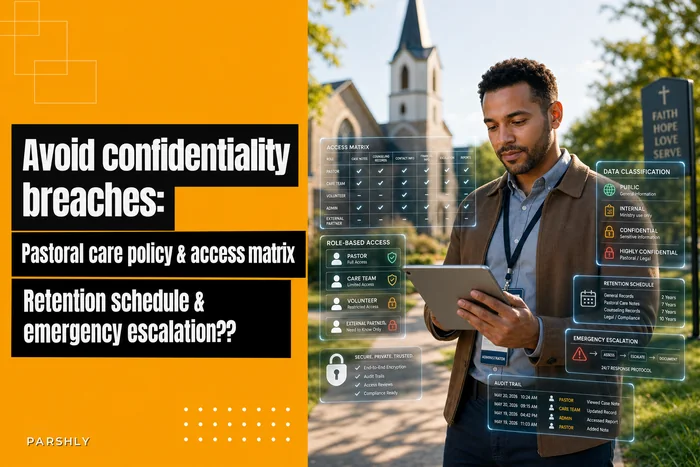
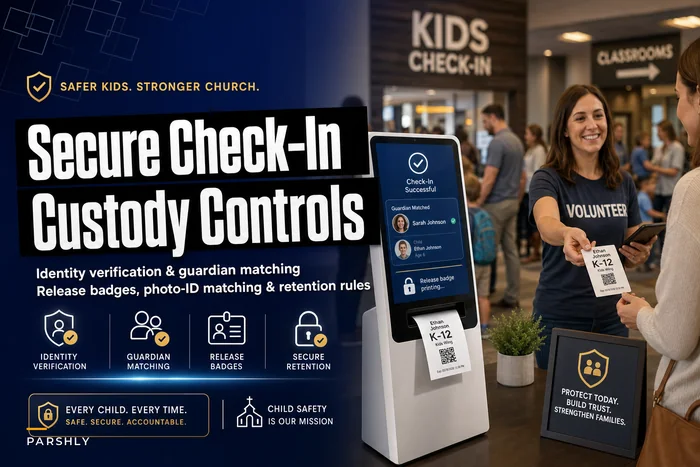
Several of these chapters deserve deeper standalone treatment, and you may already have strong material for them — a detailed church role matrix with temporary access rules and an audit cadence, an operational pastoral care policy with an access matrix and retention schedule, or a secure children's check-in workflow with guardian matching and release controls. The point of the manual isn't to rewrite those. It's to give them a shared home, consistent ownership, and a single escalation logic so they stop living as disconnected islands.
Here's a simple visual to show the workflow for consolidating chapters, assigning owners, and routing changes.
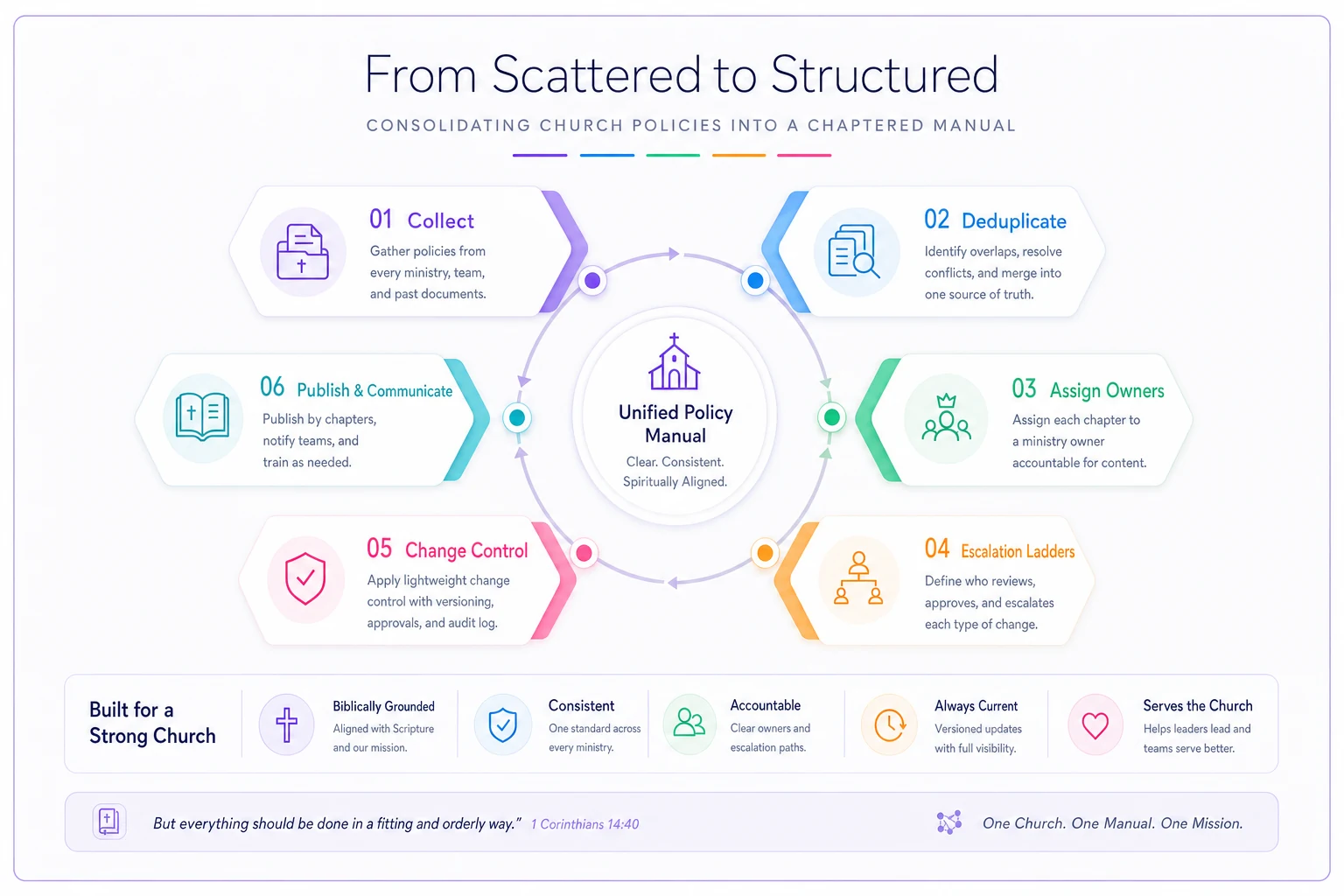
The point of the manual isn't to rewrite those. It's to give them a shared home, consistent ownership, and a single escalation logic so they stop living as disconnected islands.
Ownership templates: the part everyone underestimates
A policy without an owner is a suggestion. The single biggest change most churches can make isn't rewriting content — it's assigning a name to every chapter and making that assignment visible.
An ownership template for each chapter should answer, in plain language:
-
Who owns this chapter (a role, not just a person — "Treasurer," not "Dave").
-
Who they can delegate to, and for what.
-
How often it gets reviewed — a real date, not "annually" in theory.
-
Who signs off on changes before they go live.
-
Where the current version lives so there's exactly one source of truth.
The role-not-person distinction matters more than it sounds. When ownership is tied to a person and that person leaves, the chapter becomes orphaned. When it's tied to a role, the handoff is automatic — whoever becomes treasurer inherits the finance chapter, including the responsibility to keep it current.
A common mistake is over-assigning. If the same senior pastor owns nine of the eleven chapters, you haven't distributed governance, you've just written down the bottleneck. Healthy distribution means most chapters are owned by the person who does the work daily, with the senior leader owning only the governance-and-change chapter.
Escalation ladders that people actually remember
Escalation is where good manuals separate from decorative ones. A rule that says "report concerns to leadership" is useless in the moment someone needs it. People under stress don't read paragraphs; they need a ladder they can climb without thinking.
A clean escalation ladder for any given issue type answers three questions: who first, how fast, and what if that person is unreachable. That third question is the one most churches forget, and it's the one that fails on a Sunday morning when the primary contact is leading worship.
A typical safety escalation might read: notify the on-duty safety lead immediately → if unreachable within a few minutes, notify the campus pastor → document the incident in writing the same day → the safety lead reports to the designated officer within 24 hours. It includes both the fast path and the fallback, and it separates acting from documenting. In real operations, the failure usually isn't that nobody acted — it's that nobody wrote it down, so the follow-up never happened.
Keep escalation ladders short enough to fit on a laminated card at the check-in desk or the counting table.
The best escalation ladders are short enough to fit on a laminated card at the check-in desk or the counting table. If your escalation process requires opening a document, it won't be used when it matters most.
Lightweight change control (the emphasis is on lightweight)
Churches hear "change control" and imagine bureaucracy that will strangle a volunteer-run organization. That fear is legitimate — heavy approval processes do get abandoned. The goal is the lightest possible system that still prevents silent drift.
A workable version looks like this:
-
Anyone can propose a change — via a simple form or a shared doc, not a meeting.
-
The chapter owner reviews it and either accepts, edits, or declines with a one-line reason.
-
Changes affecting money, safety, or data get one additional sign-off from a second role.
-
Every accepted change gets a date and a version note — even just "Updated 3/2025: added summer two-adult exception, approved by J. Owner."
-
The old version is archived, not deleted, so you can always answer "what was the rule in March?"
That's it. No committee, no quarterly review cycle required. The version note is doing most of the heavy lifting. The simple act of dating changes and recording who approved them eliminates the vast majority of "who decided this?" arguments that eat up leadership time.
The reason to keep archives is subtle but real. When an incident happens, the question is often "what policy was in effect at that time?" An organization that can answer that cleanly is in a fundamentally stronger position — with insurers, with families, and internally.
When this level of structure makes sense — and when it doesn't
When it makes sense: You've grown past the point where one person holds everything in their head. You've added staff, a second service, or a campus. You've had at least one "nobody knew the rule" incident. You're facing a leadership transition and the knowledge risk is obvious. Any of these is a clear signal.
When it's overkill: A church of 40 with three volunteers and no paid staff doesn't need eleven governed chapters. Trying to install full governance on a tiny team creates paperwork nobody maintains, and an abandoned system is worse than an honest informal one — it gives false confidence. Start with two or three chapters that carry real risk (safety, money, data) and leave the rest informal until you feel the strain.
Who should not lead this: Don't hand the whole consolidation project to the busiest person in the building, and don't hand it to someone brand new who doesn't know the unwritten rules. The ideal person is a mid-tenure administrator or lay leader who knows how things actually work and has enough time to write it down.
A real scenario
A two-service church of around 350 attenders had solid individual policies but no unifying manual. Their finance procedures lived with the treasurer, safety rules lived in the children's ministry binder, and data-access rules were mostly verbal. When their longtime administrator gave notice, leadership realized they couldn't fully explain how their own operations ran.
They spent roughly six weeks consolidating — not writing new policies, mostly gathering, deduplicating, and structuring what already existed into seven chapters with named owners and short escalation ladders. During that process they found three outright contradictions between documents and two "policies" nobody had followed in years.
The measurable difference showed up during the handoff. Instead of the usual weeks of frantic knowledge transfer, the new administrator was functionally independent in a matter of days, because the answers were written down and owned. A benevolence approval that used to bounce around for several days resolved same-week because the escalation path was explicit. Nothing dramatic, no revenue miracle — just an organization that stopped depending on any single person's memory to function.
Keeping the manual alive as you scale
The failure mode for a finished manual is neglect. A binder assembled with enormous effort in year one, untouched by year three, is just fragmentation with better formatting. What keeps it alive is the governance chapter doing its job: real review dates, a low-friction way to propose changes, and owners who feel accountable for their sections.
As churches grow toward multiple campuses or larger staff, centralizing the manual in a shared workflow or operations platform starts to earn its keep — not for the technology itself, but because a single searchable source with version history and clear ownership does automatically what a binder can't: it keeps everyone reading the same current rule, and it remembers what changed and who approved it. The value isn't the tool; it's that the manual stops depending on someone remembering to update seven separate documents.
Your policies probably aren't the problem. The absence of a system that connects, owns, escalates, and updates them is. Consolidate the fragments into chapters, put a name on each one, give every serious issue a ladder people can climb under pressure, and make change cheap enough that the manual stays true to how you actually operate. Do that, and the church runs on a system instead of on the memory of whoever happens to still be around.
Ready to transform your church management?
Join 500+ churches using Parshly to enhance community engagement, streamline administration, and grow their ministries.