


Churches handle the most vulnerable moments in people's lives. Divorce proceedings, addiction struggles, mental health crises, financial disasters—these conversations land on pastoral desks every week. Yet most churches operate with the same document systems they use for bulletin announcements and volunteer schedules.
The pastoral care confidentiality workflow breaks when sensitive information flows through regular church channels. Staff members accidentally see counseling notes in shared drives. Volunteers stumble across prayer requests containing medical details. Board members receive reports with identifiable personal struggles. Each breach erodes the sacred trust that makes pastoral care possible.
Building an operational policy for pastoral records isn't about paranoia or bureaucracy. It's about creating clear boundaries that protect both congregants and staff while maintaining the accessibility needed for effective ministry.
Why pastoral confidentiality fails operationally
Most confidentiality breaches happen through normal church operations, not malicious intent. A youth pastor forwards an email chain to coordinate care, not realizing it contains details about a parent's addiction. An admin assistant schedules a follow-up meeting and accidentally includes case notes in the calendar invite. A volunteer prayer team member shares a request on social media, thinking they're helping mobilize support.
These failures multiply because churches typically run on informal systems. The senior pastor keeps handwritten notes in a desk drawer. Associate pastors use personal email for sensitive conversations. Counseling appointments get tracked in the same calendar as building rentals. When crisis hits and multiple staff need to coordinate, information starts flowing through whatever channel seems fastest.
The complexity compounds with church structure. Unlike therapists bound by HIPAA, pastoral teams navigate a maze of spiritual, legal, and relational obligations. Mandatory reporting requirements vary by state. Denominational policies add another layer. Insurance requirements create documentation needs that can conflict with confidentiality concerns.
Small churches face a particular version of this problem. With limited staff, the same person might handle pastoral care, office administration, and volunteer coordination. Creating real separation between those roles becomes nearly impossible when one person wears three hats. The church secretary who schedules counseling appointments also processes giving records and coordinates small groups—each role requiring different levels of access to information.
Building your access matrix for pastoral records
An access matrix defines exactly who can see what information and under which circumstances. This isn't about creating bureaucracy—it's about protecting vulnerable people while enabling effective ministry.
Simplify your church’s day-to-day operations.
Parshly helps you organize events, track donations, and engage your congregation—all in one place.
- Centralized member management
- Donation tracking & reporting
- Volunteer scheduling & notifications
No credit card required
Start with information categories, not roles. Churches often begin by listing positions (senior pastor, associate pastor, admin) and then trying to assign access rights. This approach tends to fail because it doesn't account for the varying sensitivity levels within pastoral care itself.
Information sensitivity levels
Level 1: General pastoral concern
-
Someone requests prayer for "health challenges"
-
Family asks for support during "difficult season"
-
Member seeks guidance for "work situation"
Level 2: Specific pastoral need
-
Marital counseling appointment scheduled
-
Financial assistance request submitted
-
Grief support following loss
Level 3: Detailed pastoral records
-
Counseling session notes
-
Specific addiction or mental health struggles
-
Legal situations requiring pastoral support
Level 4: Legally protected information
-
Confessional content (where applicable)
-
Information under litigation hold
-
Mandatory reporting documentation
Start with information categories, not roles.
Creating your access matrix
| Information Level | Senior Pastor | Associate Pastors | Care Team Lead | Admin Staff | Database Access |
|---|---|---|---|---|---|
| General Concern | Full access | Full access | View only | View only | Yes |
| Specific Need | Full access | As assigned | Notification only | Scheduling only | Limited fields |
| Detailed Records | Full access | Own cases only | No access | No access | No |
| Protected Info | Full access | With authorization | No access | No access | No |
The matrix changes based on church size and structure. A 150-member congregation might have one pastor handling everything with volunteer support. A 2,000-member church might have specialized pastoral care staff with dedicated counseling rooms and formal intake procedures.
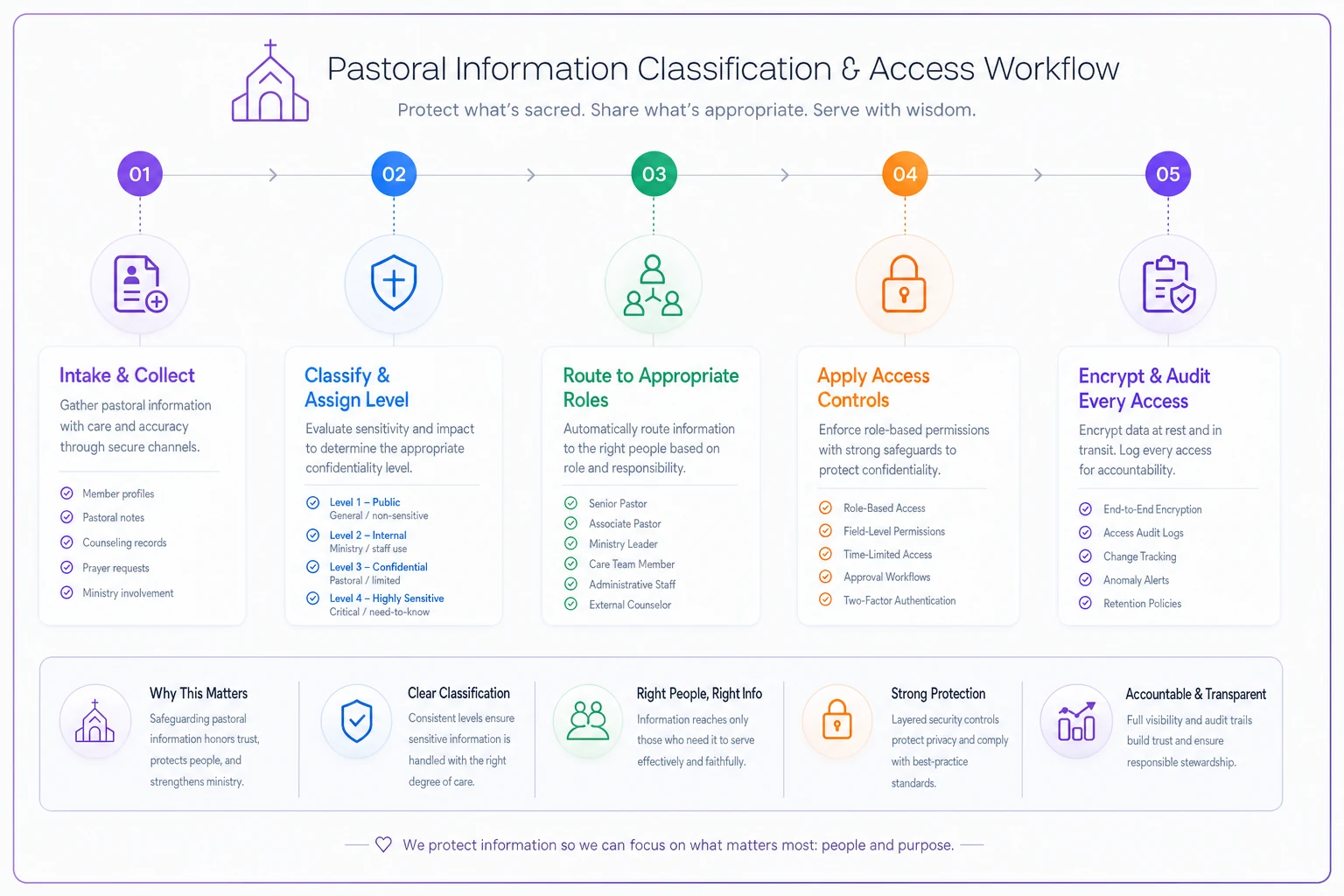
This diagram shows the intake-to-access workflow for pastoral records and how classification maps to permissions in practice.
Consent scripts that actually work
Generic consent forms fail because they're either too vague ("we may share information as needed") or too restrictive ("complete confidentiality"). Real pastoral care requires nuanced consent that acknowledges both spiritual and legal realities.
The consent conversation should happen before the need arises. During new member orientation, explain how pastoral care information gets handled. Include it in membership materials. Don't wait until someone's in crisis to explain confidentiality limits.
Initial consent script for general pastoral care:
"When you share concerns with our pastoral team, we handle that information carefully. For general prayer requests and support needs, our care team coordinates to serve you best. For sensitive counseling matters, information stays only with directly involved pastoral staff unless you specifically authorize broader sharing or we have legal obligations to report. Would you like to know more about when we might need to share information?"
Specific situation consent points:
When someone shares intention to harm themselves or others: "I'm concerned about your safety, and I need to involve our crisis response team. This might include [specific people/resources]. My priority is keeping you safe while respecting your privacy as much as possible."
When coordinating care across multiple staff: "To provide the best support, I'd like to loop in [specific person] who specializes in [specific area]. I'll share only what's necessary for them to help. Is that okay with you?"
When legal reporting is required: "Based on what you've shared, I have a legal obligation to report this to [specific authority]. I want to be transparent about this process. Would you like to make the report together, or would you prefer I handle it?"
Specificity is what makes these scripts actually work. Vague language creates confusion and breaks trust when information gets shared unexpectedly. Clear, specific consent protects everyone involved.
Secure note-taking practices for pastoral conversations
Pastoral notes create a real tension. Detailed documentation helps provide continuous care and protects against liability. But those same notes become dangerous if accessed inappropriately or subpoenaed in legal proceedings.
Most pastors default to extremes—either documenting nothing or recording everything. Neither works operationally. You need a systematic approach that captures essential information while minimizing risk.
What to document
Always document:
-
Date, time, and duration of meetings
-
General topic areas discussed (marriage, grief, addiction)
-
Referrals made or resources provided
-
Safety concerns or crisis interventions
-
Your pastoral actions and follow-up plans
Never document:
-
Verbatim confessions or admissions
-
Speculation about third parties
-
Your personal opinions about situations
-
Details that could damage someone if disclosed
-
Information told in absolute confidence
Document carefully:
-
Patterns of concern (multiple meetings about the same issue)
-
Collaborative care plans with other providers
-
Boundaries set or violated
-
Changes in mental or emotional state
Where to keep pastoral notes
Physical notes remain surprisingly common—and sometimes preferable. A locked filing cabinet in the pastor's office provides security without technology complications. But physical notes can't be backed up, don't support team coordination, and become inaccessible during emergencies.
Digital systems offer better operational support but require careful configuration. Regular church management software often lacks the security features needed for sensitive pastoral records. Cloud storage raises legitimate questions about data ownership and subpoena vulnerability.
The right solution depends on your church's size and technical capabilities. Smaller churches might use encrypted note apps with two-factor authentication. Larger churches need specialized pastoral care modules within their church management systems, with role-based access controls and audit trails.
Whatever system you choose, establish clear protocols:
-
Where notes get stored (never in email)
-
How notes get backed up
-
Who holds encryption keys or passwords
-
When notes get transferred during staff transitions
-
How notes get destroyed per the retention schedule
Whatever system you choose, establish clear protocols: - Where notes get stored (never in email) - How notes get backed up - Who holds encryption keys or passwords - When notes get transferred during staff transitions - How notes get destroyed per the retention schedule
Creating your retention schedule
Churches often keep pastoral records forever, thinking more documentation equals better protection. The opposite is usually true. Old records become liability without providing meaningful ministry value. A clear retention schedule that balances care continuity with risk management is worth building.
Your retention schedule should reflect both legal requirements and pastoral realities. State laws set minimum retention periods for certain records. Insurance policies might require documentation for potential claims. But beyond those requirements, longer retention often creates more problems than it solves.
Suggested retention periods
Immediate destruction:
-
Draft notes or working documents
-
Duplicate information stored elsewhere
-
Personal reminder notes not needed for ongoing care
One year retention:
-
Routine pastoral conversations
-
General prayer requests
-
Non-crisis spiritual guidance
Three year retention:
-
Ongoing counseling relationships
-
Financial assistance records
-
Marriage and family counseling
Seven year retention:
-
Crisis interventions
-
Mandatory reporting documentation
-
Situations involving minors
Permanent retention (in sealed records):
-
Legal holds or active litigation
-
Historical abuse allegations
-
Documents required by denomination
These periods start from the last interaction, not the first. If someone receives counseling for two years, the retention period begins when counseling ends, not when it started.
Build disposal into your workflow. Schedule quarterly reviews to identify records ready for destruction. Use secure shredding for physical documents and certified data destruction for digital records. Document what gets destroyed and when—this proves you follow your policy consistently.
Emergency escalation rules
Crisis doesn't wait for office hours. A teenager texts their youth pastor about suicide at midnight. A church member calls about domestic violence on Saturday afternoon. A family faces sudden homelessness on Christmas Eve. Your escalation policy determines whether these situations get handled effectively or become dangerous failures.
Most churches rely on informal escalation—whoever receives the crisis calls whoever seems appropriate. This works until it doesn't. The youth pastor on vacation doesn't see the text for three days. An associate pastor makes a well-meaning but wrong call about mandatory reporting. A volunteer prayer line coordinator doesn't recognize the severity of what they're hearing.
Crisis tier definitions
Tier 1: Immediate danger
-
Active suicide threat or attempt
-
Violence occurring or imminent
-
Medical emergency
-
Child or elder abuse in progress
Response: Call 911 immediately, then notify senior pastor
Tier 2: Urgent pastoral need
-
Suicide ideation without immediate plan
-
Domestic situation requiring intervention
-
Mental health crisis needing professional help
-
Unexpected death in congregation
Response: Contact designated crisis team member within 1 hour
Tier 3: Pressing pastoral concern
-
Marriage crisis requiring counseling
-
Addiction relapse needing support
-
Financial emergency requiring assistance
-
Family conflict needing mediation
Response: Respond within 24 hours, coordinate care team
Building your escalation chain
For youth/children situations: Primary: Youth Pastor → Secondary: Executive Pastor → Emergency: Senior Pastor → External: Child Protection Services
For adult mental health crises: Primary: Care Pastor → Secondary: Licensed counselor on call → Emergency: Senior Pastor → External: Mental health crisis line
For domestic violence: Primary: Women's ministry pastor → Secondary: Safe house coordinator → Emergency: Senior Pastor → External: Domestic violence hotline
Each person in the chain needs clear instructions for their role. The youth pastor needs to know exactly when a situation exceeds their training. The senior pastor needs protocols for situations requiring immediate external intervention. Everyone needs phone numbers that actually work outside office hours.
Document every escalation—not lengthy narratives, just basic facts: who called, when, about what, who was notified, what actions were taken. This documentation protects both the church and the person in crisis.
Technology considerations for pastoral confidentiality workflows
The shift to digital ministry tools creates new confidentiality challenges. Your church management system designed for attendance tracking now holds counseling notes. The communication platform for volunteer coordination carries sensitive prayer requests. The scheduling software for room bookings reveals who's attending addiction recovery meetings.
Most of these platforms weren't built with pastoral confidentiality in mind. Their default settings often share too much with too many people. A database designed to help everyone stay connected becomes a problem when it's also handling information that should stay private.
Consider how typical church software handles pastoral information. The same system tracking small group attendance might flag when someone stops attending—useful for follow-up, but problematic if the absence relates to confidential pastoral care. Prayer request modules often default to broad visibility. Calendar systems show appointment titles to anyone with schedule access.
Some churches try solving this with separate systems—one database for general ministry, another for pastoral care. This creates its own headaches. Staff juggle multiple logins. Information gets duplicated or lost between systems. Coordination becomes nearly impossible when teams can't see the full picture.
The smarter move is configuring your existing systems for confidentiality rather than adding complexity. Most church management platforms support role-based permissions if properly set up. Create pastoral care tags that restrict visibility. Set up private note fields that only designated staff can access. Build approval workflows for sensitive information sharing.
For churches ready to invest in their operational infrastructure, AI-powered platforms can help maintain confidentiality while improving coordination. These systems can automatically flag sensitive information, enforce retention schedules, and create audit trails for access—turning manual policy enforcement into a more reliable operational workflow rather than something that depends entirely on individual judgment calls.
Real scenario: How one church fixed their confidentiality crisis
Grace Community Church (around 400 members) faced a confidentiality breakdown when a well-meaning volunteer prayer coordinator shared detailed information about a member's addiction struggle in the weekly prayer email. The member had shared with their small group leader, who passed it to the prayer team, who included it in broader communication. Within hours, well over 200 people knew details that should have stayed private.
The breach revealed systematic failures. No classification system for prayer requests. No consent process for sharing between ministries. No technical barriers to prevent sensitive information from flowing into public channels. The prayer ministry ran on trust and good intentions—without operational safeguards.
Their fix took about three months but genuinely transformed how pastoral care operated:
First, they created clear information categories. Level 1 prayers could go church-wide. Level 2 stayed within specific ministries. Level 3 remained with pastoral staff only. Every prayer request got classified at submission.
Second, they rebuilt their consent process. The small group curriculum included a session on prayer request sharing. New members learned the system during orientation. Anyone submitting requests selected their own comfortable sharing level.
Third, they reconfigured their church management software. Prayer requests required classification before submission. Different levels routed to different groups automatically. The all-church prayer list pulled only from Level 1 requests.
The technical changes supported but didn't replace human judgment. Staff training emphasized recognizing sensitive information regardless of how it was classified. The prayer team developed protocols for "upgrading" requests that seemed more sensitive than labeled.
Six months later, prayer request participation had actually increased. Members trusted the system to respect their boundaries. The prayer ministry could mobilize appropriate support without risking confidentiality. Pastoral staff spent less time managing information flow and more time providing actual care.
Moving from policy to practice
Writing a confidentiality policy is the easy part. Embedding these practices into daily church operations—when everyone's juggling multiple responsibilities and crisis keeps interrupting planned improvements—is where most churches struggle.
Start small. Don't try implementing everything at once. Pick your highest-risk area: maybe youth ministry, maybe prayer requests, maybe counseling notes. Build one working system before expanding to the rest.
Train repeatedly. A single announcement won't change established habits. Build confidentiality training into onboarding. Include reminders in staff meetings. Share appropriately anonymized examples of why these protocols actually matter—real stories land differently than policy documents.
Audit regularly. Every quarter, review a sample of pastoral records. Are they classified correctly? Stored securely? Retained appropriately? These audits reveal where the system breaks down in practice, not just on paper.
Plan for transitions. Staff changes create real confidentiality risks—the departing youth pastor's notebook full of student struggles, the retiring senior pastor's decades of counseling files. Build handoff protocols before transitions happen, not during them.
Your pastoral care confidentiality workflow protects the vulnerable moments when people need ministry most. These aren't bureaucratic barriers to ministry—they're the operational foundation that makes trusted pastoral care possible. When people know their deepest struggles will be handled with genuine care and clear boundaries, they're more likely to seek help in the first place.
The churches that get this right don't treat confidentiality as a burden. Clear protocols free pastoral staff from constant judgment calls about information sharing. Robust systems prevent the kind of breach that destroys trust overnight. And good confidentiality workflows ensure that when someone reaches out in their darkest moment, the church can respond with both compassion and competence.
Building these systems takes time and intention. But the alternative—operating on trust and good intentions alone—inevitably fails when faced with the complex realities of modern pastoral care. Whether through simple document templates or AI-powered platforms that systematically enforce confidentiality protocols, churches need operational systems that match the sacred trust placed in them.
Your pastoral care confidentiality workflow protects the vulnerable moments when people need ministry most. These aren't bureaucratic barriers to ministry—they're the operational foundation that makes trusted pastoral care possible. When people know their deepest struggles will be handled with genuine care and clear boundaries, they're more likely to seek help in the first place.
The churches that get this right don't treat confidentiality as a burden. Clear protocols free pastoral staff from constant judgment calls about information sharing. Robust systems prevent the kind of breach that destroys trust overnight. And good confidentiality workflows ensure that when someone reaches out in their darkest moment, the church can respond with both compassion and competence.
Building these systems takes time and intention. But the alternative—operating on trust and good intentions alone—inevitably fails when faced with the complex realities of modern pastoral care. Whether through simple document templates or AI-powered platforms that systematically enforce confidentiality protocols, churches need operational systems that match the sacred trust placed in them.
Ready to transform your church management?
Join 500+ churches using Parshly to enhance community engagement, streamline administration, and grow their ministries.