


Sunday morning, 9:47 AM. A divorced dad shows up to pick up his daughter from your children's ministry. The volunteer at the pickup station doesn't recognize him. He's got the right pickup tag, but something feels off. The child seems hesitant. Your volunteer freezes—there's no clear protocol for this exact situation.
This happens more than church leaders realize. Every children's ministry handles hundreds of custody handoffs each week, and each one carries real legal and safety weight. Releasing a child to the wrong adult can mean custody violations, kidnapping charges, or worse. Yet most churches run their children check-in workflow church systems on trust, familiar faces, and paper tags that anyone could duplicate at home.
One custody mistake can destroy your church's reputation, trigger lawsuits that drain ministry funds for years, and most importantly, put a child in danger. Churches face custody challenges schools don't—you often serve split families where both parents attend different services, custody arrangements that change week to week, and visiting families you've never met.
Why Church Custody Handoffs Break Down
Church children's ministries operate in a strange middle ground. You're not a school with formal enrollment records and legal custody documentation on file. You're not a daycare with state-mandated ratios and inspections. You're a volunteer-run operation that needs to safely manage dozens or hundreds of kids every Sunday with whoever showed up to serve that week.
The typical church relies on three broken systems.
Paper name tags get handed to parents at check-in. Anyone can grab extras. Tags get lost, shared between family members, or photographed and duplicated. I've watched parents hand their pickup tag to an older sibling in the parking lot because they needed to leave early. That teenager now has authorization to pick up a 3-year-old.
Facial recognition by volunteers works until it doesn't. Your regulars know the Smith family, but what happens when a substitute serves in the toddler room? What about the visiting grandmother who insists she picks up little Emma every third Sunday? Volunteers end up making split-second judgment calls based on confidence and perceived urgency rather than actual verification.
The sign-in clipboard creates an illusion of security. Parents scribble names on a sheet, maybe list an emergency contact, and that's your entire custody record. No ID verification. No photo matching. No way to track who actually picked up each child or when.
These systems collapse under real Sunday morning pressure. During peak pickup after service, you've got 40 parents crowding the hallway, kids crying, volunteers trying to manage the chaos. Nobody's carefully checking IDs against pickup authorizations. Throw in the social pressure—nobody wants to be the volunteer who made Pastor Johnson's wife show ID—and your security theater falls apart completely.
The Real Cost of Custody Mistakes
When custody handoff failures happen, they cascade fast. The immediate crisis is obvious—a child goes home with the wrong adult. But the operational aftermath can damage a church for months, sometimes permanently.
Simplify your church’s day-to-day operations.
Parshly helps you organize events, track donations, and engage your congregation—all in one place.
- Centralized member management
- Donation tracking & reporting
- Volunteer scheduling & notifications
No credit card required
First comes the legal response. Even if nothing bad happens to the child, you're looking at potential kidnapping charges, custody violation lawsuits, and child endangerment investigations. Your church insurance might not cover custody-related incidents if you can't prove you followed documented procedures. Legal fees start at $15,000 just to respond to initial complaints.
Regulatory scrutiny makes everything worse. Child Protective Services launches investigations. Local authorities review all your child protection policies. You might face mandatory reporter violations if volunteers didn't properly document or report the incident. Some states require churches to notify every family when a custody incident occurs, which triggers mass panic and families leaving.
Your volunteer base can evaporate quickly. The volunteer who made the mistake often never returns, destroyed by guilt. Others quit, terrified they'll be next. Parents pull their kids. New families hear whispers and choose other churches. A single custody mistake can cut your children's ministry attendance by 30–40% and take years to recover from.
What actually finishes churches off is the operational paralysis that follows. Leadership becomes so terrified of another incident that they implement procedures that make legitimate pickups nearly impossible. Every parent needs three forms of ID. Pickup takes 45 minutes. Divorced parents must bring court orders every Sunday. Your children's ministry transforms from a welcoming space into a checkpoint, driving away the families you're trying to serve.
Building Identity Verification That Actually Works
Most churches think identity verification means checking driver's licenses, but that's just theater if you're not matching IDs against pre-registered authorized adults. Real identity verification creates a chain of custody from check-in through release.
Start with registration verification. When families first register for children's ministry, capture the driver's license or state ID for every authorized adult. Don't just write down names—actually scan or photograph the IDs. Store them in your children check-in workflow church system where volunteers can reference them. This becomes your source of truth.
During check-in, match the adult presenting the child against your authorized list. If Dad drops off but Mom is picking up, flag that in your system. If someone new appears—a grandparent, nanny, or family friend—they need to be added to the authorized list by a registered parent before they can drop off or pick up. No exceptions, regardless of how trustworthy they seem.
Create visual verification at every handoff. When printing check-in labels, include a small photo of authorized pickup adults on the child's label that stays in the classroom. Volunteers can quickly verify they're releasing to the right person without needing to access a separate system. For families without photos on file, mark their labels clearly: "VERIFY ID REQUIRED."
This is where most churches fail: they verify at check-in but not at pickup. Your pickup process needs the same rigor. The adult presents their claim ticket. The volunteer matches the ticket number to the child. Then they verify the adult's identity against either the photo on the child's label or by checking ID against the authorized list. Every single time.
For custody-restricted situations, create override protocols. Mark these children's files with bright red flags in your system. Require supervisor approval for any pickup. Document everything—who picked up, when, which supervisor approved. These cases are lawsuits waiting to happen, so your documentation needs to be bulletproof.
Guardian Matching Beyond Name Recognition
Guardian matching gets complicated when you realize how many edge cases exist. The registered parent sends their new boyfriend to pick up the kids. A rideshare driver arrives with a note from Mom. An older sibling who looks 14 but claims they're 16 wants to grab their younger brother. Each scenario needs clear protocols that volunteers can actually execute under pressure.
Build an authorized adult database that goes beyond just parents. Include regular caregivers, family members, and emergency contacts. But require the enrolling parent to explicitly authorize each person for pickup. Grandma might be listed as an emergency contact, but that doesn't automatically mean she can take the children home.
Set age minimums for pickup authorization. Most churches default to "high school age" but that's too vague when you've got a stressed volunteer making quick decisions. Pick a specific age—16 is common—and stick to it. Require ID verification for any authorized adult who appears under 21. Young-looking adults will complain, but it's better than releasing a child to another child.
For split custody situations, you need documentation that makes volunteers' jobs clear. Don't accept verbal arrangements about who picks up on which Sundays. Require written custody agreements or parenting plans. If parents share custody, get both to sign off on the pickup list. When custody restrictions exist, require court documentation and create internal alerts that flag these children during every check-in and pickup.
-
Level 1 — Parents with full access
-
Level 2 — Regular caregivers who can pick up with standard verification
-
Level 3 — Emergency contacts who require additional confirmation (such as a phone call to a parent) before release
This prevents the "Mom sent me" scenarios while still maintaining flexibility for real emergencies.
Build escalation paths directly into your workflow. If someone shows up who isn't authorized but insists they should be, volunteers shouldn't make that call alone. Designate a children's ministry supervisor for each service who handles all exceptions. Train volunteers to say: "Let me get my supervisor to help with this special situation." That one line removes the pressure from volunteers while keeping your security intact.
Release Badges and Physical Security
The physical badge system determines whether your entire security framework actually functions. Paper name tags are basically worthless—anyone with a printer can duplicate them. Wristbands are better but still transferable. The best churches use a combination of physical and digital verification that's much harder to defeat.
Design badges that can't be easily replicated. Use special paper stock with watermarks or security features. Include unique elements on each week's badges—different colors, patterns, or codes that change every Sunday. Print badges on-demand at check-in so nobody can prepare fakes in advance. Include both a claim number and a QR code that links to the child's record in your children check-in workflow church system.
Create parent badges that must be presented for pickup. The badge should include the claim numbers for all their children, the service time they checked in, and the pickup authorization level. Make these badges visually distinct from volunteer or visitor badges. If someone loses their badge during service, they need to go through full identity verification with ID and supervisor approval for pickup.
Badges alone aren't enough. You need physical barriers that force verification to actually happen. Position check-out stations at the only exit from children's areas. Use half-doors or counters that create natural pause points where volunteers can verify badges before children are released. Install mirrors or cameras so volunteers can see if someone's trying to grab a child and bypass the station.
What many churches miss: the badge needs to be collected or destroyed at pickup. If parents keep their badges, they could use them to pick up children at multiple services or on future Sundays. Either collect badges in a secure disposal box or use badges that self-destruct—perforation lines that must be torn to remove, making them obviously void if presented again.
Collect badges at pickup or use perforated/self-destructing badges to make reuse obvious and prevent future pickup attempts.
Two-part verification is non-negotiable. The parent presents their badge showing claim numbers. The volunteer matches those numbers to the children's badges. Only after both match does the handoff happen. No badge, no child—even if it's the senior pastor. Especially if it's the senior pastor, because everyone's watching how consistently you enforce policies.
Photo Matching and Digital Verification
Modern churches need digital verification that goes beyond paper systems. Photos provide an additional security layer that's hard to defeat and removes subjective volunteer judgment from the equation.
During family registration, capture photos of all authorized adults. Not just driver's license photos—actual facial photos taken at registration. Update these annually or whenever appearance significantly changes. Store them in your secure children check-in workflow church database where only authorized personnel can access them.
At check-in, your system should display the authorized adult photos when families check in. The volunteer verifies that the person dropping off matches someone in the system. If not, they either need to be added with proper verification, or the child can't be checked in. This stops unauthorized adults from dropping off children who might not be safe in their care.
Print thumbnail photos directly on children's classroom labels. When the pickup adult arrives, volunteers can quickly match the person to the photo without pulling up a separate system. For privacy, keep these photos small and low-resolution—clear enough for verification but not suitable for other uses.
Build photo verification into your digital workflow. When an adult presents their pickup badge, scanning it should pull up their photo in the system. The volunteer verifies the match before release. This two-factor approach—something they have (badge) plus something they are (photo match)—significantly improves security without creating major delays.
For visiting families or those without photos on file, implement backup procedures. Take a photo at check-in that's temporarily stored and deleted after pickup. Or require physical ID verification at both drop-off and pickup. Mark these children clearly in your system so volunteers know to apply extra care.
Record Retention and Audit Trails
Your custody documentation is worthless if you can't prove what happened six months ago when a complaint surfaces. Most churches either keep nothing or keep everything forever, neither of which actually protects you legally.
Create a comprehensive check-in/check-out log that captures:
-
Child name and identifier
-
Check-in time and authorizing adult
-
Check-in volunteer identifier
-
Classroom assignment
-
Any special notes or custody flags
-
Pickup time
-
Pickup adult name and verification method
-
Pickup volunteer identifier
-
Any incidents or exceptions noted
Store these records for at least three years, which covers most statute of limitations for custody-related claims. Some churches keep them until children age out of the program plus three years. Whatever you choose, be consistent and document your retention policy.
Raw records aren't enough—you need to be able to audit them. Every month, randomly audit 5–10 pickup transactions. Pull the records and verify that proper procedures were followed. Did volunteers actually check IDs when required? Were custody restrictions properly enforced? Were exceptions properly documented and approved?
Create incident documentation that goes beyond normal records. Any time something unusual happens—a custody dispute at pickup, an unauthorized person attempting pickup, a child refusing to go with their authorized adult—document everything immediately. Get written statements from all volunteers involved. Take photos of any relevant documents presented. These records become critical evidence if legal issues arise later.
Your digital system should track every access and modification. Who looked up a child's record? Who added a new authorized adult? Who overrode a custody restriction? These audit logs need to be tamper-proof and regularly backed up. When custody disputes escalate to court, technical records often matter more than witness testimony.
For paper records, implement a dual-control system. Check-in sheets, incident reports, and custody documents get filed by one person and verified by another. Store them in a locked cabinet with limited access. Create a check-out log for anyone who needs to access historical records. This chain of custody for your documentation becomes important when you need to prove records haven't been altered.
Greeter Scripts That Prevent Problems
Your greeters are the first line of defense, but most churches don't actually train them on custody situations. They need specific scripts and protocols that feel welcoming while maintaining security.
Train greeters to spot custody red flags before families reach check-in. Watch for adults who seem unfamiliar with the children they're bringing, children who appear distressed or reluctant, multiple adults arguing about who should check in kids, anyone asking questions about your pickup procedures, or adults trying to check in children without the children present.
When greeters notice concerns, they shouldn't confront directly. Instead, they radio ahead to check-in stations: "Special attention needed for the family in the blue jackets." This lets check-in volunteers prepare for additional verification without creating confrontation in the lobby.
Provide exact scripts for common situations:
When someone asks about pickup procedures: "For everyone's safety, only authorized adults with matching pickup tags can collect children. Would you like me to help you get added to a pickup list?"
When a child seems reluctant: "Good morning! Looks like someone might be feeling shy today. [To child] Who brought you to church today?" Listen to how the child responds, not just what they say.
When adults are arguing: "I can see there might be some confusion about check-in today. Let me get our children's director to help make sure everyone's on the same page."
These scripts de-escalate while maintaining security. Greeters should never make custody determinations—their job is to identify potential issues and route them to decision-makers.
For visiting families, greeters set expectations upfront: "Welcome! Since this is your first time, we'll need to get some information to keep your kids safe. We take security seriously here—everyone needs proper authorization for pickup, even grandparents!" This prevents surprise and resistance at pickup time.
Building Your Complete Workflow
A secure children check-in workflow church system requires all these components working together. Here's how the complete Sunday morning flow should work:
| Phase | Key Actions | Who's Responsible |
|---|---|---|
| Pre-Service Preparation | Review custody alerts, print warning labels, brief volunteers, assign exception supervisor | Children's Director |
| Arrival and Greeting | Observe families, radio concerns ahead, direct to check-in or registration | Greeters |
| Registration (First-Time) | Capture IDs, take photos, get written authorizations, document custody restrictions | Check-In Lead |
| Check-In Process | Verify drop-off adult, print labels and badges, flag exceptions | Check-In Volunteers |
| Classroom Management | Verify children against roster, keep labels on children, report concerns | Teachers |
| Pickup Preparation | Organize children, verify labels, position at classroom doors | Teachers and Floaters |
| Release Process | Verify badge, match claim numbers, confirm identity, collect badge | Check-Out Volunteers |
| Exception Handling | Lost badges, unauthorized adults, custody disputes routed to supervisor | Supervisor |
| Post-Service Audit | Verify all children picked up, document incidents, update system | Children's Director |
Pre-Service Preparation
Review any custody alerts for expected attendees. Print special warning labels for high-risk situations. Brief volunteers on any specific concerns. Verify all equipment works—label printers, cameras, ID scanners. Assign the supervisor role for handling exceptions.
Arrival and Greeting
Greeters observe families approaching and radio ahead about any concerns. They direct new families to registration and returning families to check-in. They set expectations about security procedures in a friendly way.
Registration (First-Time Families)
Capture all parent/guardian information with ID verification. Take photos of all authorized adults. Get written authorization for any additional pickup adults. Document any custody restrictions with supporting paperwork. Issue temporary badges while permanent ones are created.
Check-In Process
Verify the adult dropping off is authorized. Print child labels with photos and any special alerts. Print parent pickup badges with claim numbers. Confirm pickup arrangements if different from drop-off. Route any exceptions to the supervisor.
Classroom Management
Teachers verify children against their class roster. They note any concerning behaviors or statements about family situations. Labels with photos stay with children at all times. Any custody concerns get immediately reported to the supervisor.
Pickup Preparation
Five minutes before release, teachers organize children and verify all labels are still attached. They position themselves at classroom doors to control release. Floaters prepare to assist with complicated pickups.
Release Process
Parent presents pickup badge at checkout station. Volunteer verifies badge authenticity and checks claim numbers. Volunteer calls for specific children from classrooms. Teacher verifies pickup authorization against child's label. Volunteer matches adult identity through photo or ID. Child is released only after all verifications complete. Badge is collected or destroyed.
Exception Handling
Lost badges require full ID verification plus supervisor approval. Unauthorized adults get referred to the children's director. Custody disputes trigger an immediate security response. All exceptions get documented in incident reports.
Post-Service Audit
Verify all children were properly picked up. Document any incidents or concerns. File all paperwork securely. Update any authorization changes in the system. Brief the next service's team on any ongoing issues.
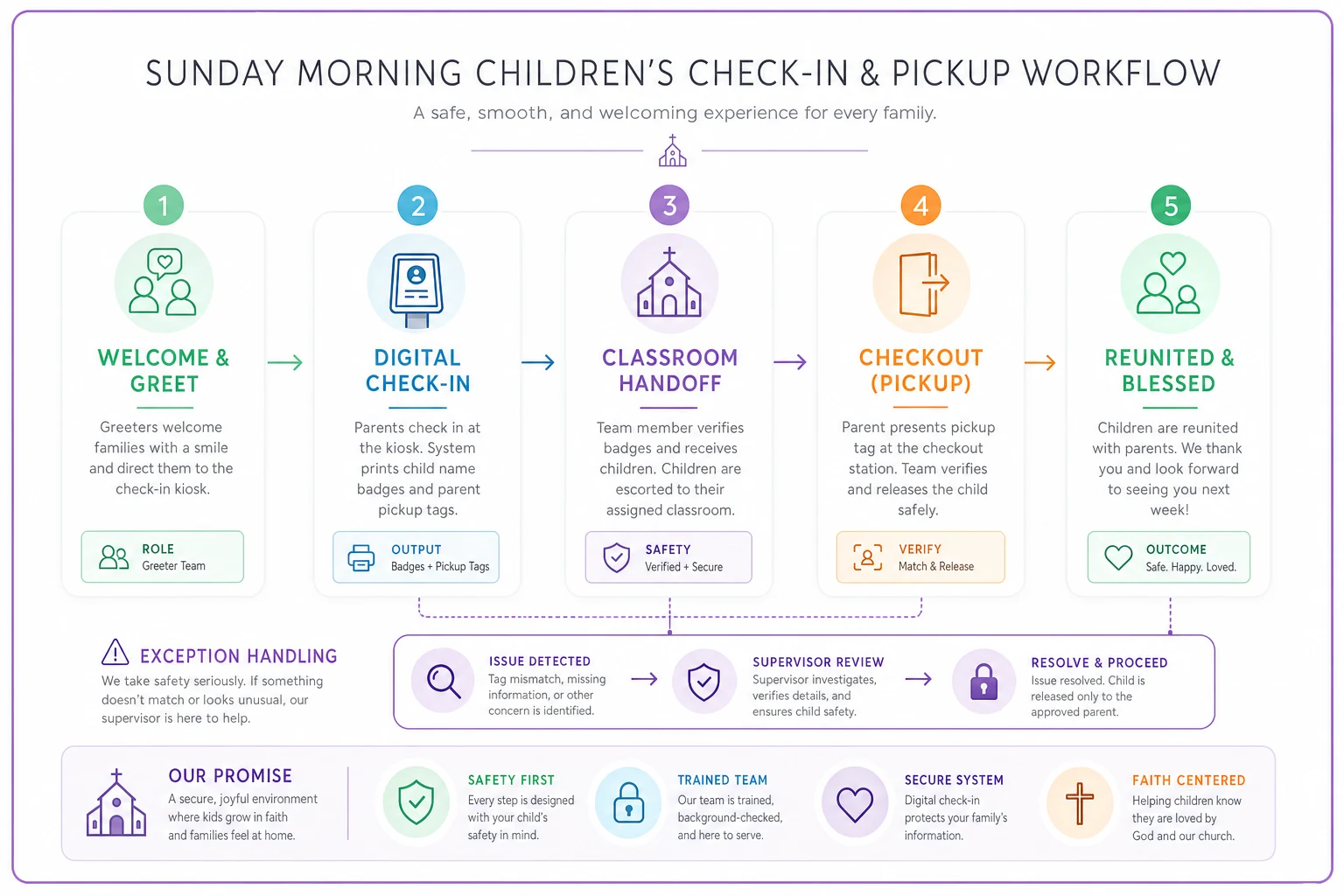
Here's a quick visual of the flow to share with volunteers and leadership during training.
Who Should Not Implement This Level of Security
Not every church needs this level of custody control. If you're a small congregation where everyone genuinely knows everyone—truly knows, not just recognizes—you might be adding friction without reducing real risk. If all your families have attended for years with stable custody situations, simpler procedures might actually work fine.
Churches without dedicated children's space shouldn't attempt this system. If kids are released directly to parents in the sanctuary after service, you can't control the handoff points. Similarly, if you rely entirely on parent volunteers who rotate weekly, consistent enforcement is going to be nearly impossible.
Don't implement this if you can't commit to the technology infrastructure. A half-digital, half-paper system creates more vulnerabilities than either alone. If you're still using handwritten name tags and sign-in sheets, focus on getting basic digital check-in working before adding photo verification and authorized adult databases.
Some congregations have cultural or theological objections to this level of documentation. If your community views photo requirements or ID verification as governmental overreach, forcing these procedures will drive families away faster than any security benefit you gain.
Making It Sustainable With Technology
Manual custody verification doesn't scale past about 50 kids. Beyond that, the operational burden overwhelms volunteers and procedures start breaking down under real conditions. This is where AI-powered operational software transforms children's ministry security from a weekly scramble into a workflow that actually holds up under pressure.
Modern children check-in workflow church platforms handle the complex verification automatically. When a family approaches the check-in kiosk, the system identifies them, knows who's authorized for drop-off and pickup, flags any custody concerns, and prints appropriate badges and labels. Volunteers facilitate rather than make security decisions from scratch each time.
The real value comes from centralizing all this information. Instead of paper files and mental notes, every family's complete history lives in one secure system. Custody documents, authorization lists, incident reports, and audit trails all connect. When a situation arises, volunteers can access exactly what they need without hunting through filing cabinets or trying to remember a conversation from three months ago.
AI automation particularly helps with the edge cases that cause problems. The system can automatically flag when someone who usually doesn't pick up arrives, when pickup patterns suddenly change, or when an unauthorized adult attempts check-in. It can require additional verification for visitors while moving regular families through quickly. These kinds of intelligent workflows reduce both security risks and the operational friction that makes volunteers burn out.
The technology also handles the documentation burden that usually falls apart under real Sunday morning conditions. Every check-in, every pickup, every exception gets logged automatically with timestamps and volunteer identifiers. When a custody dispute surfaces months later, you pull complete records in seconds rather than trying to reconstruct what happened from memory.
The Bottom Line on Church Child Security
Building a secure children check-in workflow church system isn't about paranoia or legal protection—it's about stewarding the trust parents place in your ministry every Sunday. When parents drop off their kids, they're expecting you to protect them with the same care they would. That's only possible with systematic procedures that remove guesswork from custody decisions.
Most churches learned these lessons the hard way, through near-misses or actual incidents that could have been prevented. The family that seemed perfectly normal until the restraining order situation exploded in your lobby. The volunteer who meant well but released a child to an estranged parent. The visitor who seemed trustworthy but had quietly lost custody rights months before.
Building these systems takes real effort upfront. You'll face resistance from long-time members who remember when church was simpler. Volunteers will complain about the additional steps. Some families will leave for churches with more relaxed policies. But the alternative—one preventable incident that dismantles your ministry—is far worse than the pushback.
The churches that make this work treat child security as a core operational priority, not an afterthought. They invest in proper systems, train volunteers thoroughly, and enforce procedures consistently regardless of who's involved. They understand that true hospitality means creating an environment where every family can trust their children are safe.
Start with the basics: verified registration, controlled access points, and documented pickups. Add layers as your ministry grows and your operational capacity expands. Whatever level you implement, be consistent. A security system that only works sometimes is worse than no system at all—it creates false confidence that disappears exactly when you need it most.
Ready to transform your church management?
Join 500+ churches using Parshly to enhance community engagement, streamline administration, and grow their ministries.