

Most churches already sit on more donor data than they realize. The problem isn't collection — it's that the data just sits there. Giving reports get glanced at quarterly, maybe pulled before a board meeting, and then everyone moves on. Meanwhile a family that quietly stopped giving in March doesn't get noticed until the year-end statement goes out, and by then the relationship has drifted.
What separates churches that steward well from those that don't isn't the size of their database. It's whether their numbers are wired to do something. A real donor analytics stewardship model connects giving data to a specific action — sometimes an automated thank-you, sometimes a phone call from a pastor, sometimes a shift in how next quarter's ministry dollars get allocated. The measurement has to lead somewhere.
This is about building that bridge: from signal, to threshold, to action, and into how you actually plan and fund ministry.
Why giving data stays stuck as a report
The usual pattern looks like this. A church runs a giving summary, sees total contributions are down 6% year-over-year, feels a vague sense of worry, and... that's it. Nobody can tell you which households drove the decline. Was it a handful of large donors pulling back, or hundreds of small ones giving slightly less? Those are completely different problems with completely different responses, and a top-line number hides both.
This happens because the data lives in one world and the ministry decisions live in another. The treasurer sees dollars. The pastor sees faces on Sunday. Rarely do those two views get stitched together into a single question: who needs a conversation this week, and why?
The other reason it stalls is fear of misreading the signal. Giving is personal, and nobody wants to call a family and imply they're being watched. So leaders avoid acting on patterns entirely — which means a genuinely concerning trend (a steady, faithful giver going silent for four months) gets the same non-response as normal noise. A good model makes the distinction obvious enough that acting feels natural, not intrusive.
Start with segments that mean something operationally
Donor segments only matter if each one implies a different action. Slicing your database into "high, medium, low" tells you nothing you can use. A more useful cut is built around behavior and trajectory, because those point toward what to actually do.
Simplify your church’s day-to-day operations.
Parshly helps you organize events, track donations, and engage your congregation—all in one place.
- Centralized member management
- Donation tracking & reporting
- Volunteer scheduling & notifications
No credit card required
A practical starting segmentation looks something like this:
| Segment | Rough description | What it signals | Primary action owner |
|---|---|---|---|
| New givers (0–6 months) | First gift recorded recently | Relationship is fragile; needs reinforcement | Automated sequence + staff |
| Consistent core | Regular rhythm, 12+ months | Backbone of the budget; steward quietly | Automated acknowledgment |
| Lapsing | Was consistent, gap of 60–90+ days | Early warning — something changed | Human outreach |
| Lapsed | No gift in 6+ months | Re-engagement needed with care | Pastor / designated staff |
| Capacity-growth | Increasing gift size or frequency | Deepening commitment worth honoring | Personal thank-you |
| One-time / event | Gave once around a campaign | Unknown relationship depth | Light nurture |
Each row doesn't just describe a group — it names a signal and assigns a response. That's the whole point. A segment that doesn't change anyone's behavior is just a label.
One mistake worth flagging: churches tend to obsess over the top segment and ignore the lapsing one. But the lapsing segment is where stewardship has the highest leverage. Someone who gave faithfully for three years and then went quiet is telling you something — about their finances, their connection to the church, or their life circumstances. Catching that at 60 days instead of 6 months is the difference between a caring check-in and an awkward rediscovery.
Signal thresholds: the line between noise and action
The hard part isn't naming segments — it's deciding when a change is real enough to trigger something. Giving is naturally lumpy. People go on vacation, switch to quarterly gifts, or give annually at tax time. If your thresholds are too sensitive, you'll flood your team with false alarms and they'll start ignoring the alerts entirely. Too loose, and you miss the window that matters.
A workable approach is to set thresholds relative to each household's own baseline, not a church-wide average. A family that gives $50 a week and misses three weeks is a different signal than a family that gives $500 twice a year and is "late" by a month.
-
Lapse warning gap exceeds 1.5x the household's normal interval between gifts
-
Significant decline rolling 90-day giving down more than ~30% versus prior 90 days, for a previously consistent giver
-
Positive shift gift size up meaningfully or frequency increasing over two to three cycles
-
Silence on a recurring gift a scheduled recurring donation fails or is canceled
Calibrate your initial thresholds using a sample of consistent, known households so you don't generate obvious false positives.
That last one is underrated. A failed recurring transaction often isn't a decision — it's an expired card. But it reads in the data as a lapse. Treating a failed payment the same as an intentional stop will cost you givers who never meant to leave. Getting the donation plumbing right underneath all of this matters, which is why a clean end-to-end secure donation workflow is the real foundation for any analytics layer. Garbage in, misleading signals out.
Mapping thresholds to stewardship sequences
Once a threshold trips, something should happen without anyone having to remember to make it happen. Automated stewardship sequences earn their keep here — not to replace relationship, but to handle the consistent, low-stakes touches so humans are free for the ones that need judgment.
The split that works well: automate the predictable, personalize the pastoral.
A new giver crossing into the database might get a short welcome acknowledgment, a note about how gifts are used, and a light touch a few weeks later — all sequenced automatically. A consistent core giver might get a genuine, non-transactional thank-you after a milestone. None of these require a staff member to notice and act in the moment.
But lapsing and lapsed segments should route to a person. The system's job there is to surface the name, the context ("gave weekly for two years, last gift 74 days ago"), and the suggested owner — then get out of the way. The conversation itself has to be human.
For the re-engagement side, tone is everything. A lapsed faithful giver does not want a fundraising ask; they want to know someone noticed them, not their money. The approach in donor-first re-engagement sequences that avoid hard asks is the right instinct here — dignity first, dollars later, if ever.
A simple way to think about the routing logic:
-
Signal detected — threshold crosses for a household
-
Classify — is this automatable (welcome, thank-you, failed-payment fix) or pastoral (lapse, sharp decline)?
-
Route — automatable goes to a sequence; pastoral generates a task for a named owner with full context
-
Timebox the human path — if a pastoral task isn't actioned within 5–7 days, it escalates to a backup owner
-
Log the outcome — what happened, so the next signal reads correctly
Visualizing the routing flow can help teams agree on who does what.
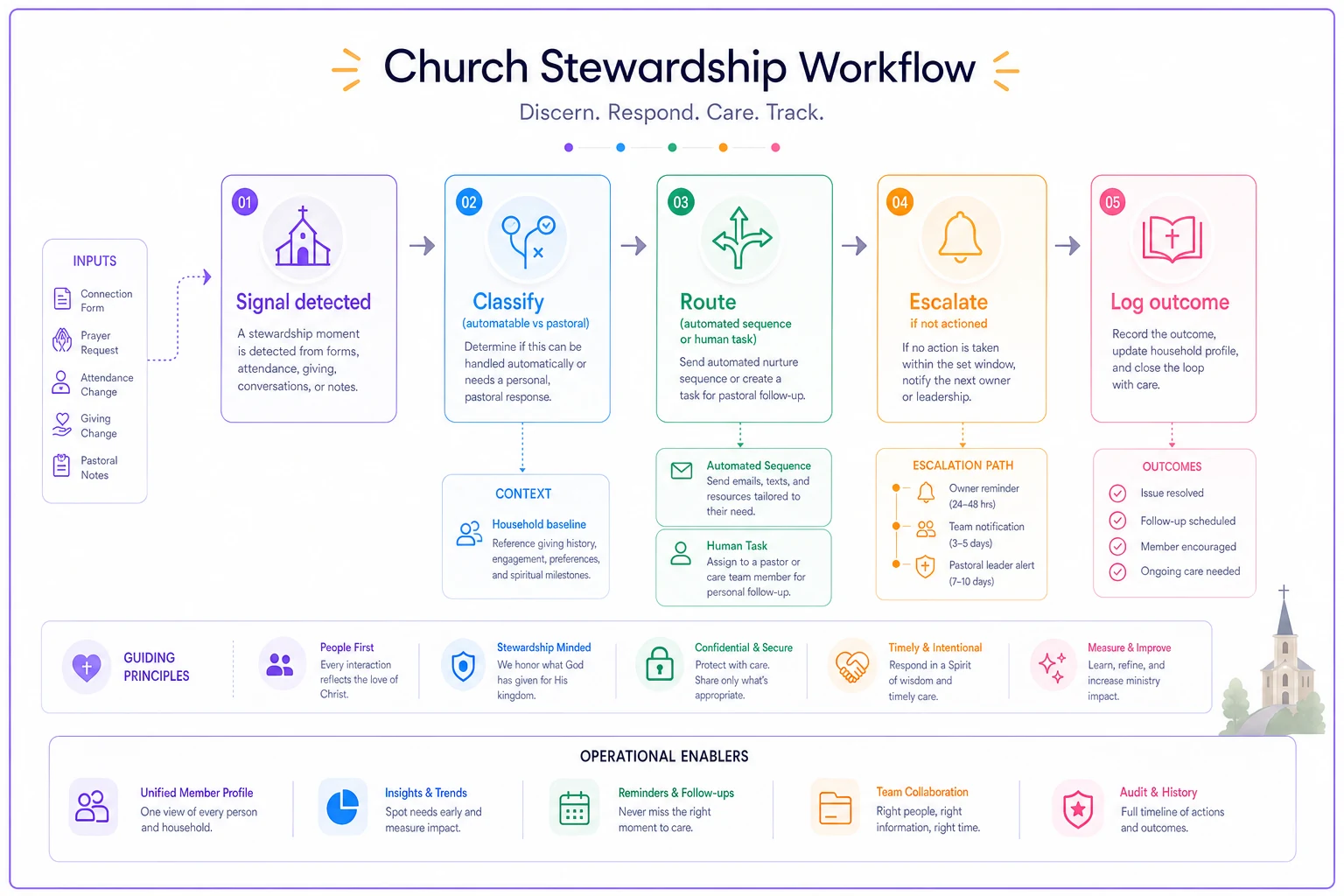
That fourth step is where most well-intentioned systems quietly fail. A task gets created, lands in someone's queue, and dies there. Without an escalation rule, "someone should call the Hendersons" becomes nobody calling the Hendersons.
KPIs that should trigger human outreach
Not every number belongs on a dashboard, and not every dashboard number should trigger action. The ones that warrant a human reaching out tend to be about trajectory and relationship, not totals.
A short list of trigger-worthy KPIs:
-
Count of households newly entering the lapsing segment this week
-
Recurring-gift failure rate (card declines, cancellations)
-
Net movement between segments month over month (are core givers drifting toward lapsing?)
-
First-gift-to-second-gift conversion rate for new givers
-
Number of pastoral outreach tasks open past their escalation window
The insight most leaders miss: the flow between segments tells you more than the size of any segment. A stable-looking core that's quietly leaking three households a month into "lapsing" is a slow bleed that top-line giving won't reveal for a year. Watching the movement gives you a chance to intervene while the relationship is still warm.
Resist the urge to report on everything. A board or staff team can act on five indicators. Give them twenty and they'll act on zero. Pick the handful that reliably precede a problem or an opportunity, and hold those steady long enough to spot trends.
Wiring the model into ministry planning
This is the part that gets skipped, and it's the part that makes the whole thing worth building. Donor analytics shouldn't just drive thank-you notes — it should shape how you plan and fund ministry.
Consider resource allocation. If your data shows new-giver retention is weak — lots of first gifts, few second gifts — that's not a fundraising problem, it's an assimilation problem. The right response might be reallocating a few staff hours toward a stronger welcome and connection process, not launching another appeal. The numbers point you at the actual bottleneck instead of the symptom.
A few resource-allocation rules worth adopting:
-
Fund the segment with the highest leverage, not the highest total. Rescuing lapsing core givers usually costs less and returns more than chasing new large gifts.
-
Tie stewardship staffing to outreach volume. If lapsing-segment inflow doubles seasonally, the human outreach capacity has to flex with it.
-
Treat recurring-gift failures as a fixable operational line item, not lost revenue — because much of it is recoverable with a simple nudge.
On forecasting: segment trajectories make projections far more honest than a flat percentage guess. Say a church with around 220 giving households runs the numbers and finds its consistent core (about 140 households) is holding steady, but the lapsing segment grew from roughly 12 to 28 households over two quarters, and new-giver second-gift conversion is sitting near 35%. A flat forecast might assume giving continues more or less level. The segment view says otherwise — that growing lapsing group, left alone, likely translates into a noticeable dip two quarters out, enough to matter when setting the next budget. Acting on it now (targeted pastoral outreach plus fixing the card-decline leakage) is a far cheaper intervention than closing a gap later.
That's forecasting that actually informs a decision, instead of a number that just makes the board nervous.
When this model makes sense — and when it doesn't
This isn't for everyone, and pretending otherwise leads to churches building machinery they never use.
When it makes sense:
-
You have at least a couple hundred giving households — enough that you genuinely can't track everyone in your head
-
Giving data is reasonably clean and households are de-duplicated
-
Someone owns stewardship as part of their actual role, not as a vague shared responsibility
-
You're ready to act on signals, not just watch them
When it's a bad idea:
-
Your donation records are a mess of duplicates and mismatched names — fix the foundation first
-
Nobody has time to make the human calls the system surfaces; automation without human follow-through just generates ignored tasks
-
Leadership wants the dashboard for reporting optics rather than action
Who should probably not start here: a church of 60 where the pastor already knows every family by name and notices when the Johnsons miss a few weeks. For that size, the relational radar is better than any model. Build the system when you've outgrown your memory, not before.
A short real scenario
A mid-sized congregation — roughly 300 attenders, around 190 giving households — had solid total giving but a nagging sense that people were slipping away quietly. They had no way to see it until the annual statements went out.
They set up a basic segmentation and three thresholds: a 75-day lapse warning for consistent givers, a recurring-payment failure flag, and a new-giver second-gift tracker. The failure flag alone surfaced something they'd missed — a batch of expired-card declines that nobody had been following up on. Recovering most of those added back somewhere in the range of $600–$800 a month in giving that was never a decision to leave, just a dead card.
On the pastoral side, the lapse warnings routed about four to six names a week to a staff member. Not all needed a deep conversation, but a few uncovered real situations — a job loss, a family in a hard season — that the church was then able to actually care for. Within two quarters the lapsing segment stopped growing, and more importantly, leadership felt they were ahead of what was happening instead of reading about it in December.
Nothing about this required fancy tools. It required connecting the data they already had to a short list of actions and a named person to own them.
Pulling it together
A donor analytics stewardship model works when every number has a home — a segment it belongs to, a threshold that defines "something changed," an action that follows, and a person or sequence responsible for it. Strip away any one of those and you're back to reports nobody acts on.
Start small. Clean up the giving records first — the donation operations templates and checklists are a sensible place to get the plumbing right before you build analytics on top of it. Then pick two or three thresholds that clearly separate noise from signal, route them to the right owner, and give the pastoral path an escalation rule so tasks don't die in a queue.
The measurement part is easy. The discipline is in making sure the data always points at a next step — and that someone actually takes it.
Ready to transform your church management?
Join 500+ churches using Parshly to enhance community engagement, streamline administration, and grow their ministries.