


Churches lose thousands of dollars annually through donation processing errors that shouldn't happen. Not from fraud or theft—just plain operational breakdowns. A $500 mission trip donation lands in the general fund. The building campaign receives a memorial gift meant for youth ministry. Someone's recurring tithe gets double-processed, and the refund creates a three-week accounting headache nobody has time to fix.
These aren't technology problems. They're workflow problems that compound into reconciliation nightmares.
The pattern is pretty consistent across churches of every size: most treat giving as a single transaction when it's actually a multi-step workflow requiring coordination between platforms, people, and processes. The churches that get it right build secure donation workflows that connect payment processing to fund accounting to donor communication in one continuous flow.
Why church donation workflows break differently than other nonprofits
Churches face a unique operational challenge that most other nonprofits don't: they process donations through more channels, with more designation options, from more donor types, all while maintaining stricter confidentiality requirements.
Think about your typical Sunday. Envelope givers who've used the same system for 30 years. Online donors setting up recurring gifts at 2 AM. Text-to-give during service. Kiosk transactions in the lobby. Stock transfers from estate planning. Each channel creates its own data trail, its own reconciliation requirements, its own potential failure points.
Then layer in designation complexity. A single donor might split their gift across general fund, missions, building campaign, and a memorial fund—all in one transaction. Multiply that by 200 families, each with their own giving patterns and preferences.
The operational load gets crushing fast. A 300-member church typically processes somewhere around 2,400 individual transactions annually across all channels. That's 2,400 opportunities for designation errors, failed reconciliations, or consent documentation gaps.
Most churches try solving this with better spreadsheets or more volunteer hours. Spreadsheets don't scale, and volunteers burn out. What works is building a secure donation workflow that treats each gift as a multi-step process with clear handoffs, validation points, and controls.
The hidden reconciliation burden nobody talks about
Here's what month-end actually looks like in most church offices: the bookkeeper has seven browser tabs open—online giving platform, bank portal, accounting software, three different spreadsheets, and probably Gmail searching for that one ACH notification. Manually matching transactions across systems. Hunting for a $50 discrepancy that turns out to be a processing fee nobody accounted for.
Simplify your church’s day-to-day operations.
Parshly helps you organize events, track donations, and engage your congregation—all in one place.
- Centralized member management
- Donation tracking & reporting
- Volunteer scheduling & notifications
No credit card required
The real problem isn't the discrepancy. It's that every single donation requires human intervention to move from payment platform to accounting system to donor record. Each manual touchpoint introduces risk.
A church processing 200 gifts monthly spends roughly 15-20 hours on reconciliation tasks. That's half a work week, every month, just moving numbers between systems and checking that they match. The cost isn't just time—it's what that staff member could be doing instead of data entry.
When you map out where reconciliation actually fails, three bottlenecks come up consistently:
Channel consolidation breakdown—Each giving channel exports data differently. Your online platform uses one date format, text-giving uses another, ACH transfers show up three days late. Staff spend hours just normalizing data before they can even start reconciling.
Designation mapping errors—The donor selects "Building Fund" online, but your accounting system calls it "Capital Campaign 2024." Someone has to manually map every designation, every time, or gifts land in the wrong funds.
Timing mismatches—Sunday's cash offering gets deposited Monday, but credit card transactions don't settle until Wednesday, and ACH gifts might not show up until Friday. Your bank balance never matches your giving records because everything happens on different timelines.
Building payment channel architecture that actually scales
Payment channel selection isn't about offering every possible option—it's about choosing the right mix for your congregation while maintaining operational sanity. Churches that get this wrong end up managing eight different payment systems, each with its own login, export format, and reconciliation process.
Start with channel economics. Each payment type has different operational costs beyond just processing fees:
| Payment Type | Processing Cost | Reconciliation Time | Error Rate | Donor Friction |
|---|---|---|---|---|
| Cash/Check | $0 fees | 8 min per batch | 2-3% | Low for regulars |
| Online recurring | 2.2% + $0.30 | 2 min per batch | <1% | Medium setup, low ongoing |
| Text-to-give | 2.5% + $0.30 | 3 min per batch | 1-2% | Very low |
| Kiosk/Terminal | 2.3% + $0.15 | 4 min per batch | 1-2% | Low |
| ACH transfer | $0.25-0.50 | 5 min per transaction | <1% | High setup, low ongoing |
| Stock/Crypto | Varies widely | 20+ min per transaction | 5-8% | Very high |
Route regular tithers to ACH or recurring card payments to reduce reconciliation time.
The strategic question isn't which channels to offer—it's how to route donors toward the most operationally efficient channel for their giving pattern. Regular tithers should be on ACH or recurring card payments. One-time special offerings work fine through text-giving. Large capital campaign gifts justify the complexity of stock transfers.
What most churches miss is that channel architecture needs clear rules about what each channel actually handles. Don't process restricted gifts through text-to-give if your platform can't capture designation details. Don't accept memorial donations through channels that can't document donor intent. Each channel should have defined use cases based on operational capability, not just donor preference.
Consent capture and designation controls that prevent future headaches
Donor intent documentation might be the most overlooked operational requirement in church giving. Not the tax receipt—everyone knows about that. The actual record of what the donor wanted their gift to support.
A donor gives $5,000 "for the youth mission trip" through online giving. Six months later, they're upset because it went to general youth programming. You check the records—the online form only had "Youth Ministry" as an option, not specific trip designation. Now you're in an awkward conversation about restricted funds that a better intake form could have prevented entirely.
Build designation controls at three levels:
Input validation—Your giving interface needs to match your actual fund structure. If you have 12 designated funds, donors need to see all 12 options with clear descriptions. Don't make them guess whether "Missions" means local outreach or international partnerships.
Documentation requirements—Any restricted gift over a threshold (usually $250-500) needs written documentation of donor intent. Email confirmations work, but they need to explicitly state the designation and any restrictions. This protects both the church and the donor.
Change protocols—Sometimes funds need to be redirected. The building campaign ends with a surplus. A designated missionary retires. You need clear, documented procedures for these situations, including who can authorize changes and how donors get notified.
The operational failure happens when churches treat all gifts as unrestricted by default, then try to reconstruct donor intent later. Build your workflow to capture and confirm designation at the point of giving, not during reconciliation.
The secure donation workflows standard: connecting every step
A secure donation workflow isn't just about payment security—it's about operational security. Every gift should flow through a defined process with clear handoffs and validation points.
-
1. Gift initiation (0-5 minutes) - Donor selects payment method and amount - System validates payment details - Designation gets selected from standardized list - Consent/restriction details captured if applicable
-
2. Payment processing (instant to 3 days) - Transaction processes through payment gateway - Initial receipt generated with transaction ID - Designation data attached to transaction record - Flags set for any special handling requirements
-
3. Settlement and batching (daily) - Transactions group by settlement date - Batch totals calculated by fund designation - Variances flagged for investigation - Deposit preparation documentation created
-
4. Fund allocation (within 48 hours) - Settled funds allocated to designated accounts - Restricted gift documentation filed - Any splits or special allocations processed - Accounting system updated with full detail
-
5. Reconciliation checkpoint (weekly) - Bank deposits matched to batch totals - Designated funds verified against donor intent - Processing fees allocated correctly - Variances investigated and resolved
-
6. Donor communication (within 7 days) - Official receipt generated with all IRS requirements - Designation confirmation included - Year-to-date giving summary updated - Any special acknowledgments sent
-
7. Month-end validation (monthly) - All transactions reconciled across systems - Designated fund balances verified - Restricted fund compliance checked - Reports generated for finance committee
Here’s a quick visual of that workflow.
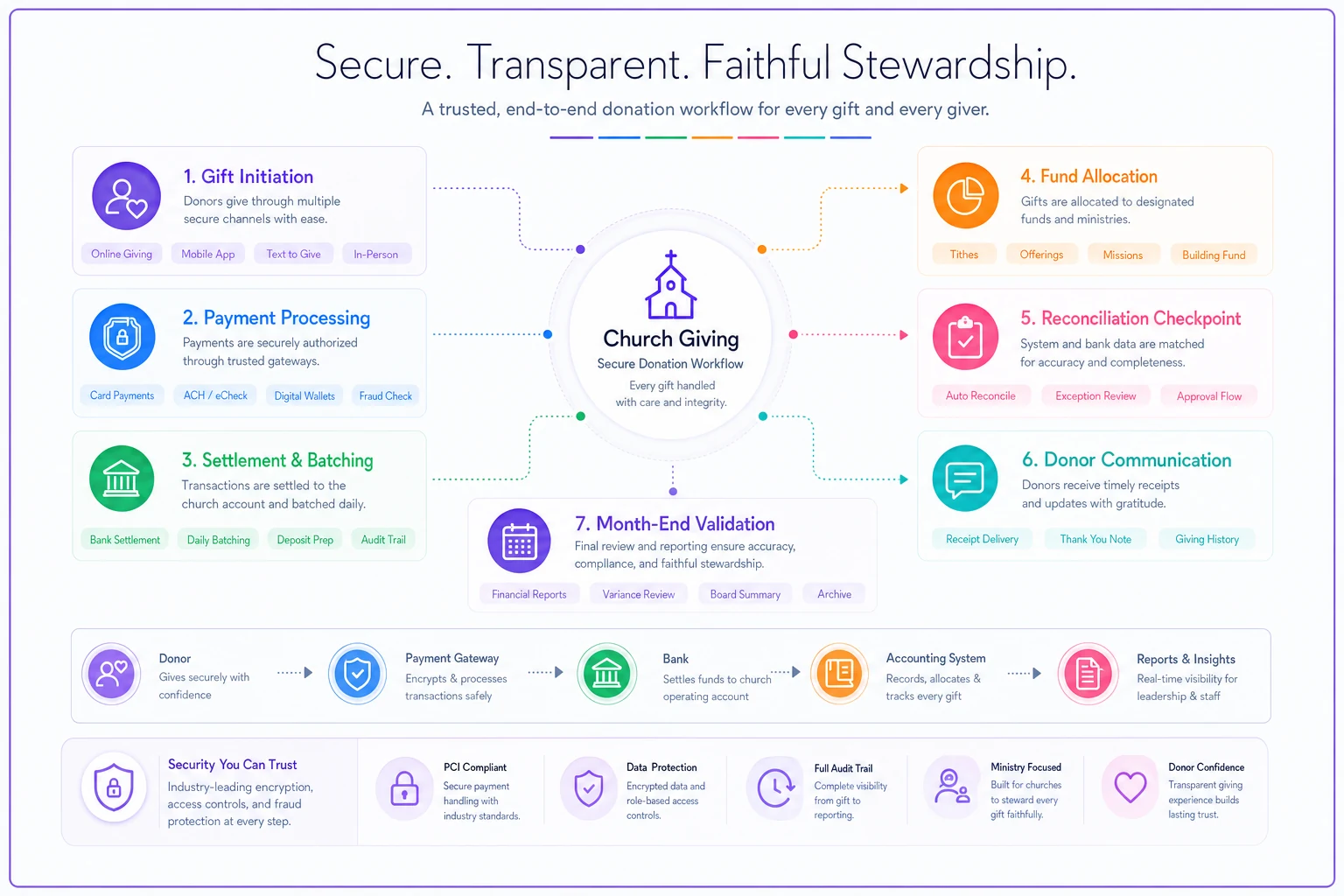
The key difference: this workflow runs the same way every time, regardless of payment channel or amount. Consistency reduces errors more than any technology upgrade.
Month-end controls and the audit trail nobody maintains properly
Month-end in most churches looks like controlled chaos. The bookkeeper knows everything needs to reconcile by the board meeting, but there's no actual control framework—just frantic checking until the numbers match.
Real month-end controls are preventive, not detective. You're not hunting for problems; you're confirming that your workflow prevented them.
Build your month-end process around four control points:
Transaction completeness—Every donation that hit your bank account has a corresponding donor record. This seems basic until you realize how many churches have "miscellaneous" deposits they can't trace back to specific gifts.
Designation accuracy—Every restricted gift went to its designated fund. Run a designation audit report that shows donor intent versus actual allocation. Any variances need investigation and documentation.
Fee allocation—Processing fees got charged to the right accounts. Churches often absorb thousands in fees from the general fund when they should be allocated proportionally across designated funds.
Compliance verification—All restricted funds were used according to donor specifications. This covers temporary restrictions, memorial funds, and any other conditional donations.
The audit trail requirement goes beyond just keeping records. You need to show the complete flow of every dollar from donor to designation—transaction logs, batch reports, allocation records, and reconciliation documentation all connected in a way an auditor can follow six months later.
What secure donation workflows actually prevent
Churches that implement proper secure donation workflows see immediate operational improvements, but the real value shows up in what stops happening.
No more emergency reconciliation sessions trying to find missing deposits. When every transaction follows the same workflow with the same validation points, deposits don't go missing. They might fail a validation check, but that gets flagged immediately rather than discovered three weeks later.
No more donor complaints about misallocated gifts. Clear designation capture and confirmation means donors know exactly where their gift went, and you have documentation to prove it.
No more finance committee meetings derailed by basic questions. When your workflow generates consistent reports with clear audit trails, committee members spend time on strategy rather than investigating variances.
No more year-end scrambles for tax receipts. A secure workflow generates and stores receipt documentation as part of the process—not as a separate year-end project tacked on in January.
The operational impact compounds. Churches running manual, fragmented donation processes typically spend 60-80 hours monthly on giving-related administration. A properly designed secure donation workflow can cut that to 15-20 hours—mostly verification and reporting rather than data entry and error correction.
The technology piece: when operational software makes sense
Most churches hit an inflection point around 150-200 regular givers where manual donation workflows start breaking down. Spreadsheet-based reconciliation becomes a near full-time job, and human error rates climb past the point of being manageable.
This is where AI-powered operational software can genuinely change the equation—not by replacing human judgment, but by automating the repetitive reconciliation tasks that eat up staff hours. Modern platforms can automatically match bank deposits to giving records, flag designation discrepancies, and generate audit trails without manual data entry.
The key is choosing software that treats donations as workflows, not just transactions. Look for platforms that can:
-
Consolidate multiple payment channels into a single reconciliation workflow
-
Automatically map designations between giving platforms and accounting systems
-
Generate exception reports for anything requiring human review
-
Maintain complete audit trails without manual documentation
-
Scale from 100 to 1,000 donors without adding operational complexity
Technology alone won't fix broken workflows, though. You need the operational foundation first—clear channel architecture, documented designation rules, defined reconciliation steps. Then the software amplifies good processes rather than automating broken ones.
Moving forward: your next operational steps
Fixing church donation workflows doesn't require a complete overhaul. Start with the highest-impact improvements that reduce reconciliation burden right away.
First, map your current state. Document every payment channel, every designation option, every reconciliation step. This usually takes about a week, but it reveals where time gets wasted and where errors originate.
Then standardize designation codes across all systems. Your online giving platform, accounting software, and donor database need identical fund codes and descriptions. This single change can cut reconciliation time by 30-40%.
Next, move to weekly reconciliation checkpoints instead of waiting for month-end. Catching errors within days rather than weeks prevents small issues from turning into serious problems.
Finally, document donor intent at the point of giving. Update your giving interfaces, train your ushers, modify your intake procedures—whatever it takes to capture clear designation information upfront rather than reconstructing it later.
Churches that get this right stop treating donations as a necessary administrative burden and start seeing them as a measurable operational system. When secure donation workflows are built properly, giving errors become rare exceptions rather than weekly firefights. Staff gets time back for actual ministry. Donors trust that their gifts go exactly where intended.
That's the difference between managing donations and building a giving operation that can actually scale with your ministry's growth.
Ready to transform your church management?
Join 500+ churches using Parshly to enhance community engagement, streamline administration, and grow their ministries.