


Your recurring donor program probably loses 12–15% of its givers every year to failed payments. Not because they wanted to stop giving—but because their card expired, they switched banks, or a payment just bounced. These aren't donors who've lost faith in your mission. Their payment method broke.
The tragedy isn't the lost revenue. It's watching a real relationship dissolve over an expired Visa.
Most churches handle this backwards. They either ignore failed payments until the donor quietly disappears, or they bombard people with urgent "update your card!" emails that feel transactional and a little desperate. Neither works, because both miss the actual problem: a failed payment is an operational issue, not a relationship one.
The hidden psychology of lapsed recurring donors
The default assumption churches make is that a lapsed donor made a conscious decision to stop supporting the ministry. But after building donation management systems for dozens of churches, the pattern is pretty consistent—most lapsed recurring donors have no idea they've stopped giving.
Think about your own subscriptions. When Netflix can't charge your card, you don't philosophically abandon streaming. You just haven't gotten around to fixing it. Church giving works the same way, except churches tend to handle the follow-up worse than Netflix does.
A recurring donor whose payment fails moves through pretty predictable stages. First comes confusion when they get a generic "payment failed" email that looks like spam. Then guilt—they meant to fix it but got busy. After two or three failed attempts, embarrassment creeps in. By month four, they've probably assumed the church has written them off, and restarting feels awkward, like showing back up to a gym after ghosting for six months.
The real failure happens in those first 48 hours after a payment declines. Most churches wait days, sometimes weeks, to reach out. By then, the donor has already started building a mental narrative about why they stopped giving.
Building sequences that preserve dignity
Recovering lapsed recurring donors—versus losing them permanently—comes down to timing, tone, and having the right systems in place. You need automated sequences that trigger immediately but feel personal and pastoral.
Simplify your church’s day-to-day operations.
Parshly helps you organize events, track donations, and engage your congregation—all in one place.
- Centralized member management
- Donation tracking & reporting
- Volunteer scheduling & notifications
No credit card required
Start with prediction, not reaction. Modern payment processors can flag cards approaching expiration 60 days out. A simple automated email saying "We noticed your card ending in 4782 expires next month—here's a quick link to update it" prevents most failures before they happen. No guilt, no pressure, just helpful.
When payments do fail, your first touchpoint needs to happen within six hours. Not days. But this cannot read like a collections notice. Frame it as technical support:
"Hi Sarah, we had a small hiccup processing your monthly gift this morning. This sometimes happens with bank processing delays. We'll retry automatically in 48 hours, but if you'd like to update your payment method now, here's a secure link."
Notice what's not in there? No mention of mission impact. No guilt about programs losing funding. No financial pressure. Just someone helping fix a technical problem.
The technical architecture behind dignity
This is where churches usually fall apart—they try to manage re-engagement manually through spreadsheets and personal emails. Responses take days, feel inconsistent, and donors slip through the cracks. You need automated workflows that trigger instantly but adapt based on what the donor actually does.
A solid re-engagement cadence looks something like this:
| Timing | Action |
|---|---|
| Hour 0–6 | Technical support email (failed payment notification) |
| Day 2 | Automated retry attempt (no communication needed) |
| Day 3 | If retry fails, send update reminder with direct link |
| Day 7 | Second automated retry |
| Day 8 | If still failing, pastoral check-in from an actual person |
| Day 14 | Final automated retry |
| Day 15 | Transition to light-touch stewardship sequence |
Each message needs different positioning. The Day 3 reminder stays purely operational. The Day 8 pastoral check-in shifts focus entirely: "I noticed your recurring gift hasn't processed recently. No pressure at all—just wanted to check if everything's okay."
That human touchpoint at Day 8 matters more than people expect. Roughly 40% of lapsed donors have something bigger happening—job loss, medical bills, a family crisis. They need pastoral care, not another payment reminder. The automated sequence should flag these for personal follow-up while continuing light technical reminders for everyone else.
Light-touch stewardship without the hard ask
After two weeks of failed payments, most churches either give up or get aggressive. Both approaches damage relationships. Instead, shift to a stewardship sequence that maintains connection without asking for anything.
This isn't about manipulation. It's about preserving the relationship until the donor is ready to re-engage financially. The sequence shifts from payment recovery to story sharing:
-
Week 3
Impact story from a ministry they previously supported
-
Week 5
Invitation to a free church event (no donation ask)
-
Week 7
Ministry update with photos or video
-
Week 10
Survey about communication preferences
-
Week 13
Personal video message from the pastor (batch recorded)
No money mentioned. Impact shown without creating guilt. Participation invited without requiring payment.
Around week 10, something interesting tends to happen. Donors receiving these light touches often restart giving on their own—they fix their payment method without being prompted. Consistent communication plus removed pressure creates space for people to re-engage on their own terms.
Automation that scales but feels personal
The operational challenge is making automated sequences feel genuinely personal when you have 200+ recurring donors. You can't manually manage individual re-engagement campaigns at that scale, but pure automation feels robotic and does real relationship damage.
The fix is building "automated personalization windows"—your base sequence runs automatically, but it creates specific moments for human intervention:
-
When someone opens three emails but never clicks, flag for a personal call
-
When payment failure happens three months running, trigger a pastoral care review
-
When someone completes your communication survey, have someone respond personally within 24 hours
Your platform needs to track these signals and surface them for staff. A simple Monday morning report showing "these five donors need personal outreach this week" makes human touch actually scalable.
Create 'automated personalization windows' so staff only handle flagged exceptions, not every failed payment.
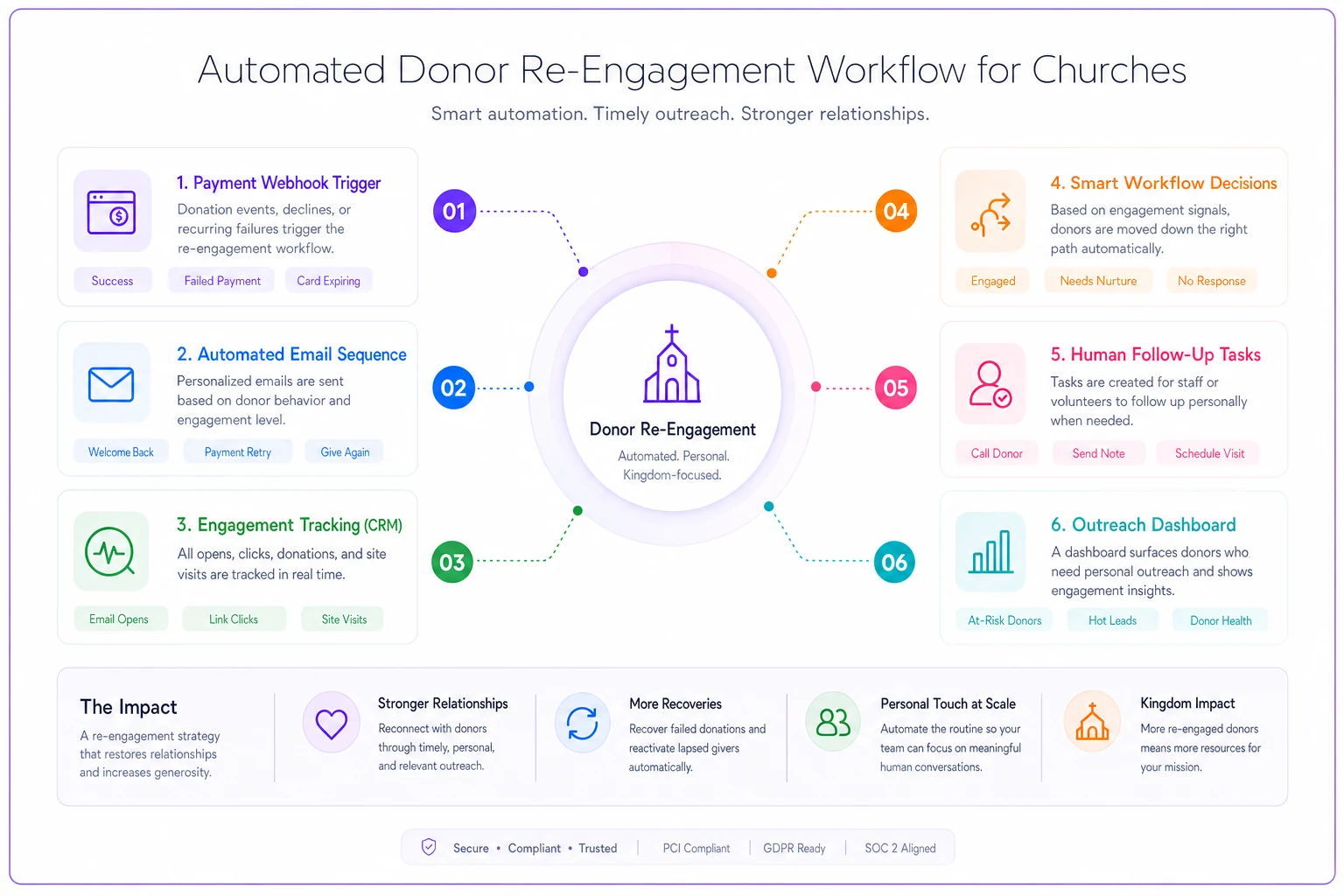
A simple Monday morning report showing "these five donors need personal outreach this week" makes human touch actually scalable.
The technical setup looks roughly like:
Recovery metrics that actually matter
Churches usually track the wrong things here. They obsess over immediate win-back rates instead of relationship preservation. The metrics that actually tell you something:
Response rate tells you if your messages resonate. Below 15% means your tone is off. Above 25% means you're connecting.
Time to recovery shows sequence effectiveness. Most successful recoveries happen within 10 days. If your average is 30+ days, your early touchpoints aren't landing.
Reactivation stick rate measures whether recovered donors stay. Getting someone back for one month doesn't matter if they lapse again immediately.
Pastoral care referral rate indicates how many lapsed donors need support beyond payment updates. This should sit around 5–10%. Higher than that suggests congregation-wide financial stress worth paying attention to.
Voluntary restart rate tracks donors who restart without being asked. This is probably your best indicator of relationship health.
One church moved their first touchpoint from 72 hours to 6 hours post-failure and watched their recovery rate jump from 22% to 47%. Another found that adding the Day 8 pastoral check-in doubled long-term retention of recovered donors.
Common sequence mistakes that destroy trust
The biggest mistake churches make is treating lapsed recurring donors like delinquent accounts rather than relationship partners. It shows up in predictable ways:
Mistake 1: The guilt trip "Your $50 monthly gift feeds 10 children. Without your support, these children won't eat." This might work once. It destroys long-term relationships.
Mistake 2: The immediate downgrade "Can't do $50 anymore? How about $25?" Presumptuous, and usually wrong.
Mistake 3: The public callout Mentioning lapsed giving during personal interactions or, worse, from the pulpit.
Mistake 4: The instant abandonment One failed payment and radio silence forever. That tells donors they were only valued for the transaction.
Mistake 5: The aggressive recovery Daily emails and multiple calls within the first week. Desperation doesn't work in donor relations any more than it does anywhere else.
When to stop trying (and how to leave the door open)
Not every lapsed donor will return, and that's fine. But how you close out a recovery sequence determines whether they might come back later.
After 90 days of failed payments and no response, shift to quarterly stewardship touches—no payment asks, just ministry updates four times a year. Keep them in your general congregation communication but remove them from financial campaigns.
The final message in your active recovery sequence matters. Don't just ghost them. Something like:
"We've tried reaching you about your recurring gift, but we know life gets busy. Your support has meant a lot to our ministry. Whenever you're ready—whether that's next month or next year—we're here. No questions asked, no awkwardness. You're part of our church family regardless."
Then actually mean it. Mark their record to prevent aggressive future fundraising. When they show up in person, greet them warmly without mentioning giving.
Roughly 15% of "permanently lapsed" donors restart giving within two years if you handle the exit gracefully. Burn that bridge with aggressive recovery attempts and that number drops close to zero.
The operational backbone that makes this work
Good intentions aren't enough here. You need integrated systems that share data without manual handoffs.
Your payment processor needs to send real-time webhooks to your communication platform. When a payment fails at 2am, your system should automatically queue the support email for 8am delivery.
Your CRM needs to track both giving history and engagement signals. Not just that Sarah gave $50 monthly for two years—but that she opens 60% of emails and attended the fall fundraiser. That context changes how you communicate.
Your email platform needs to have real segmentation capability. Donors who gave for five or more years get different messaging than someone who set up recurring giving six months ago. Major donors get personal calls. Smaller donors get well-crafted automated sequences.
Your analytics should surface exception reports automatically—donors opening emails without clicking, cards expiring in the next 60 days, giving patterns that suddenly change.
Most churches try to manage this through spreadsheet exports and manual processes. That's why recovery rates stay below 20% and relationships quietly deteriorate. Donor management platforms with AI automation built in can orchestrate these workflows without constant manual oversight—predicting failures before they happen, triggering instant responses, and flagging the moments that actually need a human.
Creating sustainable re-engagement rhythms
Building the initial sequence is honestly the easier part. Maintaining it through staff turnover, seasonal overwhelm, and donor fatigue is where most programs break down.
Build sustainability through templates and triggers rather than manual effort. Your Day 3 reminder should auto-populate donor name, gift amount, and payment method. Your Day 8 pastoral check-in should generate a task with donor history already attached. Quarterly stewardship touches should schedule automatically based on lapse date.
Create variants for different donor segments. Major donors get personal calls within 24 hours. First-time recurring donors get extra grace and more explanation. Long-term donors get messaging centered on appreciation. The platform handles routing based on donor attributes—staff just handles the exceptions.
Review and refine quarterly. Which messages have the highest open rates? Where do donors most often restart? Which sequences lead to retention past month three? Use that to adjust timing and tone.
And when finance committees push for more aggressive collection, show them the data. Dignity-preserving sequences don't just feel better—they perform better. Churches that prioritize relationship over transaction see higher lifetime donor value, stronger retention, and better congregation engagement overall.
The ministry impact of operational excellence
How you handle lapsed donors shapes your entire giving culture. Word spreads when someone feels pressured or written off. But it also spreads when someone feels genuinely cared for during a hard season.
One church had a member whose husband lost his job, causing their recurring gift to fail. Instead of payment demands, they received a pastoral call offering prayer and practical support—job networking resources, temporary financial assistance. Eight months later, when employment stabilized, the family doubled their recurring gift and became vocal advocates for the church's approach to community care.
That story moved through the congregation. New recurring donors signed up because they trusted how the church would handle future hardship. Existing donors increased gifts because they saw values in action. The operational system became a ministry tool.
This is why re-engagement strategies for lapsed recurring donors have to prioritize dignity over dollars. You're not just protecting revenue—you're demonstrating what you actually believe about grace and human worth through the systems you build.
The churches seeing 45–50% recovery rates aren't using better scripts or more aggressive tactics. They're treating lapsed donors like people going through something, not accounts to collect. They're using automation to ensure consistent, timely, dignified responses at scale. They're measuring relationship health alongside financial metrics.
Your recurring donor program will lose people to failed payments—that's just reality. But whether those people remain part of your church community, whether they restart giving in six months or two years, whether they tell friends your church genuinely cares—that depends on the re-engagement sequences you build now.
Stop treating payment failures like relationship failures. Build automated sequences that preserve dignity, offer support, and maintain connection regardless of transaction status. Your donors deserve that respect. Your ministry depends on those relationships. And your operational systems can either strengthen both or quietly shatter them.
Ready to transform your church management?
Join 500+ churches using Parshly to enhance community engagement, streamline administration, and grow their ministries.