


Most churches don't have an operations problem inside any one ministry. They have a problem between ministries. Worship needs the stage set a certain way. Facilities already committed that room to a grief-support group. Kids ministry ordered supplies that finance didn't budget for. The youth pastor scheduled a fundraiser the same weekend the missions team planned their big push. Nobody did anything wrong — there was just no layer sitting above all the individual playbooks to catch the collision before it happened.
That missing layer is what this article is about. You've probably already built solid playbooks for individual functions — check-in procedures, donation reconciliation, volunteer scheduling. Those are the ground floor. What most churches never build is the governance layer that ties those playbooks together: who decides what, how conflicts get resolved, how money tradeoffs get made out loud instead of in someone's head, and how the whole thing gets reviewed on a rhythm instead of only when something breaks.
Why the collisions happen (and why they get worse as you grow)
At a church of 80, the "governance layer" is one person's brain. The lead pastor knows every commitment because they were in every conversation. There's no matrix because there doesn't need to be one — coordination happens by proximity. Everyone's in the same three rooms.
The trouble starts somewhere around the point where you add a second paid staff member or your second service. Now decisions get made in parallel. Two people are both saying yes to things without knowing the other person said yes to something conflicting. The facilities calendar has double-bookings. The budget has three ministries all assuming they own the same $2,000 line. And the pattern nobody notices at first: the more capable your ministry leaders get, the more collisions you create, because capable leaders take initiative, and initiative without a coordination layer means everyone's driving fast toward the same intersection.
A typical example looks like this. A church around 350 people adds a part-time family ministries director. Great hire, lots of energy. Within two months she's launched a midweek kids program, reserved the fellowship hall for it, and ordered curriculum. Nobody told her the fellowship hall was the overflow space during the building's HVAC repair, or that the curriculum line had already been spent by the nursery. None of that is her fault. There was simply no place where "who owns this room, this budget, this decision" lived in a form anyone could check.
What breaks at scale isn't competence. It's the absence of a shared decision structure that everyone can see.
The governance layer, in plain terms
Think of it as four small things, not a giant manual. Each is deliberately lightweight, because the moment governance gets heavy it gets ignored.
Simplify your church’s day-to-day operations.
Parshly helps you organize events, track donations, and engage your congregation—all in one place.
- Centralized member management
- Donation tracking & reporting
- Volunteer scheduling & notifications
No credit card required
-
A RACI + decision matrix — who's Responsible, Accountable, Consulted, and Informed for the decisions that cross ministry lines.
-
A monthly ops-sync — one recurring meeting with a fixed agenda where cross-functional tradeoffs actually get made.
-
Conflict-resolution rules — a pre-agreed way to break ties on rooms, budget, calendar, and volunteers before emotions get involved.
-
A one-page ops dashboard — resource decisions tied to named owners and their budget tradeoffs, visible in one glance.
None of this replaces your existing playbooks. If you've already built out your policies into a real church operations manual with ownership templates and change control, this governance layer sits directly on top of it — it's the thing that decides between the chapters when they compete for the same resources.
Building the RACI + decision matrix
Most church RACI attempts fail because they try to map every task. Don't. Map only the decisions that cross functional boundaries — those are the ones that cause collisions. Setting up chairs for your own event doesn't need a matrix. Deciding who gets the fellowship hall on a contested Saturday absolutely does.
Here's the distinction that matters and that people constantly blur: Accountable is one person, always. Responsible can be several people doing the work. Accountable is the single name you call when it goes sideways. When two people think they're both accountable for the calendar, you don't have redundancy — you have a guaranteed conflict.
A workable cross-functional matrix for a mid-size church might look like this:
| Cross-functional decision | Accountable (one name) | Responsible | Consulted | Informed |
|---|---|---|---|---|
| Room/space assignment conflicts | Operations lead | Facilities team | Ministry requesting | All ministry leads |
| Reallocating budget mid-year | Finance owner | Staff requesting | Lead pastor | Board treasurer |
| Adding a new recurring program | Lead pastor | Ministry director | Ops + Finance | All staff |
| Volunteer over-subscription (same people, two teams) | Volunteer coordinator | Both ministry leads | Affected volunteers | Ops lead |
| Calendar date collisions | Operations lead | Event owners | Worship + Facilities | Congregation comms |
The magic isn't the grid. It's the one-name-Accountable rule combined with actually publishing the thing where staff can see it. What tends to happen in a lot of small organizations is the matrix gets built at a planning retreat, saved to someone's laptop, and never referenced again. A matrix nobody opens is decorative. Put it somewhere shared and reference it by name — "per the matrix, that's the ops lead's call" — until people stop arguing about who decides and just start deciding.
When a RACI is overkill
If you're under 100 people with one or two staff, you don't need this yet. Your coordination cost is still lower than the cost of maintaining the document. Wait until you notice the same category of collision happening twice — double-booked rooms, surprise budget overlaps — because a repeat is the signal that proximity-based coordination has stopped working.
Once you've hit that threshold, the matrix stops being overhead and starts being the thing that saves your fall planning season.
The monthly ops-sync that actually earns its 45 minutes
A cross-functional matrix tells you who decides. The ops-sync is where those decisions surface before they become emergencies. This is not your staff devotional, not your vision meeting, and not your event debrief. It's a tight operational meeting with one job: catch collisions in the next 60 days and resolve resource tradeoffs.
A fixed agenda keeps it from drifting into everyone's favorite complaints:
-
Calendar look-ahead (next 60 days) — what's coming, what overlaps, what's contested.
-
Resource tradeoffs on the table — every request for money, space, or volunteers that competes with something else.
-
Open conflicts from last month — did they get resolved, or are they still bleeding?
-
Budget variance flags — any line running hot, any owner who needs a reallocation decision.
-
Owner assignments — every unresolved item leaves with one name attached.
The single biggest mistake is letting the ops-sync become a status update. Status updates are one-directional — people report and nobody decides anything. The whole point of this meeting is decisions. If nobody leaves with a resolved tradeoff or a reassigned owner, the meeting failed, regardless of how informed everyone feels.
A practical rule: cap it at 45 minutes and end with a two-line summary — decisions made, owners assigned.
A practical rule: cap it at 45 minutes and end with a two-line summary — decisions made, owners assigned. If it consistently runs long, your matrix probably isn't clear enough about who's Accountable, so items that should be one person's call are getting debated by committee.
Conflict-resolution rules you set *before* you need them
The reason room and budget fights get ugly in churches is that they're resolved in the moment, emotionally, usually by whoever pushes hardest or has the most seniority. That's not a system — it's a personality contest, and it quietly teaches everyone that the way to win resources is to escalate.
Pre-agreed rules take the emotion out. You decide the tiebreakers once, calmly, when nothing's at stake, and then you apply them. A few that hold up well:
-
Room conflicts recurring ministry commitments outrank one-time events; if both are recurring, whoever booked first holds it, and the displaced party gets first pick of alternatives.
-
Volunteer over-subscription a person can't be double-rostered for the same time slot; the ministry that recruited them first keeps them, and the second ministry gets flagged early enough to backfill.
-
Budget reallocation any move above a set threshold — say $500 — goes to the finance owner, not the requesting staff member, and gets logged.
-
Calendar collisions the ops lead breaks the tie using a published priority order (worship services > all-church events > ministry-specific events > external rentals).
The volunteer piece connects directly to capacity. If you're constantly resolving people-conflicts, that's usually a symptom of planning volunteers reactively rather than running a real capacity-planning lifecycle for ministries and event spikes. Conflict rules manage the collisions; capacity planning reduces how many collisions you generate in the first place. You want both.
One observation worth sitting with: the churches that fight least about resources aren't the ones with the most resources. They're the ones where everybody already knows the rules. Scarcity doesn't cause conflict — ambiguity about how scarcity gets resolved causes conflict.
The one-page ops dashboard
This is the piece most churches skip because it feels like reporting overhead. It isn't reporting. It's the single view that lets you see, at a glance, whether your commitments and your money still line up.
One page. Not a binder. The whole value is that a leader can look at it in thirty seconds and know where the pressure is. A workable version tracks, per major ministry or initiative:
-
Owner — the one name Accountable.
-
Budget allocated vs. spent — with a flag when it crosses, say, 80%.
-
Open resource requests — space, money, or volunteers still unresolved.
-
Next tradeoff decision due — and who owns it.
Forcing it onto a single page is the point. That constraint reveals tradeoffs. When kids ministry, youth, and worship are all listed side by side with their budgets and their open asks, you can see that saying yes to one means saying no or later to another. Spread across five spreadsheets, that tradeoff is invisible — and invisible tradeoffs are the ones that blow up your fiscal year in November.
The dashboard also does something political for you: it makes budget tradeoffs feel neutral. Instead of the finance owner personally telling the youth director no, the dashboard shows the youth line is at 92% and the request would push it over. The number says no, not a person. That's a much healthier place for those conversations to happen, and it pairs naturally with the approval-threshold thinking in a solid finance governance approach for small churches.
How the whole thing fits together as a workflow
[Ministry Director wants to launch something new] ↓ [Checks RACI matrix → Lead Pastor is Accountable; Ops + Finance are Consulted] ↓ [Brings it to monthly ops-sync] ↓ [Group reviews ops dashboard → fellowship hall committed; family line at 85%] ↓ [Conflict rules applied → recurring commitment holds the room] ↓ [Finance owner approves reallocation (over threshold) → decision logged] ↓ [Dashboard updated with new owner and budget position] ↓ [No surprise in November. No hallway argument. No double-booking.]
The flow below walks the decision from request to dashboard update.
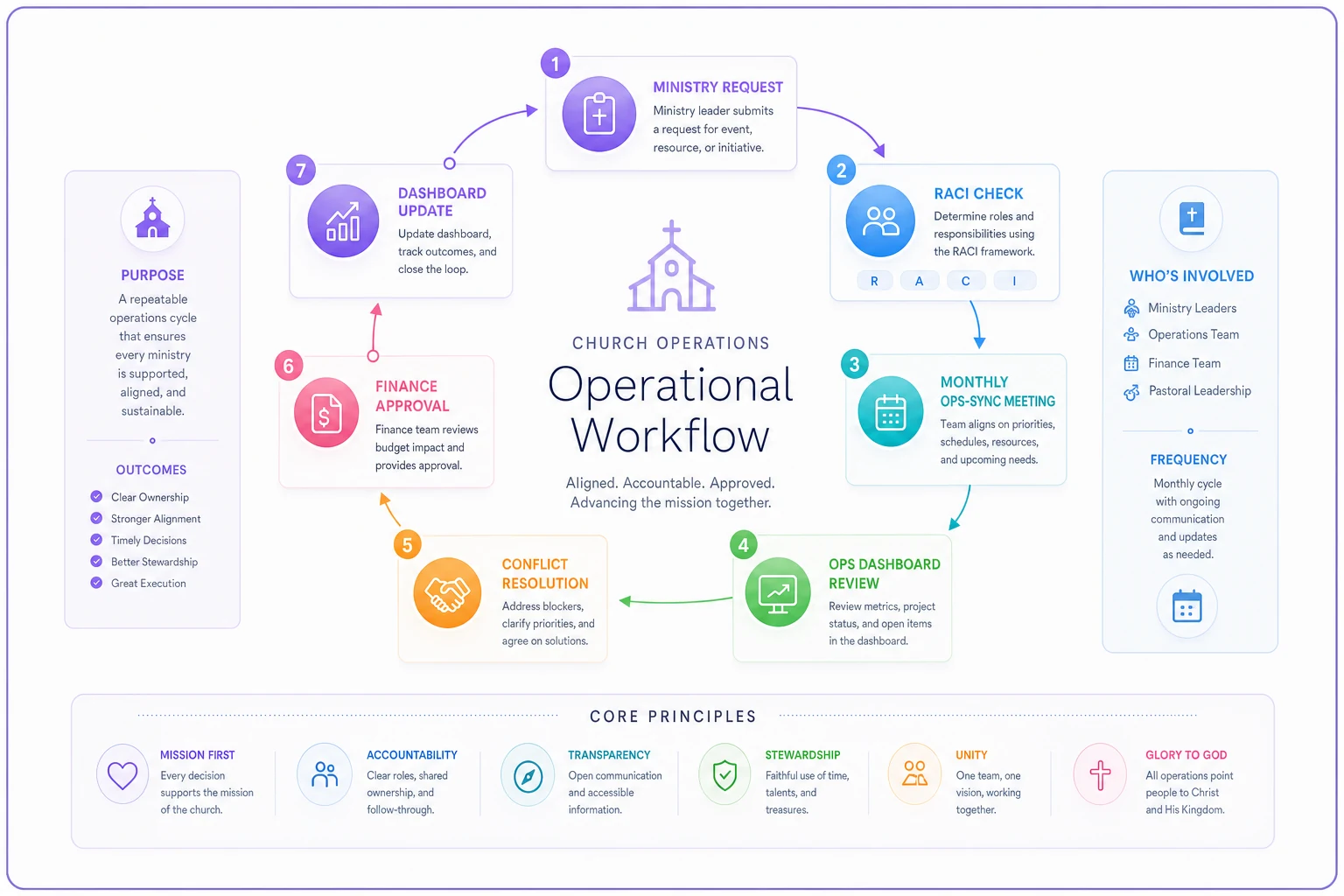
Walk it through end to end and the layer starts to make sense as a loop, not four separate tools. No collision. No surprise in November. No hallway argument three weeks later about who booked what. The whole thing resolved in one meeting because the structure was already there to catch it.
A real scenario
A multi-service church of roughly 500 people, four paid staff, kept hitting the same wall every fall. Missions, youth, and family ministries all launched fall programming in the same three-week window, all wanting the same two large rooms, and the budget lines quietly overlapped. The previous year they'd double-committed the fellowship hall, moved a youth event twice, and finished the fall about $4k over on shared supply spending nobody had reconciled against a single owner.
They put in a lightweight version of the layer above — a one-page matrix, a 40-minute monthly ops-sync, four written conflict rules, and a single-page dashboard the ops lead updated before each sync. Nothing fancy. The first fall under the new system, the room collisions surfaced in August at the sync instead of exploding in September. The supply overlap got caught at around 80% spend and got reallocated on purpose instead of by accident. They came in close to budget, and — the part the staff actually cared about — the fall planning season went from tense to boring. Fewer arguments. The tradeoffs happened out loud, in one room, on a rhythm.
Nothing about that outcome required more money or more staff. It required a place for the decisions to live.
When this makes sense — and when it doesn't
Build this when you have more than one or two paid staff, more than one service or campus, and you've watched the same category of cross-functional collision happen twice. Those are the conditions where proximity-based coordination has already quietly failed and you just haven't named it yet.
Skip it (for now) when you're small enough that everyone's still in the same conversations. A church of 60 that installs a formal RACI matrix is adding overhead it doesn't need and probably won't maintain. Governance should match the actual coordination cost, not aspire to look like a bigger organization.
Who should be careful with this: churches where one strong personality currently makes all the calls informally. This layer will feel like it's taking away their authority — and in a sense it is, by design, because informal single-point control is exactly what stops scaling around 300–400 people. Introduce it as protecting that leader's time and reducing hallway ambushes, not as a challenge to their role, or it'll get quietly killed.
Where the tools fit
You can run all four pieces on a shared spreadsheet and a recurring calendar invite. Plenty of churches do, and for a while that's genuinely enough. The place it starts to strain is keeping the dashboard current — because a one-page dashboard is only useful if the numbers behind it are live, and manually updating budget-versus-spent and open resource requests before every sync becomes its own chore that eventually gets skipped.
That's the practical reason churches eventually move this layer into an operations platform that already holds the calendar, the budgets, the volunteer rosters, and the ownership assignments in one place — so the dashboard reflects reality instead of someone's Tuesday-night data entry. AI-assisted operational tools can flag collisions automatically: the room double-book, the budget line crossing its threshold, the volunteer rostered on two teams at once — surfaced before the ops-sync instead of discovered during it. The point isn't the software, though. The point is the structure. Build the structure first on whatever you've got; move it into better tooling when the manual upkeep starts to cost more than the collisions did.
The real takeaway
The individual playbooks make each ministry run. The governance layer is what keeps those ministries from quietly undermining each other as you grow — and it's almost always the missing piece, because it's the one nobody owns until something breaks. Four small things: who decides, where tradeoffs surface, how conflicts resolve, and one page that shows the money against the commitments. Put those in place while things are calm, and the fall planning season, the budget crunch, and the room fights all get a lot less dramatic. Not because you got more resources — because you finally built somewhere for the decisions to live.
Ready to transform your church management?
Join 500+ churches using Parshly to enhance community engagement, streamline administration, and grow their ministries.