



Last Sunday's 11 AM service had twelve empty parking team positions. The week before, children's ministry turned parents away because too many volunteers showed up for the same shift. Sound familiar?
Most churches treat volunteer management like a weekly fire drill. You know the pattern: Thursday panic texts, guilt-based pulpit announcements, and that one reliable person covering three roles every Sunday morning.
The real problem isn't finding volunteers. Churches typically have plenty of willing people. The breakdown happens in capacity planning—understanding your actual needs, documenting clear expectations, building redundancy, and measuring what keeps volunteers engaged versus what quietly drives them away.
Why volunteer chaos scales with church growth
Small churches under 150 members often manage fine with informal coordination. The youth pastor knows everyone, volunteers text each other directly, gaps get covered through relationships. But somewhere around 200 regular attenders, this breaks down.
Suddenly you're managing 80–120 volunteer positions across weekend services. Add quarterly events, seasonal programs, and special services, and you're coordinating 200+ volunteer slots monthly. The informal system that worked at 100 members creates operational chaos at 300.
-
Communication breaks down between ministry areas
-
Volunteers get double-booked or forgotten
-
New attendees wait months before getting plugged in
-
Ministry leaders spend 15+ hours weekly on scheduling
-
Burnout accelerates because the same people cover everything
The larger issue: without a proper framework, every ministry operates its own volunteer island. Children's ministry doesn't know worship team is short on singers. The parking team doesn't realize greeters need help during second service. Resources get wasted while needs go unmet.
Capacity planning starts with actual data, not assumptions
Most churches guess at volunteer needs. "We probably need six greeters per service." But probably isn't planning.
Simplify your church’s day-to-day operations.
Parshly helps you organize events, track donations, and engage your congregation—all in one place.
- Centralized member management
- Donation tracking & reporting
- Volunteer scheduling & notifications
No credit card required
Start by documenting your actual positions across a typical month. Not what you wish you had—what you're actually filling. Track every role across every service and program for four weeks. Include setup, service time, and teardown positions.
A 250-person church running two Sunday services typically needs:
| Role | Positions per service |
|---|---|
| Worship/tech | 14–18 positions per service |
| Children's ministry | 12–16 positions per service |
| Guest services | 8–10 positions per service |
| Setup/teardown | 4–6 positions per service |
That's already 76–100 volunteer slots just for Sunday mornings. Add midweek programs, youth group, small groups, and you're easily managing 150–200 positions weekly.
What most churches miss is surge requirements. Christmas Eve might need triple your normal capacity. VBS week could require 60 additional volunteers. Community outreach events bring unpredictable spikes. Without documenting these patterns, you're planning blind.
This workflow shows a basic capacity-planning lifecycle: document positions, track for four weeks, and adjust for surges.
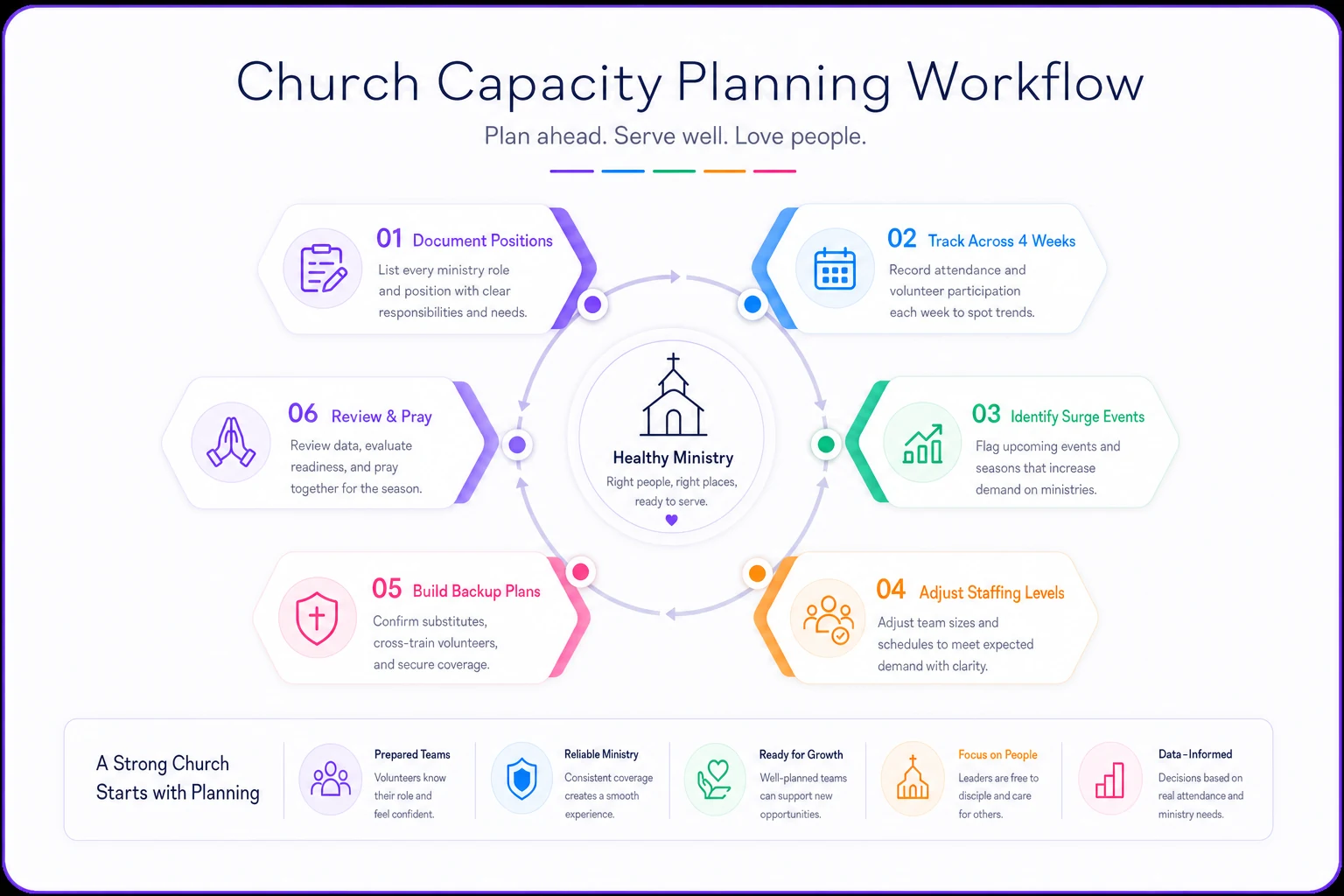
Christmas Eve might need triple your normal capacity. VBS week could require 60 additional volunteers. Community outreach events bring unpredictable spikes. Without documenting these patterns, you're planning blind.
Role descriptions prevent confusion and conflict
"Can you help with kids ministry?" isn't a role description. Neither is "we need someone on the tech team."
Every volunteer position needs five documented elements:
-
Primary responsibility (what success looks like)
-
Time commitment (including prep and cleanup)
-
Physical requirements (standing, lifting, stairs)
-
Training needed (and who provides it)
-
Who to contact with questions
A parking team role might specify: "Direct cars in Lot B, 8:15–9:00 AM, must be able to stand 45 minutes in weather, receive 30-minute training from Tom, text parking team lead with any issues."
Clear descriptions eliminate the biggest volunteer complaint: "I didn't know what I was signing up for."
They also help you match people appropriately. That eager new member with mobility challenges probably shouldn't be assigned to parking. The introverted database analyst might thrive running presentation software but struggle as a greeter. When roles are clearly defined, volunteers can self-select into positions that actually fit them.
Building redundancy without overstaffing
The typical church approach: minimum coverage with no backup plan. Then someone gets sick Saturday night and Sunday morning becomes a scramble.
Smart capacity planning builds in coverage ratios. For critical positions, maintain a 3:2 ratio—three trained volunteers for every two positions. For standard roles, 4:3 works. This creates natural rotation and prevents burnout while ensuring coverage.
Redundancy doesn't mean scheduling everyone every week. Create A/B teams that alternate weekends. Train floaters who can cover multiple positions. Identify which roles can absorb extra responsibilities in emergencies versus which ones absolutely cannot.
-
Lead teacher
Must have backup (critical role)
-
Assistant teachers
Can operate short one person
-
Check-in desk
Cannot operate short-staffed (safety protocol)
-
Craft coordinator
Can be absorbed by assistant if needed
Document which positions can run lean versus which ones compromise safety or experience when understaffed. This lets coordinators make informed decisions during shortages instead of panicking.
Measuring retention beyond attendance
Churches track worship attendance obsessively but rarely measure volunteer engagement. You need to know:
-
Average tenure per ministry area
-
No-show rates by position and person
-
Time from first visit to first volunteer role
-
Percentage serving in multiple areas
-
Exit patterns and stated reasons
A healthy church sees 30–40% of regular attenders serving in some capacity. New attender to volunteer conversion should happen within 3–6 months. Volunteer tenure should average 18+ months per role.
When volunteer tenure drops below 12 months, something's broken in that ministry area. Could be leadership, role design, appreciation gaps. You won't know without tracking.
Track no-show patterns too. If someone misses twice in six weeks, that's a yellow flag. Three times means someone should check in personally—not with guilt, but genuine concern. Often you'll find life circumstances you can actually help address.
The surge planning most churches skip
Every church knows Easter and Christmas Eve require extra volunteers. But most still scramble when these "surprise" events arrive.
Build surge calendars that identify high-demand periods 3–6 months out:
-
Holiday services (roughly 3x normal capacity)
-
VBS/camp weeks (60+ additional volunteers)
-
Community events (variable but significant)
-
Baptism Sundays (extra hospitality, setup, and celebration teams)
For each surge period, document:
-
Expected additional positions needed
-
Lead time for recruitment
-
Training requirements specific to the event
-
Post-event recovery period (when not to ask these volunteers for more)
That last one matters. If someone serves every night during VBS week, don't schedule them for the following Sunday. Build rest into the framework or watch burnout accelerate.
Technology solves coordination, not commitment
Volunteer management platforms with AI automation can dramatically reduce administrative burden. Automated scheduling, reminder texts, and shift swapping eliminate hours of manual coordination.
But technology won't fix fundamental framework problems. If you don't know your actual capacity needs, software just digitizes the chaos. If roles aren't clearly defined, automated scheduling creates automated confusion.
The right operational software helps by:
-
Centralizing all volunteer data and availability
-
Automating routine communications and reminders
-
Tracking serving history and identifying patterns
-
Flagging coverage gaps before they become crises
-
Measuring engagement metrics automatically
This lets ministry leaders focus on relationships and development instead of spreadsheet management. One church reduced volunteer coordination time from around 20 hours weekly to about 3 hours after implementing proper systems and AI-powered scheduling tools.
Common framework failures to avoid
The guilt recruitment trap: "We desperately need help" announcements might fill immediate gaps but create reluctant, short-term volunteers. Build from vision and purpose instead.
The super-volunteer dependency: When 20% of volunteers cover 80% of positions, you're one family relocation away from crisis. Intentionally develop broader participation.
The unclear handoff problem: When volunteers don't know who to contact about schedule changes, they just don't show up. Every volunteer needs one clear point of contact.
The appreciation assumption: Assuming volunteers feel valued without systematic appreciation leads to quiet exits. Build appreciation touchpoints into the framework—personal notes, public recognition, volunteer appreciation events.
The training shortcut: Throwing volunteers into positions without proper onboarding creates frustration and mistakes. Every role needs documented training, even the ones that seem simple.
Implementing the framework incrementally
Don't try to overhaul everything at once. Start with one ministry area—typically children's ministry since it has the highest safety and consistency requirements.
Month 1: Document current state
-
Map all positions and current volunteers
-
Track actual attendance and gaps
-
Note surge periods and pain points
Month 2: Define and communicate roles
-
Write clear position descriptions
-
Set coverage ratios
-
Identify backup procedures
Month 3: Build measurement systems
-
Start tracking key metrics
-
Implement basic scheduling tools
-
Create feedback channels
Month 4: Expand to another ministry area
-
Apply lessons learned
-
Maintain consistency in approach
-
Keep refining the first area
Start with children's ministry since its safety and consistency requirements make it an effective pilot area.
Within six months, core ministries should be operating under the framework. Within a year, the entire volunteer operation runs systematically instead of chaotically.
Creating sustainable volunteer culture
The best church volunteer management framework creates culture, not just coverage. Volunteers should feel like valued ministry partners, not free labor filling gaps.
This means:
-
Regular vision casting about kingdom impact
-
Clear pathways from attending to serving
-
Systematic appreciation and recognition
-
Investment in volunteer development and training
-
Flexibility when life circumstances change
-
Celebration of victories and milestones
When volunteers understand their role in the bigger picture, feel equipped for success, and know they're genuinely appreciated, retention follows naturally.
One church saw volunteer retention increase from 11 months average to 22 months after implementing a proper framework. Another reduced weekly coordination time by 75% while actually improving coverage rates.
The framework isn't about controlling people—it's about stewarding resources wisely and honoring the time people offer. When done right, it transforms volunteer coordination from a weekly scramble into something that actually sustains itself.
Your volunteers want to serve effectively. They want clarity about expectations. They want to know their contribution matters. A proper capacity-planning lifecycle delivers all three while dramatically reducing the administrative burden on staff. The Sunday scramble doesn't have to be your normal.
Ready to transform your church management?
Join 500+ churches using Parshly to enhance community engagement, streamline administration, and grow their ministries.