

The number that shows up on your livestream dashboard is almost never the number you should be reporting to your board. A Sunday stream can show "1,240 views" while the honest answer to "how many households worshiped with us online" might be closer to 300. That gap isn't a rounding error — it's the difference between a metric that helps you make decisions and one that quietly inflates every report you touch for the rest of the year.
Most churches never fix this because the platform hands them a big, flattering number and moving on feels easier than arguing with it. But if you're using online attendance to justify staffing, plan follow-up, or decide whether the second service still earns its keep, that inflated number costs you real decisions. Get the counting right first, then figure out who actually deserves a follow-up.
Why the platform number lies to you
Every streaming platform counts differently, and none of them count the way a pastor thinks about attendance.
YouTube counts a "view" after roughly 30 seconds. Facebook counts a view at 3 seconds, and a "1-minute view" separately. If someone scrolls past your stream in their feed and it auto-plays silently for four seconds, that's a view. Multiply that across a Sunday where your clip gets pushed into feeds, and your "attendance" balloons with people who never heard a word of the sermon.
Then there's the household problem running the opposite direction. A family of five watching on one TV counts as a single connection. So your platform simultaneously overcounts casual scrollers and undercounts real worshiping households. You can't fix one without a rule for the other, and most churches apply neither.
The third distortion is duplication. The same person watches ten minutes on their phone at 9:05, gets interrupted, then rejoins on the laptop at 9:40. That's two "viewers" in most dashboards. One person, two devices, counted twice. Across a congregation that regularly switches screens, this alone can pad your count by 15–25%.
Separate the two numbers you actually need
Before any de-duplication, decide what you're measuring. There are really only two numbers worth reporting, and confusing them is the root of most bad online attendance data.
Simplify your church’s day-to-day operations.
Parshly helps you organize events, track donations, and engage your congregation—all in one place.
- Centralized member management
- Donation tracking & reporting
- Volunteer scheduling & notifications
No credit card required
Reach is how many people the content touched at all — the scrollers, the 30-second samplers, the curious. It's a marketing number, useful for evaluating whether your clips are getting discovered.
Meaningful attendance is how many people genuinely worshiped with you. This is your ministry number, and it belongs in the same conversation as your in-person count.
The mistake that shows up constantly: churches report reach and call it attendance. Then the following year, when a platform algorithm change cuts feed distribution, "attendance" appears to collapse 40% — even though the same faithful households are still tuning in every week. Now you're explaining a crisis that never happened.
Here's a practical breakdown of how the same Sunday looks under different counting rules:
| Metric | What the platform shows | What it actually represents | Report as |
|---|---|---|---|
| Total views | 1,240 | Anyone who triggered the counter, incl. 3–30 sec | Reach only |
| Unique viewers | 640 | Distinct accounts/devices, still duplicated | Rough reach |
| 10+ min watchers | 410 | People who actually stayed a while | Attendance candidate |
| De-duplicated households | ~300 | Real worshiping units | Meaningful attendance |
The right-hand column is the only one that should sit next to your in-person number. Everything else is context.
Set an engagement threshold and stop guessing
A "view" is not attendance. You need a minimum watch time before a viewer counts as present — the same way you wouldn't count someone who stood in the parking lot for 90 seconds as attending the service.
A workable threshold for most churches is 10 continuous minutes, or watching through at least one identifiable segment of the service (worship set, sermon, communion). Ten minutes is long enough to filter out accidental autoplay and feed-scrollers, short enough that you're not punishing the parent who's half-watching while wrangling a toddler.
If your platform gives you watch-time buckets, this is straightforward — count the 10-minute-plus bucket. If it only gives raw views, use average view duration as a proxy. If average watch time is 4 minutes across 1,240 views, most of that number is noise, and your meaningful count is a fraction of it.
-
Live and replay count differently. Someone watching the replay Tuesday afternoon is engaged, but they're not part of Sunday's gathering. Track replays as a separate line so your Sunday number stays clean.
-
Set the threshold once and don't move it. The moment you adjust it mid-year, every trend comparison breaks. Pick 10 minutes, document it, leave it.
-
Chat and reactions are signal, not attendance. A comment confirms a real human, but don't inflate your count with reaction taps.
If your average view duration is far below your threshold, prioritize improving the first-minute experience rather than stretching definitions.
A few threshold rules that hold up in practice:
De-duplication tactics that actually work
You can't get to a clean household number from anonymous view data alone. But you can get close with a layered approach, and you can get precise for the people who identify themselves.
Layer one — device de-duplication. If your platform reports unique devices or accounts, start there instead of raw views. This kills the same-account-multiple-times problem but not the two-devices-one-person problem.
Layer two — the household divisor. This is the unglamorous fix nobody likes but everybody needs. Survey your online worshipers once or twice a year with a single question: "How many people typically watch on your screen?" If the average comes back around 1.8, apply a divisor to your device count to estimate households, or multiply to estimate souls, depending on what you're reporting. Yes, it's an estimate. It's still a far more honest estimate than pretending each device is one person.
Layer three — identified connections. The only way to truly de-duplicate is to know who's watching. When someone checks in through a form, uses a personalized link, or comments with a recognizable account, you can match them to a real record. Over a few weeks you build a roster of known online households, and your uncertainty shrinks to just the anonymous tail.
Here's the workflow that ties these together each week:
-
Pull the platform's unique-device or unique-account count, not total views.
-
Filter to viewers who crossed your 10-minute threshold.
-
Subtract known duplicates — the same person you can confirm on two devices.
-
Apply your household divisor from the most recent survey.
-
Add identified online check-ins that the platform undercounted (the family-on-one-TV cases).
-
Log the result as meaningful online attendance for that service, replay numbers kept separate.
This weekly workflow ties the layers into a repeatable process.
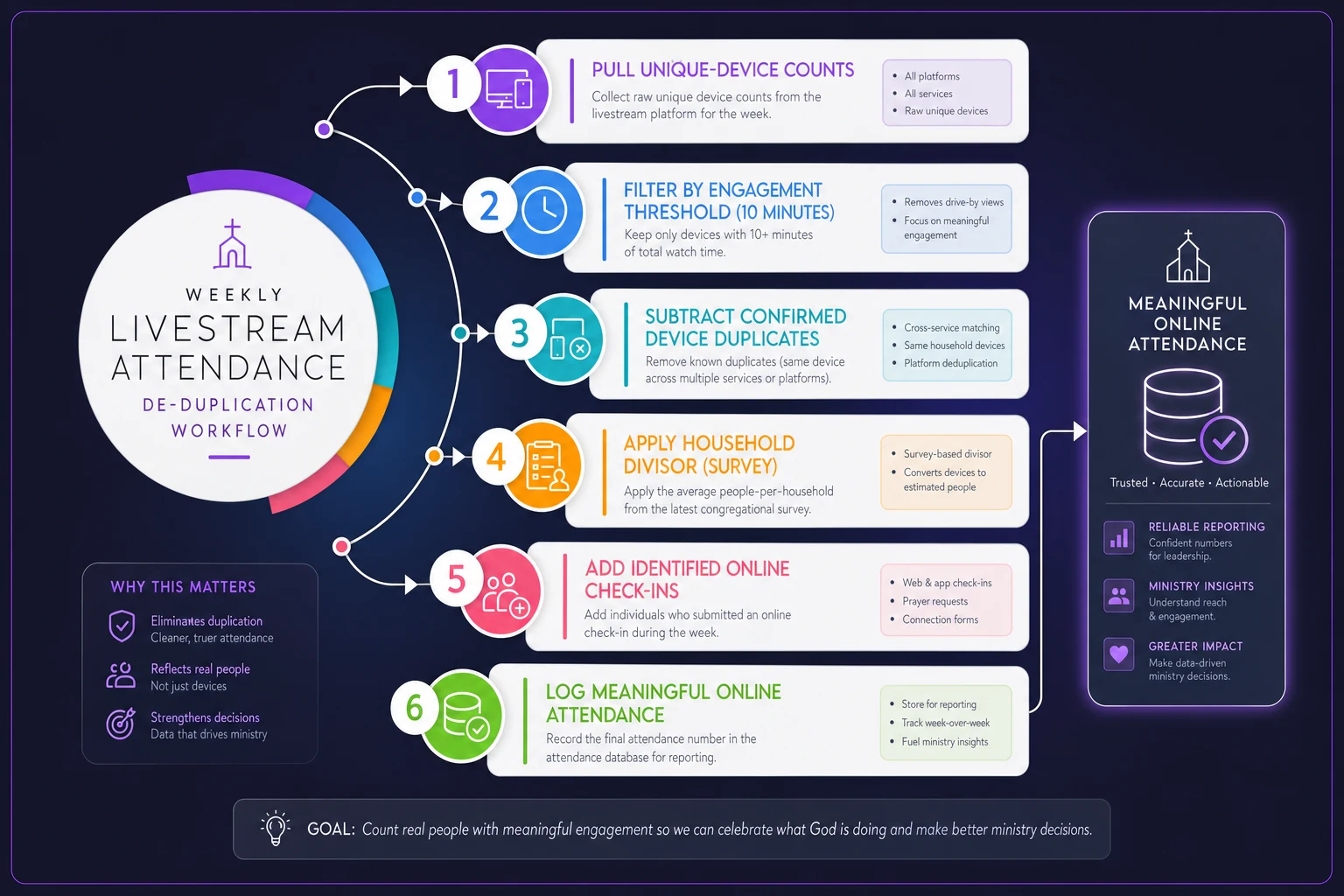
Run it the same way every week. Consistency matters more than perfection here — a slightly-off number applied identically every Sunday still gives you a trustworthy trend line, which is what you actually need for planning.
Tagging spectator types so follow-up isn't wasted
Once you can identify some of your online viewers, not all of them deserve the same response. Blasting the same "thanks for watching" email to a longtime member and a brand-new visitor makes both feel like a mailing list entry. Tag them.
Four spectator types cover almost everyone:
-
Known members watching remotely — traveling, sick, homebound, or new parents. These people don't need a "welcome" message; they need to feel still-connected. A wrong tag here reads as "you forgot who I am."
-
Regular online-only attenders — people whose entire relationship with your church is the stream. This group is easy to ignore because they never show up physically, and ignoring them is how you lose them.
-
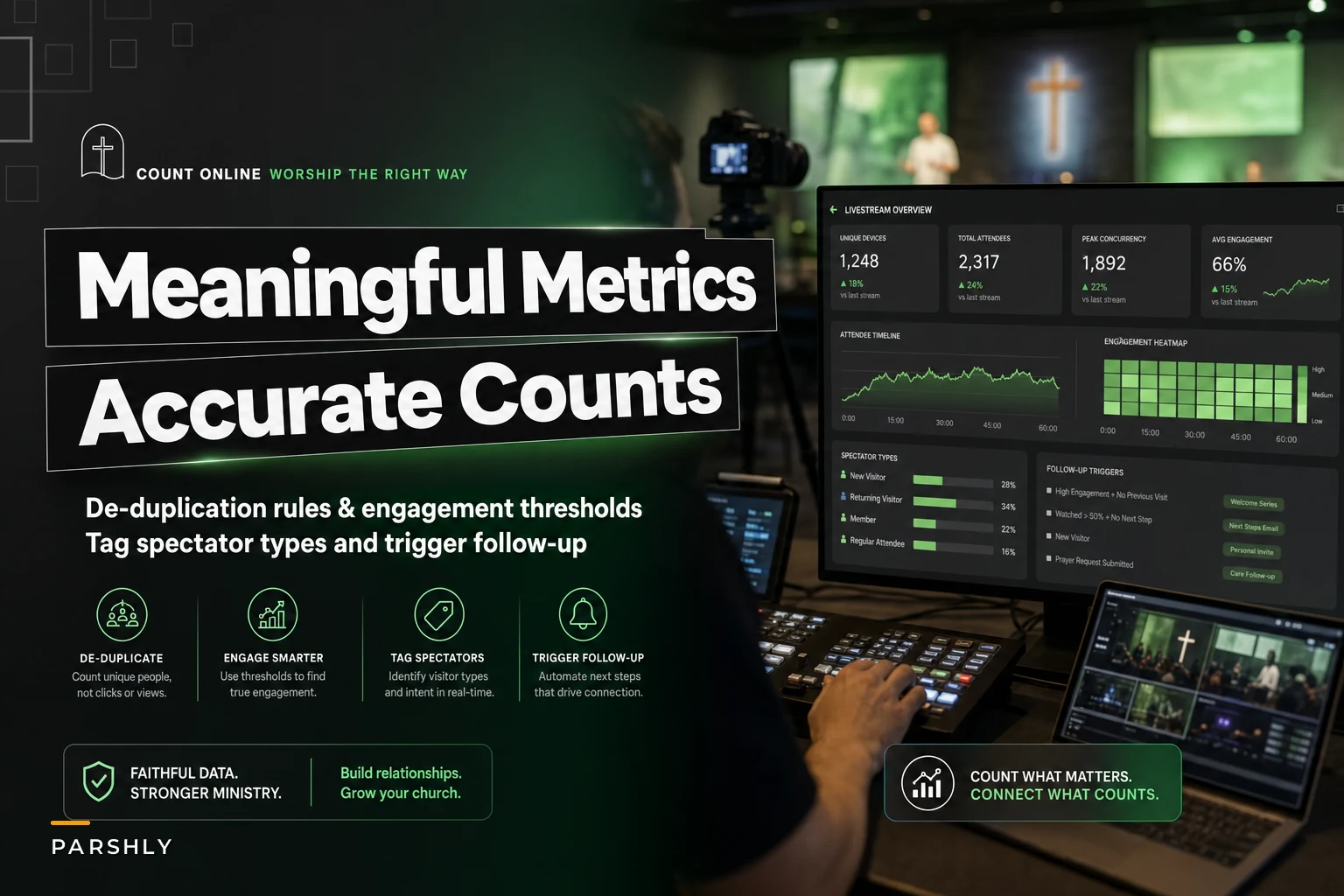
First-time online visitors — someone who found you this week. This is your highest-value follow-up, and it's exactly the group that slips away if you treat online and in-person visitors as separate universes. The same care you'd give an in-person guest applies here; the breakdown on keeping first-time visitors from slipping through the cracks works cleanly for online arrivals too.
-
Casual samplers — the 3-to-10-minute crowd. No follow-up needed. Tagging them at all just keeps them out of your other buckets so you don't accidentally chase people who watched four minutes and left.
The pattern worth noticing: most churches over-invest follow-up on casual samplers (because they're the biggest number) and under-invest on regular online-only attenders (because they're invisible). Worth flipping that instinct.
Follow-up triggers for high-engagement viewers
High engagement online should trigger the same kind of response a raised hand does in the room. The problem is you can't see the raised hand unless you've defined what counts as one.
Set specific triggers, not vibes:
-
Watched 30+ minutes and it's their first time → new-visitor welcome path, handed to whoever owns guest follow-up.
-
Commented with a prayer request or a question → same-week personal reply from a staff member or pastoral volunteer, not an automated thanks.
-
Online-only attender who's shown up 4+ weeks straight → an invitation to one real touchpoint: a next-steps call, a small group, a coffee if they're local.
-
Regular attender who suddenly watched online three weeks running → a gentle check-in. People often move to the stream right before they drift away entirely, and a "we've missed seeing you" note at week two or three catches drift you'd otherwise never notice.
That last trigger is the one almost nobody builds, and it's arguably the most pastorally valuable. Online attendance data isn't just a scorecard — it's an early-warning system for members quietly disengaging.
Keeping these triggers straight by hand gets unmanageable fast, which is where a church management platform earns its place. When check-ins, comments, and watch-time thresholds feed into one member record, the "watched three weeks in a row after months in-person" pattern surfaces automatically instead of relying on a staff member to remember. The tool isn't doing ministry — it's making sure the person who slipped from pew to screen doesn't slip past your notice entirely.
A real scenario
A mid-size church running one Sunday livestream had been reporting "about 900 online attenders" to their elders for two years, pulled straight from Facebook's view count. When they applied a 10-minute threshold and ran a household survey, the honest meaningful-attendance number landed around 240–260 households.
The elders' first reaction was disappointment. Then something more useful happened. With a real number, staff finally noticed that roughly 60 of those households were online-only attenders they'd never once contacted. A simple tagging pass and a next-step invitation over the following two months moved around a dozen of them into a small group or a first in-person visit. The inflated 900 had been hiding 60 real people who'd been faithfully showing up to a church that didn't know they existed.
Nothing about the audience changed. Only the counting did — and the counting is what let them see who to reach.
When precise online counting isn't worth it
If your stream is a low-priority overflow option and nobody makes decisions from the number, don't build an elaborate de-duplication process. A rough monthly reach figure is fine. Over-engineering a metric no one uses is just work.
But the moment online attendance touches a real decision — staffing a digital host, keeping a service time, reporting growth to a board — the flattering platform number becomes a liability. At that point, get it right, because those same numbers are going into reports people trust. The guide on board-ready dashboards will keep your online figures honest alongside everything else, and the lightweight tagging and metric approach for staff-light churches pairs well with the spectator tags above.
The one habit that fixes most of this
Pick your definitions once — your engagement threshold, your household divisor, your spectator tags, your follow-up triggers — write them down, and apply them the same way every single week. The exact numbers matter less than the consistency. A church that counts 260 households the same way every Sunday can trust its trend line and act on it. A church chasing whatever the platform shows this week is just reacting to an algorithm.
Get the counting honest, tag the people you can identify, and let genuine engagement — not raw views — decide who gets a follow-up. The reward isn't a prettier report. It's finally seeing the people who were worshiping with you all along, and reaching the ones who needed you to notice.
Get the counting honest, tag the people you can identify, and let genuine engagement — not raw views — decide who gets a follow-up. The reward isn't a prettier report. It's finally seeing the people who were worshiping with you all along, and reaching the ones who needed you to notice.
Ready to transform your church management?
Join 500+ churches using Parshly to enhance community engagement, streamline administration, and grow their ministries.