


Most churches don't have a volunteer problem. They have a volunteer system problem. The people are there — the willingness is there — but the machinery that moves someone from "I'd be open to helping" to "I show up every third Sunday and know exactly what to do" is either missing or held together by one heroic coordinator who remembers everything in her head.
When that coordinator burns out, moves, or takes a sabbatical, the whole thing wobbles. And it wobbles because nobody wrote down the rules. Who follows up with a new volunteer, and when? What does a role actually require? What happens when someone doesn't show? How do you decide whether to spend your limited energy on recruiting new people or keeping the ones you have?
That last question is the one almost nobody answers explicitly. And it's the one that quietly wastes the most money and goodwill. This post walks through the volunteer ecosystem as a connected system — acquire, activate, retain — and builds the decision rules and budget logic underneath each stage so leaders can actually prioritize.
Why the ecosystem breaks in the middle, not the ends
Ask a church where their volunteer struggles are and you'll usually hear "we can't get enough people." Recruitment gets the blame. But when you actually map the flow, the leak is almost never at the top.
The typical pattern: a church runs a big "serve" push in September, gets 40 sign-ups, and by November maybe 12 of those people are still active. The other 28 didn't quit because they hated it. They quit because nobody called them, they got scheduled for the wrong thing, they showed up to a team that didn't know they were coming, or they never got trained and felt useless. That's not an acquisition failure. That's an activation failure and a retention failure wearing an acquisition costume.
Recruitment is the most expensive and least durable lever you have. A new volunteer costs you sermon time, sign-up systems, onboarding energy, and a background check. A retained volunteer costs you a thank-you and a decent schedule. When your middle and back stages leak, you're pouring money into the top of a bucket with holes in the side.
So the real strategy question isn't "how do we get more people." It's "where in the pipeline is our biggest leak, and what rule fixes it."
Mapping the three stages to something you can actually run
The stages defined operationally — not as feelings, but as things that either happen or don't.
Simplify your church’s day-to-day operations.
Parshly helps you organize events, track donations, and engage your congregation—all in one place.
- Centralized member management
- Donation tracking & reporting
- Volunteer scheduling & notifications
No credit card required
Acquire — everything from awareness to a committed yes. Sign-up, first conversation, screening, background check where needed.
Activate — everything from that yes to a confident, independent first few shifts. Role clarity, micro-training, a first scheduled slot, a check-in after shift one.
Retain — everything after they're competent. Consistent scheduling, recognition, substitute coverage, and knowing when someone is drifting before they disappear.
The mistake is treating these as one blurry job owned by one person. In a healthy ecosystem, each stage has its own owner, its own artifacts, and its own success metric. Here's a way to see the whole thing at once:
| Stage | Owner | Core artifact | Success KPI | Most common failure |
|---|---|---|---|---|
| Acquire | Ministry lead + central coordinator | Role sheet + screening workflow | % of sign-ups reaching first shift | Sign-ups never get contacted |
| Activate | Team leader | Micro-training artifact + shift-one check-in | % completing 3 shifts | No training, thrown in cold |
| Retain | Team leader + coordinator | Substitute rules + recognition cadence | 90-day active rate | Bad scheduling, no coverage plan |
Notice the KPIs are stage-specific. "Total volunteers" tells you nothing about where you're bleeding. A church with 200 volunteers and a 40% activation rate is in worse shape than a church with 90 volunteers activating at 85%.
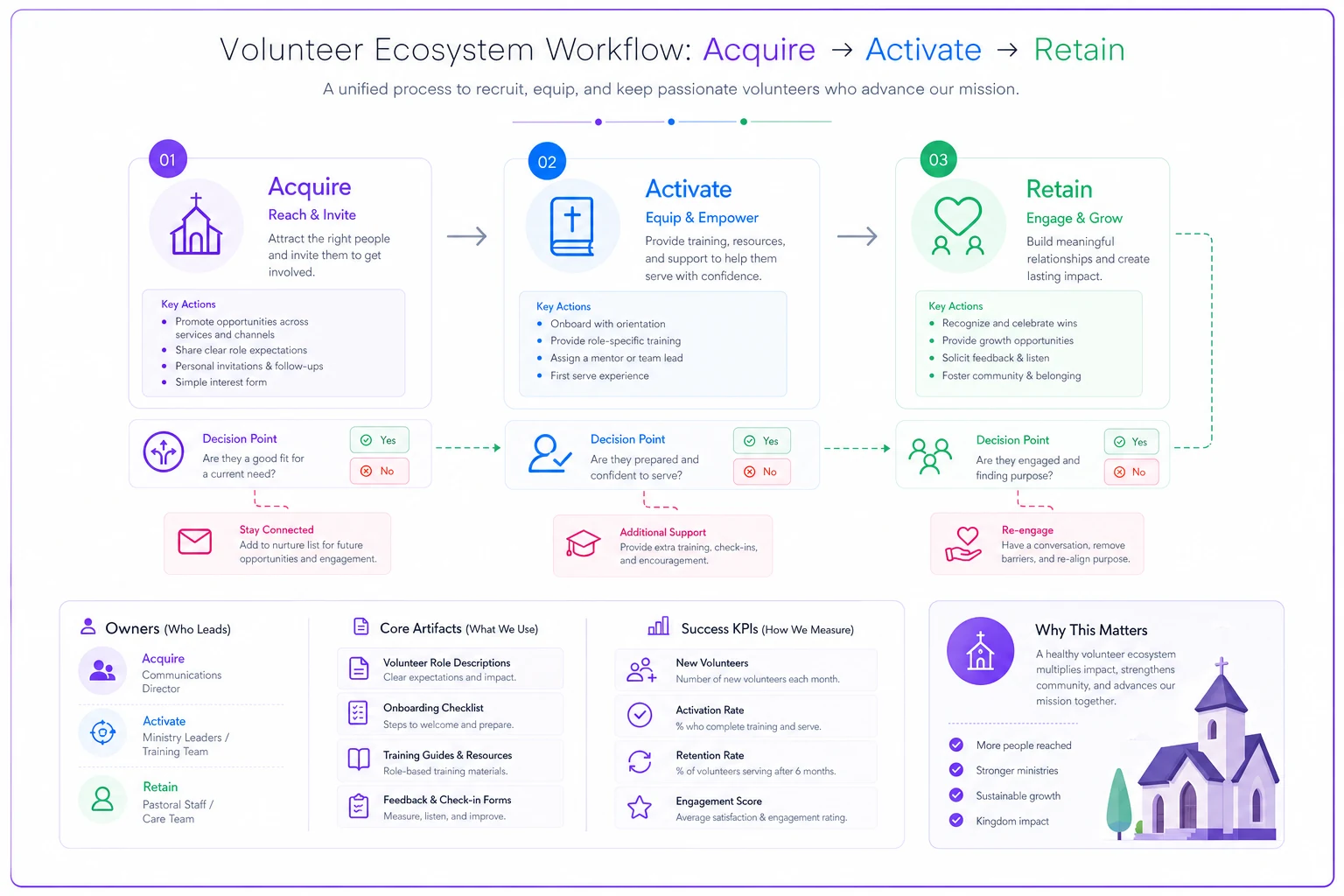
A simple diagram of the flow helps teams assign owners and spot leaks.
Here's a practical way to use those stage KPIs: map your current funnel, identify the biggest percent drop between stages, and prioritize rules that fix that stage's specific failures rather than more recruitment.
The role sheet: the artifact everything else hangs on
If you fix one thing this year, make it the role sheet. Almost every downstream problem — bad training, no-shows, awkward substitute scrambles — traces back to a role that was never actually defined.
A usable role sheet isn't a job description. It's operational. One page, and it answers:
-
What does this person physically do, step by step, during a shift?
-
What's the time commitment and frequency? (Every week? Every third week?)
-
What training or check does it require before shift one?
-
Who's their team lead and how do they reach them?
-
What's the minimum number of people needed for this role to function on a given Sunday?
That last line — the minimum staffing number — is the one people skip, and it's the one that makes your whole scheduling and substitute system possible. If you don't know that greeting needs four people and check-in needs three, you can't tell when you're understaffed until someone's standing at an empty door.
Writing real role sheets tends to surface something uncomfortable: churches have been recruiting for roles nobody defined, then wondering why people quit. Once the role is on paper, you can train to it, schedule to it, and measure against it.
Micro-training: stop building binders nobody reads
The activation stage lives or dies on training, and churches overcorrect in both directions. Some throw people in with zero prep. Others build a 40-page "volunteer handbook" that nobody opens.
What actually works is micro-training tied directly to the role sheet. A two-minute video showing the check-in tablet flow. A single laminated card with the three things a greeter should never skip. A five-line "your first Sunday" text that goes out the day before.
Training should be small, specific, and delivered at the moment of need — not a giant upfront dump. Someone volunteering for parking doesn't need the confidentiality policy. They need to know where cones go and what to do when the lot fills.
A practical pattern: each role gets three micro-artifacts.
-
Before shift one — a short "here's what to expect" (text or email, under a minute to consume).
-
During shift one — a physical cheat card or a shadowing partner.
-
After shift one — a quick check-in ("How'd it go? Anything confusing?").
Make the post-shift-one check-in a real human conversation—it's often the single highest-leverage retention move.
That third one is criminally underused. A real human asking a first-time volunteer how their first shift felt is probably the single highest-leverage retention move in the entire ecosystem. It costs nothing and catches the people who would otherwise silently ghost.
Substitute rules: the difference between a system and a group text
Nothing exposes a weak volunteer system faster than a Saturday-night cancellation. In most churches, the "substitute process" is a coordinator texting the whole team at 9pm and praying someone answers.
That works until it doesn't — and it stops working exactly when you grow, because more roles and more people mean more cancellations, and the mental load of coverage falls on one person who's now spending their Saturday nights doing triage.
A substitute rule replaces the panic with a defined order of operations:
-
Each role defines its minimum staffing (from the role sheet).
-
Each team has a named sub pool — people who've agreed to be "on call" for that specific role.
-
Swaps go to the sub pool first, in a set order, before the coordinator ever gets involved.
-
There's a cutoff time after which it escalates to the team lead, not the whole church.
The point isn't the specific rule — it's that the rule exists and doesn't require a human to improvise every time. This logic ties closely to how you handle predictable surges; the same thinking behind season-aware volunteer schedules with surge rules and shift-swap procedures applies here, just scaled up for holidays and high-traffic weekends. And if you're constantly firefighting last-minute gaps, that's usually a capacity-planning issue underneath — worth reading how a capacity-planning lifecycle prevents last-minute volunteer shortages before you start blaming individual no-shows.
The budget question nobody makes explicit
Every church has finite resources — money, staff hours, sermon minutes, the pastor's personal asks. The ecosystem strategy has to include rules for where those resources go across acquire, activate, and retain.
Most churches, without realizing it, spend nearly everything on acquisition. The big serve Sunday, the printed cards, the announcement time. Almost nothing goes to activation and retention because those don't feel like events — they feel like maintenance.
Flip that instinct. A simple allocation rule that works for a lot of mid-sized churches: if your 90-day retention is below 60%, freeze new recruitment pushes and put that energy into activation and retention until the number climbs. Recruiting into a leaky system just wastes the new people.
| Your situation | Where to put your limited energy |
|---|---|
| Plenty of sign-ups, low 3-shift completion | Activation: training + shift-one follow-up |
| Good active volunteers, but few new ones | Acquire: recruitment funnel, trial shifts |
| Solid onboarding, people fade at 6–9 months | Retain: recognition, scheduling quality, sub coverage |
| Chronic Sunday shortages despite enough people | Retain + scheduling rules, not more recruiting |
The recruitment side has its own leak point worth understanding — a lot of churches generate interest and then fail to convert it, which is really an activation-adjacent problem. The breakdown in why hospitality teams struggle to convert interest into volunteers with a trial-shift funnel is a good companion to this section, because a trial shift is essentially an acquisition tactic designed to reduce activation failure.
When a full ecosystem strategy makes sense — and when it doesn't
Not every church needs all of this formalized. Building rules and artifacts is work, and there's a real cost to over-engineering a system for a congregation of 80.
When it makes sense:
-
You've got more than roughly 50 active volunteer slots across ministries.
-
Multiple teams, multiple team leads, and coordination happening across them.
-
You're growing, or adding a second service or campus.
-
Your volunteer knowledge lives in one or two people's heads.
When it's overkill:
-
A small church where the same 15 people do everything and everyone knows everyone. Formal role sheets and sub pools add friction without solving a real problem yet.
Who should NOT start here:
If you have zero volunteer intake at all — no sign-up path, no way for a new person to say yes — fix that first. A retention system with nothing flowing into it is a solution looking for a problem.
The honest test: if losing your volunteer coordinator for a month would cause chaos, you need the system. If it wouldn't, you can probably wait.
A real scenario
A church running two Sunday services, roughly 120 active volunteers across kids, hospitality, and tech. Their coordinator was spending most of Saturday every week working the phones to fill Sunday gaps. Sign-ups from their spring serve push had been strong — around 45 new yeses — but by summer only about 15 were still serving.
When they mapped it, the leak was obvious: no role sheets, so training was inconsistent; no shift-one check-in, so new folks who had a rough first Sunday just never came back; and no sub pools, so every cancellation became a coordinator emergency.
They didn't recruit a single new person for two months. Instead they wrote role sheets for the eight most common roles, added a three-part micro-training pattern, and built named sub pools per team with a swap-first rule. The Saturday phone marathon dropped to a handful of texts. Their 90-day active rate on the next cohort of sign-ups came in noticeably higher — closer to two-thirds staying active instead of a third. Same recruitment effort, roughly double the durable volunteers, because they fixed the middle before adding more to the top.
Where software quietly earns its keep
You can run all of this on spreadsheets and sticky notes, and plenty of churches do. But there's a point where the coordination load — tracking who completed training, who's in which sub pool, who's drifting toward inactive, who hasn't been thanked in three months — outgrows what a person can hold in their head.
That's where AI-assisted operational tools actually earn their place in this space. Not flashy features, but taking repetitive coordination off your coordinator's plate. Automated shift-one check-in reminders. Flagging a volunteer who's missed three consecutive rotations before they fully disappear. Routing a cancellation to the sub pool in the right order instead of blasting the whole team. Surfacing which roles are chronically understaffed against their minimum.
These are the small, boring, constant tasks that eat human attention and quietly cause burnout — and they're exactly the tasks worth automating so your people can spend their energy on the relational parts no software can replace. The goal isn't to make the ecosystem feel corporate. It's to make sure a first-time greeter gets a warm text before their shift and an honest check-in after — every single time, whether or not one exhausted coordinator remembered to do it.
Bringing it together
A church volunteer ecosystem strategy isn't a recruiting campaign and it isn't a scheduling tool. It's a connected system where each stage — acquire, activate, retain — has a clear owner, a concrete artifact, a measurable outcome, and an explicit rule for how much of your limited energy it gets.
Get the role sheets right and training becomes possible. Get activation right and retention gets easier. Get retention right and you stop desperately recruiting. And when you make your budget-allocation rules explicit instead of accidental, you stop pouring resources into the top of a leaking bucket and start investing where it actually holds.
That shift — from heroics to rules — is what lets a volunteer program grow without depending on any single person remembering everything.
Ready to transform your church management?
Join 500+ churches using Parshly to enhance community engagement, streamline administration, and grow their ministries.