


You put a slide up during announcements. Someone waves the sign-up clipboard at the welcome desk. Twelve people write their names down. Two weeks later, you have maybe one new greeter — and honestly, you're not even sure they'll come back after their first Sunday.
That gap between "people who said yes" and "people actually standing at the door next month" is where hospitality volunteer recruitment quietly falls apart. And it's rarely because people don't want to serve. It's because the path from interest to committed volunteer is full of dead ends nobody designed on purpose.
This post is about fixing that specific gap — not recruiting more, but converting the interest you already generate into people who actually stick around.
The leak is almost always between "yes" and "first shift"
Interest capture usually works fine. Conversion is where everything dies.
Think about what a typical sign-up actually produces. A name. Maybe an email. Sometimes a phone number that's a digit off. Then there's a wait. The hospitality coordinator is busy, so follow-up happens "when they get to it." By the time someone reaches out, the person who signed up has emotionally moved on. The moment of willingness passed.
This happens because interest has a short shelf life. Someone feels moved on a Sunday, signs up on impulse, and that impulse decays fast. If the first meaningful next step happens more than a few days later, you've already lost most of the energy that made them raise their hand.
| Stage | What usually happens | Typical drop-off |
|---|---|---|
| Interest captured | Name on a list, vague contact info | — |
| First follow-up | Delayed 1–2 weeks, generic "thanks for your interest" | Big |
| Onboarding/training | Scheduled as a formal 90-minute meeting nobody can attend | Big |
| First actual shift | No shadow, thrown in cold, feels awkward | Medium |
| Second shift | Never scheduled, or scheduled a month out | Huge |
The two ugliest leaks are the delay after sign-up and the gap between the first and second shift. Most churches obsess over the top of the funnel — more slides, more announcements — when the actual problem is everything that happens after "yes."
Why the standard onboarding meeting quietly kills momentum
There's a specific mistake worth calling out: the formal orientation meeting.
Simplify your church’s day-to-day operations.
Parshly helps you organize events, track donations, and engage your congregation—all in one place.
- Centralized member management
- Donation tracking & reporting
- Volunteer scheduling & notifications
No credit card required
Someone signs up to be a greeter. The response is, "Great! We do volunteer orientation the first Tuesday of every month at 7 PM." You've just taken a low-commitment yes and immediately asked for a high-commitment weeknight. For a young parent, a shift worker, or anyone with a normal life, that's a wall.
The more formal the first ask, the lower the conversion. People will happily stand at a door for 30 minutes on a Sunday they're already attending. They will not easily give you a separate weeknight before they've even tried the role.
The fix isn't to skip training. It's to shrink it and move it into the environment where the person already is.
Micro-training beats orientation meetings
Instead of one long session, break training into small pieces a new greeter can absorb without a separate calendar commitment.
A greeter really needs to know a handful of things before their first shift:
-
Where to stand and when to arrive
-
How to hand off someone who has a real question (not fake it)
-
Where the bathrooms, nursery, and kids check-in are
-
What to do if someone shows up upset, lost, or in crisis
-
Who their point person is that morning
That's a five-minute conversation and a one-page sheet, not a 90-minute meeting. Everything else is learned by doing.
A practical micro-training approach:
-
Send a 2-minute welcome message within 24 hours of sign-up — a real message from the coordinator, not an automated "thanks."
-
Share a single one-page role sheet covering the essentials above.
-
Assign a specific first shift within 7–10 days, paired with an experienced greeter.
-
Do the "training" live during that first shift — shadowing is the training.
-
Follow up the same afternoon with a quick "how'd it feel?" check-in.
For hospitality roles, doing the job with a buddy is faster and stickier than any classroom-style onboarding. You're not teaching complex theology or handling money. You're teaching someone to be warm and point in the right direction.
The trial shift is the whole game
The single most effective conversion tool for hospitality volunteers is a trial shift — one low-pressure Sunday where the person shadows an experienced greeter and does the role with support.
It works because it removes the fear of the unknown. Most people who hesitate aren't unwilling — they're anxious. They don't know where to stand, worry they'll look awkward, or fear someone will ask a question they can't answer. A trial shift with a partner answers all of that in real time.
The trial also gives you information. Not everyone should be at the front door. Some people are wonderful but freeze up with strangers. The trial reveals fit without either side having to make an awkward commitment first. Framing matters: "Come try one Sunday with Marcus, no pressure, see if it's a fit" converts far better than "Will you commit to serving twice a month?"
One thing that gets overlooked — the pairing is critical. A trial shift with a warm, chatty veteran converts. A trial shift where the new person gets parked next to someone who ignores them converts almost nobody. Choose your buddy greeters deliberately.
Below is a simple view of how the funnel should flow once you tighten it up:
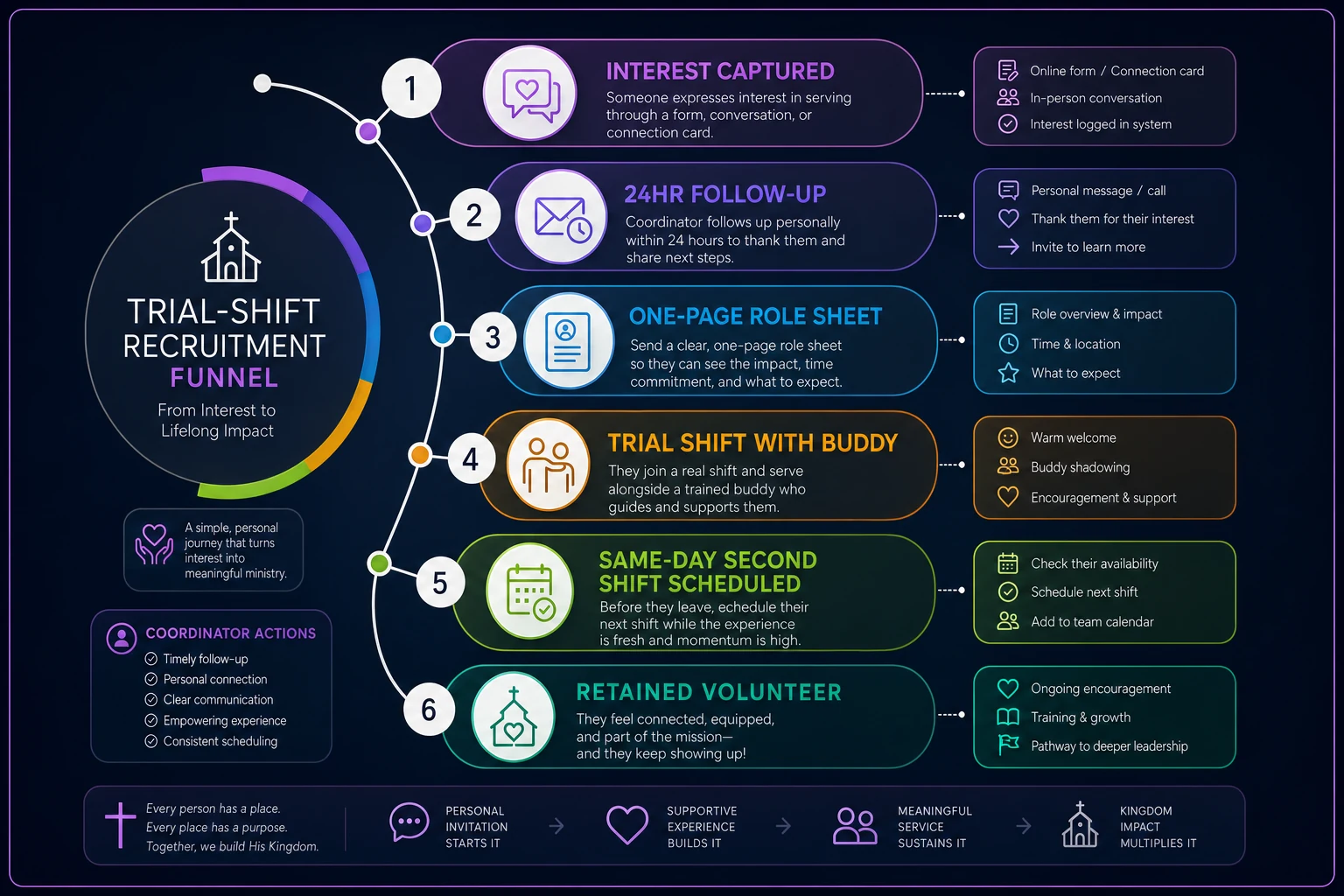
Use this funnel as your recruitment flow.
Where interest actually comes from (and what to do with each channel)
Not all outreach channels produce the same quality of interest, and treating them the same is a mistake.
-
Sunday announcement / stage mention — high volume, low intent. People sign up on emotion. These need fast follow-up or they evaporate.
-
Welcome desk clipboard — decent intent, but contact info is often incomplete. Confirm details on the spot.
-
Personal invite from an existing greeter — lower volume, dramatically higher conversion. A friend asking a friend beats every announcement.
-
New-member class — good timing, because people are already in a "getting involved" mindset.
-
Email/text broadcast — low intent unless tied to a specific, immediate need.
Personal invitations convert several times better than mass channels. If your existing greeters each personally invited one person a quarter, you'd likely outperform every announcement you make. So a smart move is spending less energy on broadcasting and more on equipping your current team to invite specific people by name.
A real scenario
A mid-sized church — around 350 in weekend attendance — had a hospitality team that felt permanently short. They'd collect roughly 8–10 sign-ups a month through announcements and the welcome desk but were only landing about one lasting volunteer per month. The coordinator was frustrated because "nobody wants to serve anymore."
The actual problem was timing and structure. Follow-up was taking 10–14 days, onboarding was a monthly evening meeting, and new people were often scheduled cold with no buddy.
They changed three things: follow-up within 24 hours, dropped the orientation meeting in favor of a one-page sheet plus a buddy trial shift, and scheduled that trial within about a week of sign-up. They also asked existing greeters to each invite one person by name that quarter.
Over the next couple of months, conversion moved from roughly 1 in 8 sign-ups to somewhere around 4 in 8 — not perfect, but a clear jump. The team stopped feeling short-staffed for the first time in a long while. Same interest volume. Different funnel.
Conversion metrics worth actually tracking
You can't fix a leak you can't see. But you don't need a dashboard with twenty numbers. Track a small set:
-
Sign-ups per month (top of funnel)
-
Time from sign-up to first contact (aim for under 48 hours — this is the killer metric)
-
Trial shifts scheduled vs. completed
-
Trial-to-second-shift conversion (the real health indicator)
-
90-day retention (are they still around three months later?)
If most of your loss is between sign-up and first contact, the fix is a faster response, not better recruiting. If most loss happens between the first and second shift, the fix is scheduling that second shift before they leave the building on trial day. Where the number drops tells you exactly what to change.
When this funnel makes sense — and when it doesn't
This approach fits churches that generate reasonable interest but can't seem to keep new hospitality volunteers. If people are saying yes and disappearing, this is your problem.
When it's not the right focus: if you genuinely aren't getting any interest — no sign-ups, no raised hands — the issue is upstream, in visibility and invitation, not conversion. A trial-shift funnel with nothing feeding it is just an empty pipe.
Who should skip the formal version of this: very small churches where the "team" is four people who all know each other. A structured funnel is overkill in that situation — a personal ask over coffee does the job. This matters most once you're large enough that new people can slip through the cracks unnoticed.
Where a little coordination structure helps
None of this requires fancy software to start — a spreadsheet and a committed coordinator can run it. But the piece that tends to break as you grow is follow-up timing. When sign-ups are scattered across a clipboard, a Sunday app, and someone's memory, the 48-hour window gets missed simply because nobody sees the new name in time.
Centralizing sign-ups and setting up simple automated reminders earns its keep here — capturing interest in one place, nudging the coordinator when a new person needs contact, flagging anyone who did a trial but never got scheduled for a second shift.
Use a shared spreadsheet or simple signup tool with a 'contacted' timestamp so the 48-hour follow-up window is obvious to the team.
The goal isn't to automate the human warmth; it's to make sure the human warmth actually reaches people before the window closes. An operational platform that handles interest capture and scheduling reminders removes the "I forgot to follow up" failure that quietly sinks so many hospitality teams.
The bottom line worth remembering
Your hospitality team is probably not failing to attract people. It's failing to catch them fast enough and give them a safe, low-pressure way to try the role before committing.
Shrink the first ask, respond within a day or two, pair new people with warm veterans for a trial shift, and schedule the second shift before they leave. Fix the conversion path and you'll be surprised how much of your "volunteer shortage" was really just a leaky funnel the whole time.
Your hospitality team is probably not failing to attract people. It's failing to catch them fast enough and give them a safe, low-pressure way to try the role before committing. Shrink the first ask, respond within a day or two, pair new people with warm veterans for a trial shift, and schedule the second shift before they leave. Fix the conversion path and you'll be surprised how much of your "volunteer shortage" was really just a leaky funnel the whole time.
Ready to transform your church management?
Join 500+ churches using Parshly to enhance community engagement, streamline administration, and grow their ministries.