


Most church boards don't have a decision problem. They have a decision timing problem. The same board that can approve a $40k roof repair in twelve minutes will spend three meetings circling a $6k youth program because nobody agreed, in advance, on what a "yes" even requires. Requests arrive whenever a staff member or ministry leader feels pressure. The board reacts. And by the end of the fiscal year, half the budget has been spent reactively on whoever asked loudest or most recently.
A real church board decision framework fixes the timing, not just the criteria. It tells everyone when decisions get made, what evidence has to be in the room, and what happens next — approve, pause, or scale. Without that rhythm, boards drift into two failure modes: rubber-stamping everything that sounds spiritually urgent, or freezing on anything that costs money. Both are governance failures dressed up as caution.
This article walks through how the whole system connects — the annual gate calendar, the portfolio scorecard, the board agenda templates, and the owner/cadence table that keeps it from collapsing back into ad-hoc requests three months after you build it.
Why boards default to reactive decisions
The root cause is almost always structural, not personal. Boards meet monthly or quarterly. Ministry needs don't respect that schedule. So a children's ministry leader who realizes in week two that she's short on curriculum budget can't wait seven weeks for the next meeting — she emails the chair, the chair loops in the treasurer, and suddenly a $2,300 decision gets made over text with no documentation and no comparison to the twelve other requests coming before year-end.
Multiply that across every ministry and you get what shows up constantly in small and mid-size churches: no two funding decisions are made the same way. One gets a full discussion. One gets approved because the person asking is well-liked. One gets denied because the meeting ran long. There's no consistency, which means there's no way to defend the decisions later when someone asks why their ministry got cut.
The part that surprises most leaders is that this gets worse as the church gets healthier. A struggling church has few requests. A growing church has a dozen ministries all demanding resources at once, and the board's informal "we'll figure it out" approach breaks under the volume. What worked at 120 people becomes chaos at 400.
The three gates: approve, pause, scale
Every funding or prioritization decision should pass through one of three gates. Not "yes/no" — that's too binary and it's why boards get stuck. The third option, "pause," is what keeps good ideas alive without committing money prematurely.
Simplify your church’s day-to-day operations.
Parshly helps you organize events, track donations, and engage your congregation—all in one place.
- Centralized member management
- Donation tracking & reporting
- Volunteer scheduling & notifications
No credit card required
-
Approve — the request has a clear owner, measurable outcome, and fits an existing strategic priority. Fund it, set a review date.
-
Pause — the idea has merit but is missing something
data, a leader, a defined outcome, or capacity. The board doesn't kill it; it sends it back with a specific list of what's needed to re-enter at the next gate.
-
Scale — an existing ministry has hit its review milestone and is performing. The board commits additional resources deliberately, rather than letting growth happen by accident.
The "pause" gate is the one most boards are missing, and it's the most valuable. It converts a political "no" into an operational "not yet, here's what we need." Nobody leaves the meeting feeling rejected. The ministry leader leaves with a checklist. That single reframe eliminates most of the resentment that builds up around budget decisions.
A 12-month gate calendar
Decisions need a schedule, or they revert to reactive within a quarter. The calendar below assumes a January–December fiscal year; shift the months to match yours. The goal is to concentrate major funding decisions into a few predictable windows so ministry leaders know exactly when to bring requests and when they'll hear back.
| Month | Gate Activity | Decision Type |
|---|---|---|
| January | Annual portfolio review — score every active ministry | Scale / Pause / Sunset |
| February | New initiative intake opens | Approve for pilot |
| March | Q1 pilot check-ins | Pause or continue |
| April | Mid-year budget reforecast | Reallocate funds |
| May | Spring/summer program gate | Approve seasonal spend |
| June | Mid-year portfolio scorecard | Scale decisions |
| July | Light month — review only, no new funding | — |
| August | Fall ministry launch gate | Approve / Pause |
| September | Q3 performance review | Scale or correct |
| October | Draft next-year budget from scorecard | Prioritization |
| November | Board approves annual budget | Approve |
| December | Year-end reconciliation, sunset decisions | Sunset / archive |
The point of the calendar isn't rigidity. Emergencies still get handled off-cycle. But when 90% of decisions happen on a known schedule, the off-cycle exceptions become rare and obvious — which is exactly what you want. If you're building this alongside your broader operating rhythm, it pairs naturally with a church annual operating rhythm and 12-month decision calendar so the board's gates line up with the staff's execution cycle instead of fighting it.
The ministry portfolio scorecard
You can't prioritize what you don't measure consistently. The scorecard turns "I feel like the men's ministry is struggling" into a comparable number the board can actually act on. Keep it simple — five dimensions, scored 1–5, is enough. More than that and nobody fills it out reliably.
Score each active ministry on:
-
Mission alignment — how directly does this serve the church's stated priorities?
-
Participation trend — growing, flat, or declining over the last two quarters?
-
Leadership health — is there a capable owner with a succession plan, or one tired volunteer holding it together?
-
Cost per outcome — roughly what does the ministry spend relative to the people it actually reaches?
-
Strategic fit — does it fill a gap, or does it duplicate something else?
A concrete example helps. A mid-size church scored its eleven ministries and found that the two consuming the most budget — a long-running Wednesday program costing roughly $9k–$11k a year and a music outreach near $7k — both scored low on participation trend and cost per outcome. Meanwhile a small grief-support group running on about $600 scored a perfect 5 on mission alignment and leadership health. Before the scorecard, the grief group had been quietly underfunded for two years because it never asked loudly. After, the board reallocated a few thousand dollars and set a scale review for June.
That's the whole point of scoring: it surfaces the quiet, effective ministries that reactive budgeting always starves. For a deeper build on the intake and scoring mechanics, the seasonal ministry prioritization framework with an intake form and scorecard covers how to collect inputs without burying leaders in paperwork.
Templated motions: how decisions actually get recorded
Here's a failure point boards rarely see coming. You build the gates, you build the scorecard, and then the actual motion — the thing that gets voted and recorded in the minutes — is still vague. "Motion to support the youth retreat." Support how much? For how long? Reviewed when?
> Motion to [approve / pause / scale] [ministry or initiative] at a funding level of [amount], owned by [name/role], with the target outcome of [measurable result], to be reviewed at the [date] gate.
The difference is significant when you read the minutes six months later. Instead of "approved youth retreat," you get "approved youth retreat at $4,500, owned by the youth director, target of 25 students attending, reviewed at the September gate." That's a motion you can actually hold someone accountable to. It also makes the next year's scorecard easier to fill out, because you already defined the outcome when you approved the spend.
Sample board agenda structure
A framework falls apart if the meeting agenda doesn't enforce it. Most church board agendas are organized by topic — Facilities, Finance, Missions — which invites endless discussion with no clear decision point. Organize by decision stage instead.
A working gate-month agenda looks like:
-
Opening and prayer (10 min)
-
Consent agenda — routine approvals batched into one vote (5 min)
-
Scorecard review — the one or two ministries up for scale/sunset this month (20 min)
-
New intake decisions — approve/pause using templated motions (25 min)
-
Paused items re-entering — did they bring what was asked for? (15 min)
-
Off-cycle exceptions — anything urgent that couldn't wait (10 min)
-
Owner confirmations and next gate preview (5 min)
The consent agenda is underused in churches and it's a quiet game-changer. Batching the dozen small, non-controversial approvals into a single vote frees up forty minutes for decisions that actually need deliberation. Boards that adopt it tend to cut meeting length by close to a third without deciding less.
For the reporting layer that feeds these agendas, lean on the work in board-ready dashboards and the minimal KPIs every small church needs so the board is reacting to the same numbers every month instead of whatever each leader chose to present.
The owner and cadence table
Decisions without owners are just opinions. This is where most frameworks quietly die — everyone agrees to the system in the meeting, then nobody is responsible for running it between meetings. Assign every piece of the framework a clear owner and a cadence.
| Component | Owner | Cadence |
|---|---|---|
| Intake collection | Administrator | Rolling, closes 2 weeks before gate |
| Scorecard scoring | Ministry leads + Board chair | Quarterly |
| Agenda prep | Board secretary | Monthly |
| Motion documentation | Secretary | Each meeting |
| Review date tracking | Administrator | Weekly check |
| Budget reconciliation | Treasurer | Monthly |
The weekly review-date check is the one people skip, and it's the one that keeps the whole system honest. Every approved motion carries a review date. Someone has to actually watch that calendar and pull the ministry back to the board when its date arrives — otherwise "reviewed in September" quietly becomes "never reviewed," and funded programs run on autopilot for years.
The weekly review-date check is the one people skip, and it's the one that keeps the whole system honest.
Every approved motion carries a review date. Someone has to actually watch that calendar and pull the ministry back to the board when its date arrives — otherwise "reviewed in September" quietly becomes "never reviewed," and funded programs run on autopilot for years.
Where the right tools quietly earn their place
Running this by hand works at small scale — a spreadsheet for the scorecard, a shared doc for intake, the secretary tracking review dates manually. It holds together until the volume climbs. Once you're managing a dozen ministries with staggered review dates, rolling intake, and mid-year reallocation decisions, the manual version starts dropping threads. A review date gets missed. An intake request sits in someone's inbox. The scorecard doesn't get updated before the gate.
This is where operational software with built-in automation stops being a luxury. Not because it makes the decisions — the board does that — but because it handles the tracking no human reliably maintains: flagging review dates before they lapse, routing intake requests to the right owner, pulling together scorecard data so the board sees current numbers instead of last quarter's. The decisions stay human; the follow-through stops depending on someone's memory. That's usually where boards feel the difference first — not in the voting, but in nothing falling through the cracks between votes.
When this framework makes sense — and when it doesn't
When it makes sense: You're running more than a handful of ministries, decisions are already feeling inconsistent, and at least one ministry has been funded (or starved) for reasons nobody can clearly explain. If budget conversations regularly run long or generate resentment, you're probably past due.
When it's overkill: A church plant with three ministries and a board of four doesn't need gate calendars and portfolio scorecards. You'd spend more time maintaining the framework than making decisions. Keep it to a shared doc and a monthly conversation until you actually feel the strain.
Who should NOT roll this out: A board that won't enforce review dates. The framework's whole value is accountability over time. If the culture is "approve it and forget it," building elaborate gates just creates documentation nobody reads. Fix the follow-through discipline first, even in a basic form, before layering structure on top.
A short real scenario
A congregation of around 350 had grown from six ministries to fourteen in four years without ever changing how it funded them. Budget meetings ran past three hours. Two ministries consumed nearly 60% of discretionary funds while three of the most effective ones scrambled for scraps. Leaders were burning out and some quietly resented the process.
They built the gate calendar and scored every ministry over one January weekend. The scoring surfaced two programs running at high cost with declining participation — together close to $18k a year, reaching fewer people each quarter. The board paused both at the next gate with a specific list of what each needed to re-enter. One came back stronger with a new leader; the other was sunset in December with clarity rather than a sudden cut.
The measurable shift wasn't dramatic spending savings — it was consistency. Budget meetings dropped to around ninety minutes. Every funding decision now had a written owner and review date. The quiet, effective ministries finally got funded on evidence instead of volume. Two leaders who'd been considering stepping down stayed, specifically because the process finally felt fair.
Bringing it together
The pieces only work as a system. The calendar sets when. The scorecard sets what evidence. The templated motions set what gets recorded. The agenda enforces it in the room. The owner/cadence table keeps it alive between meetings. Pull out any one piece and the whole thing drifts back toward reactive decisions within a quarter — usually faster.
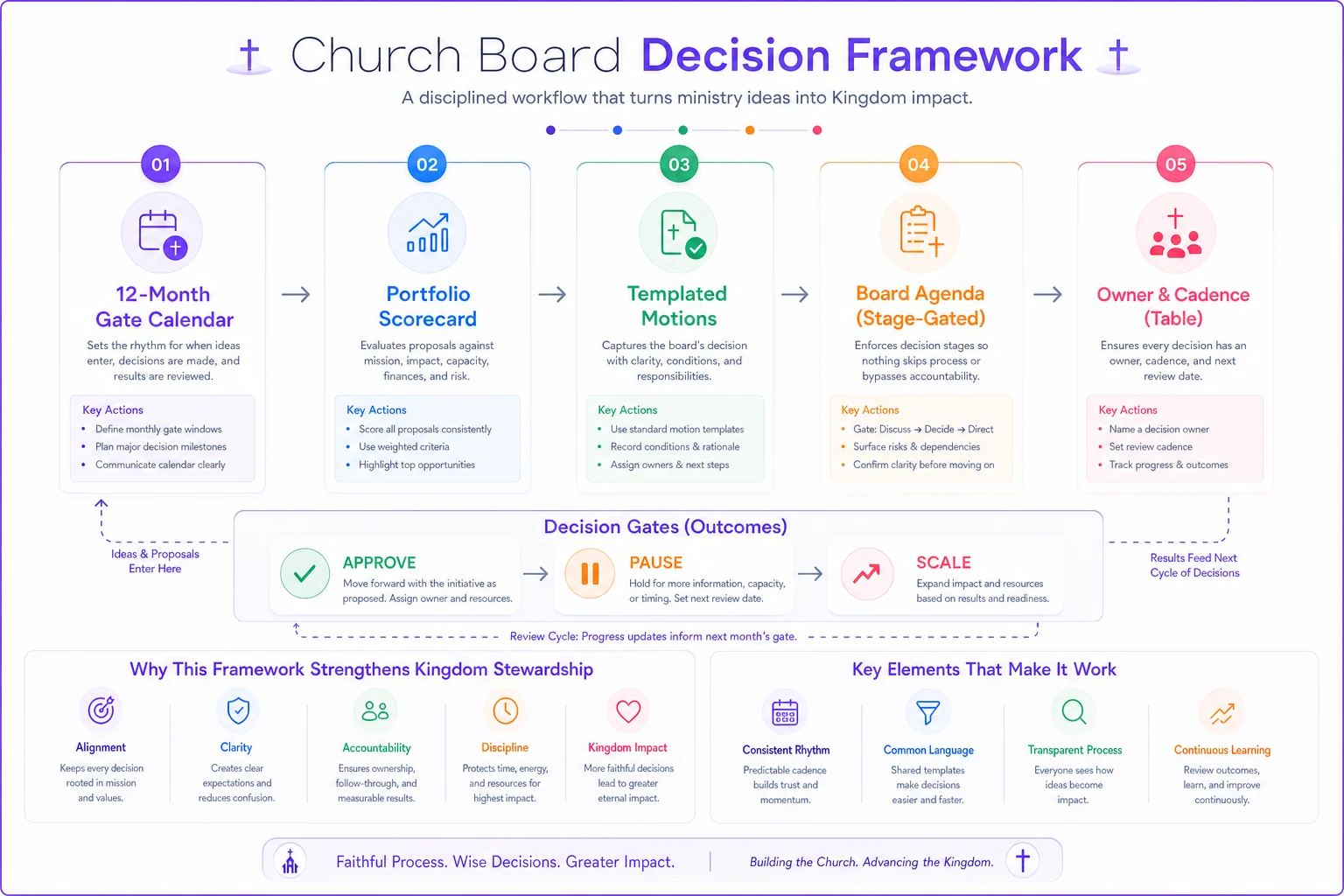
A visual summary of how the calendar, scorecard, motions, agenda, and owners connect.
The real shift a strong church board decision framework delivers isn't tighter budgets or shorter meetings, though you'll get both. It's that funding and prioritization stop being a test of who asks loudest and become a repeatable process the board can defend, improve, and hand to the next generation of leaders without starting from scratch.
That durability — surviving leadership turnover and congregational growth — is the whole point. Build it so the system outlasts the people who built it.
Ready to transform your church management?
Join 500+ churches using Parshly to enhance community engagement, streamline administration, and grow their ministries.