


Most small churches don't fail because the preaching is weak or the mission is unclear. They stall because nobody owns the connective tissue — the stuff between ministries, between Sundays, between the big ideas and whatever actually has to happen by Thursday at 5pm. The senior pastor is stretched across vision, counseling, and preaching. The office admin is buried in bulletins and facility requests. And somewhere in that gap, follow-up falls through, volunteers burn out quietly, and the same fire drills repeat every quarter.
A chief of staff role fixes this — but only if you build it as an operating system, not a title you hand to your most loyal volunteer. This is a blueprint for exactly that: a role spec, a 30/60/90 ramp, the KPIs this person should own, delegation templates, a hiring process that works for lean budgets, and the capacity signals that tell you whether your people are actually okay or just not complaining yet.
First, scale — because that's where most churches get this wrong.
When a Chief of Staff Actually Makes Sense (and When It's Premature)
The honest answer: you don't need a chief of staff until coordination becomes the bottleneck. That tends to happen at a predictable point — usually somewhere between 150 and 400 regular attenders, or whenever you've got more than four or five distinct ministry areas running simultaneously with volunteer leads who don't really talk to each other.
Below that threshold, the senior pastor can still hold most of the threads in his head. Above it, the mental load fractures. Decisions pile up. Nobody knows who approved the youth retreat budget. Two ministries book the fellowship hall on the same Saturday. The person who's been quietly running children's check-in for three years sends a resignation email that surprises everyone.
Here's a rough way to think about whether the timing is right:
| Signal | Probably Too Early | Right Timing | Overdue |
|---|---|---|---|
| Ministry areas | 1–2 | 4–6 | 7+ with no coordination |
| Weekly decisions bottlenecked on pastor | A handful | 15–25 | So many nothing gets decided |
| Volunteer turnover | Stable | Rising in 1–2 areas | Chronic across the board |
| Repeated fire drills | Rare | Monthly | Weekly |
| Staff paid roles | 1–2 | 2–4 | 3+ but still chaotic |
Who should NOT do this: churches under roughly 120 people with one or two ministries. At that size, a chief of staff is overhead you can't justify. What you actually need is a better operating rhythm and clearer ownership — which is a different problem. If that's where you are, start with the church annual operating rhythm and 12-month decision calendar instead. Get the cadence right before you add a person to manage it.
What This Role Actually Owns
The biggest mistake churches make is defining this role by activity ("helps the pastor," "oversees ministries") instead of outcomes. Vague scope is how a chief of staff turns into a glorified assistant within six months — reactive, buried in whatever landed in the inbox that morning, owning nothing measurable.
Simplify your church’s day-to-day operations.
Parshly helps you organize events, track donations, and engage your congregation—all in one place.
- Centralized member management
- Donation tracking & reporting
- Volunteer scheduling & notifications
No credit card required
A real chief of staff owns three things, and everything else is downstream of them:
-
Execution — decisions get made, communicated, and followed through. The gap between "we agreed to do this" and "this actually happened" closes.
-
Coordination — ministries, staff, and volunteers operate from shared information instead of siloed guesses. The right hand knows what the left is doing.
-
Stewardship of people — specifically volunteer capacity. This person watches the human side of the operation the way a treasurer watches money.
That third one is where small churches consistently underinvest, so we'll come back to it with real detail later.
A One-Page Role Spec You Can Adapt
Title: Chief of Staff (or Operations Director — the title matters less than the scope) Reports to: Senior Pastor
-
Weekly operating rhythm (staff meetings, decision log, ministry check-ins)
-
Cross-ministry coordination and calendar conflict resolution
-
Volunteer stewardship
capacity monitoring, onboarding quality, burnout prevention
-
Follow-through on board and leadership decisions
-
The operations dashboard and its honesty
Does NOT own:
-
Preaching, teaching, or primary pastoral care
-
Theological or doctrinal direction
-
Final budget authority (recommends; board/pastor approves)
Decision authority: Can approve operational spending up to an agreed threshold (many lean churches set this around $500–$750), can resolve scheduling conflicts without escalation, can reassign volunteer tasks within a ministry. Escalates anything touching money above threshold, staffing changes, or doctrine.
That "does NOT own" section isn't filler. It's what keeps the role from quietly absorbing responsibilities it shouldn't — and keeps the senior pastor from feeling displaced, which is a real relational dynamic that nobody in churches likes to name out loud.
The 30/60/90 Ramp
A new chief of staff who tries to fix everything in month one usually breaks trust and misses the actual problems. The ramp below front-loads listening and mapping before changing anything. People who slow down early consistently move faster later.
Days 1–30: Map the Real System
-
Sit in on every ministry's planning touchpoint at least once
-
Interview each volunteer lead for 30 minutes — one question matters most
"What's the thing that stresses you out every week that nobody's fixed?"
-
Document the current decision flow
who decides what, where things get stuck
-
Build an inventory of recurring events, their owners, and their known failure points
-
Do NOT reorganize anything yet
By day 30, this person should be able to draw the real operating map on a whiteboard — including the undocumented workarounds that actually hold things together.
Days 31–60: Install the Rhythm
-
Stand up a weekly staff/leadership operating meeting with a fixed, boring agenda (decisions pending, blockers, upcoming spikes)
-
Create a single decision log everyone can see — what was decided, by whom, when, and who owns follow-up
-
Pick 3–5 KPIs and start tracking them honestly, even if the first numbers are ugly
-
Standardize onboarding for new volunteers in the two highest-churn ministries
Much of this overlaps with how healthy churches run shared operations across teams. If you haven't structured that yet, the cross-functional church operations playbook pairs directly with this ramp — the chief of staff is essentially the person who runs that playbook day to day.
Days 61–90: Fix the Two Biggest Bottlenecks
-
Choose the two bottlenecks causing the most repeated pain (usually scheduling conflicts and volunteer follow-up in lean teams)
-
Redesign the workflow for each, document it, assign a clear owner
-
Set up the capacity signals (covered below) so burnout gets caught early
-
Review the KPI dashboard with the senior pastor and recalibrate targets
The outcome by day 90 isn't "everything is fixed." It's "we now have a nervous system — decisions flow, people are watched over, and we can see what's actually happening."
Here's a visual of the 30/60/90 ramp as a workflow.
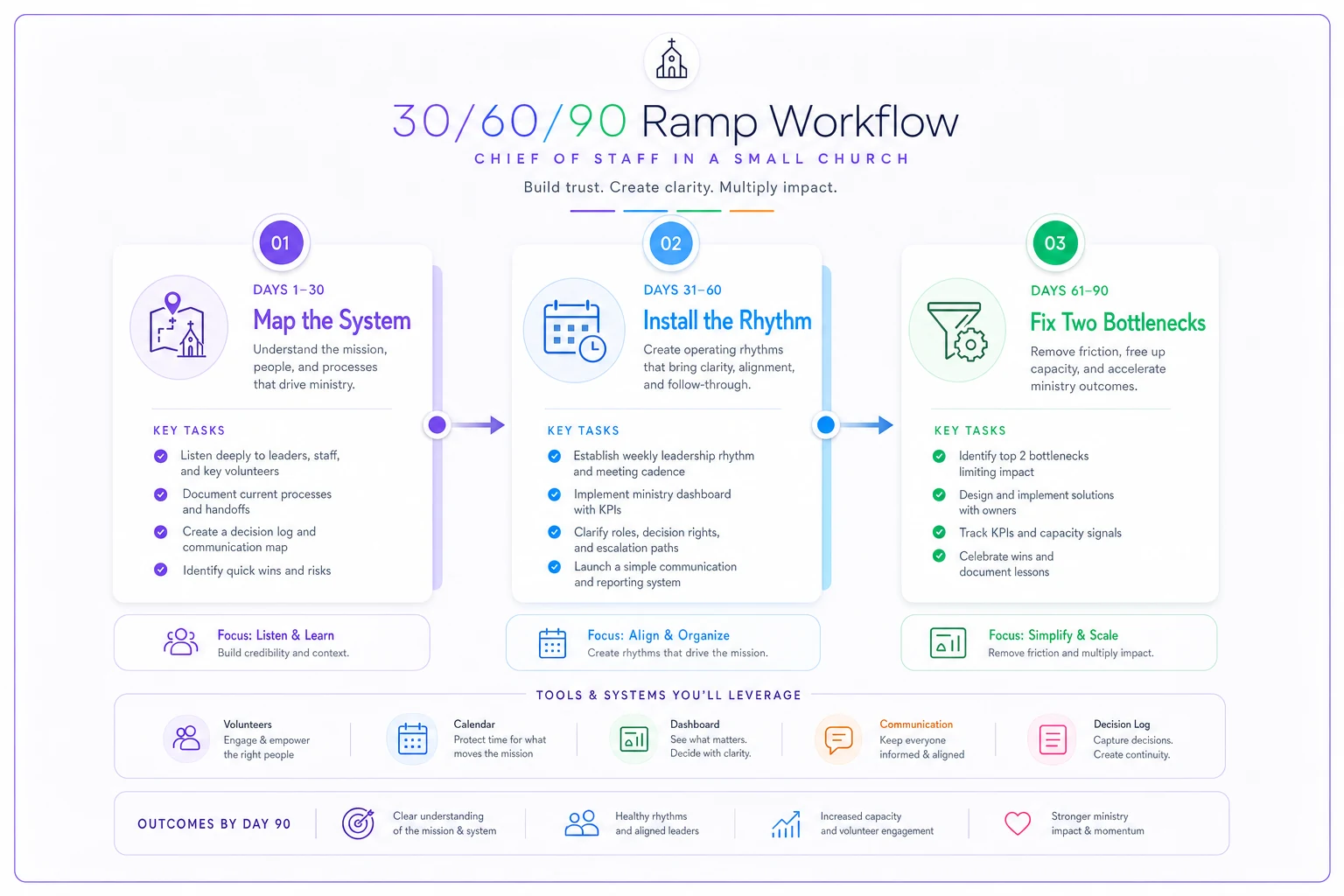
This shows how mapping, rhythm, and targeted fixes connect to create operating momentum.
The Ownerable KPI Dashboard
Dashboards fail in churches for one of two reasons: they measure attendance and giving (which leadership already watches) with nothing operational, or they track forty metrics nobody acts on. A chief of staff dashboard should be small, operational, and ownerable — meaning each number has one person accountable for it.
Here's a lean set that actually reflects operational health:
| KPI | What It Catches | Healthy Range (illustrative) |
|---|---|---|
| Volunteer fill rate | Unfilled serving slots before the weekend | 90%+ filled by Thursday |
| Decision cycle time | How long from raised to resolved | Most under 7 days |
| New volunteer 90-day retention | Onboarding quality | 70%+ still serving |
| Follow-up completion | Visitor and care follow-ups that actually closed | 85%+ within target window |
| Volunteer load concentration | How many people carry too much | No one on 3+ teams |
That last metric is the quiet killer. In a lot of small churches, roughly 20% of volunteers are doing 80% of the work, and a dashboard that only tracks "do we have enough volunteers" misses it entirely — right up until the overloaded 20% starts walking out the door.
Keep the dashboard to one screen. If it requires scrolling, nobody looks at it.
Volunteer Stewardship and Capacity Signals
This is the part most role specs skip entirely, and it's what separates a coordinator from an actual chief of staff.
Volunteer stewardship means treating your people's time and energy as a resource to be managed as carefully as money. In practice, that means watching for capacity trouble before someone resigns — because by the time you get the resignation email, you've already lost them, and usually you've lost the institutional knowledge they carried too.
Capacity Signals Worth Watching
-
Response latency — a reliable volunteer who used to reply within a day now takes four. Early fatigue signal.
-
Scope creep — someone quietly absorbing tasks outside their role because "it was easier to just do it." Feels helpful; it's a burnout accelerant.
-
Single points of failure — any ministry where one person leaving breaks everything. That's a stewardship failure waiting to happen.
-
Declining initiative — a lead who used to bring ideas now just executes. Often the first sign of disengagement.
-
Calendar collision frequency — when the same people keep getting double-booked, they're over-rostered, not flaky.
A chief of staff should review these monthly, not annually. And when a signal trips, the response isn't "recruit a replacement" — it's a conversation. Sometimes the fix is removing one responsibility, not finding one more warm body.
Review capacity signals monthly and treat trips as a conversation rather than an automatic recruitment trigger.
The deeper protection here is making sure no role is unrecoverable if the person leaves. That's its own discipline, and worth building deliberately — the succession and role-continuity playbook covers the one-page packets and ramp checklists that turn a sudden departure from a crisis into an inconvenience. Volunteer stewardship and succession planning are two sides of the same coin.
Delegation Templates That Actually Transfer Ownership
Delegation fails in churches because people hand off tasks without handing off decisions. "Can you run check-in?" without "you have authority to adjust the volunteer schedule and spend up to $50 on supplies" just creates someone who has to ask permission for everything — which is more work for everyone, not less.
-
The outcome — what good looks like, not the steps. ("Every child is checked in safely and parents feel welcomed," not "scan the tags.")
-
The authority — what they can decide and spend without asking.
-
The boundary — what must escalate. ("Any security concern, come to me immediately.")
-
The check-in — when and how you'll review, so nobody feels abandoned or micromanaged.
When you delegate this way, the chief of staff stops being a bottleneck and starts being a multiplier. When you delegate the old way — tasks without authority — the chief of staff becomes the person every decision routes through, which is exactly the problem the role was supposed to solve.
Hiring: Interview and Onboarding for a Lean Budget
Most small churches can't afford to get this hire wrong, and most can't afford a six-figure operations director either. The good news is the best candidates for this role are often already in your congregation — people with operational backgrounds from the business world who'd genuinely love to use those skills in ministry, often part-time or bivocationally.
Interview Checklist
-
"Tell me about a time you inherited a mess. What did you do first?" (Looking for: they mapped before they acted.)
-
"How do you handle a volunteer who's clearly overloaded but won't admit it?" (Looking for: stewardship instinct, not just scheduling logic.)
-
"Describe how you'd run a weekly meeting people don't dread." (Looking for: they understand rhythm and respect people's time.)
-
"When would you make a decision yourself versus bring it to the pastor?" (Looking for: judgment about authority and escalation.)
-
"What would you NOT change in your first 60 days?" (Looking for
restraint. The best answer is "a lot.")
Red flag: anyone who wants to reorganize everything in week one. That person will break trust faster than they build anything.
Onboarding Artifacts to Prepare Before Day One
-
The real org map (even if it's messy) and known pain points
-
A list of every volunteer lead with contact info and tenure
-
The recurring events calendar with owners
-
Current decision-making authority (who approves what, spending thresholds)
-
Access to systems, with the understanding that access gets reviewed
-
A written version of the role spec above, so expectations are mutual and on paper
Have these ready so the ramp actually works:
A Real Scenario
A church of around 280 regular attenders, three part-time paid staff, roughly 45 active volunteers. The symptoms were familiar: the senior pastor was spending somewhere around 12–15 hours a week on operational decisions, children's ministry had lost three volunteers in a single quarter, and the fellowship hall got double-booked twice in two months.
They brought on a part-time chief of staff — a congregation member with a logistics background, about 20 hours a week, roughly $18k–$22k annually. No big budget.
By the end of the 90-day ramp, a few things had shifted. The pastor's operational load dropped to around 4–5 hours a week — not because less was happening, but because decisions flowed through a log and a weekly rhythm instead of his phone. Children's ministry churn stopped once the capacity signals caught two overloaded volunteers early and redistributed their load. Calendar collisions essentially disappeared because one person now owned the master calendar.
The number that mattered most wasn't on any dashboard: the pastor said he had his Tuesdays back. That's the real return on this role.
Where This Goes Wrong
A few failure points worth naming, because they show up consistently:
-
The role has no authority. You hire a chief of staff but still route every decision through the pastor. Now you have two bottlenecks instead of one.
-
It becomes an assistant role. Scope drifts toward "whatever the pastor needs today," and the systemic work never happens.
-
The dashboard lies. Numbers get massaged to look good. A chief of staff who can't deliver uncomfortable honesty isn't doing the job.
-
Volunteer stewardship gets dropped first. When things get busy, capacity monitoring is the easiest thing to skip — and the most expensive thing to skip.
-
No succession thinking. You build the whole operation around this one person, and when they leave, everything you built leaves with them.
These are common enough that planning for them up front saves rebuilding later.
The Bottom Line
A chief of staff in a small church isn't a luxury hire or an org-chart vanity move. It's the person who turns a collection of ministries into an operating system — where decisions flow, volunteers are genuinely stewarded, and the senior pastor gets to be a pastor instead of a dispatcher.
Build the role around outcomes, give it real authority with clear boundaries, ramp it deliberately over 90 days, and measure the few things that actually reflect operational health. Do that, and you're not just adding a staff member — you're adding the connective tissue that lets everything else your church is trying to do actually hold together, through growth, through departures, and through the ordinary Thursday-afternoon chaos that quietly decides whether Sunday works.
Build the role around outcomes, give it real authority with clear boundaries, ramp it deliberately over 90 days, and measure the few things that actually reflect operational health. Do that, and you're not just adding a staff member — you're adding the connective tissue that lets everything else your church is trying to do actually hold together, through growth, through departures, and through the ordinary Thursday-afternoon chaos that quietly decides whether Sunday works.
Ready to transform your church management?
Join 500+ churches using Parshly to enhance community engagement, streamline administration, and grow their ministries.