

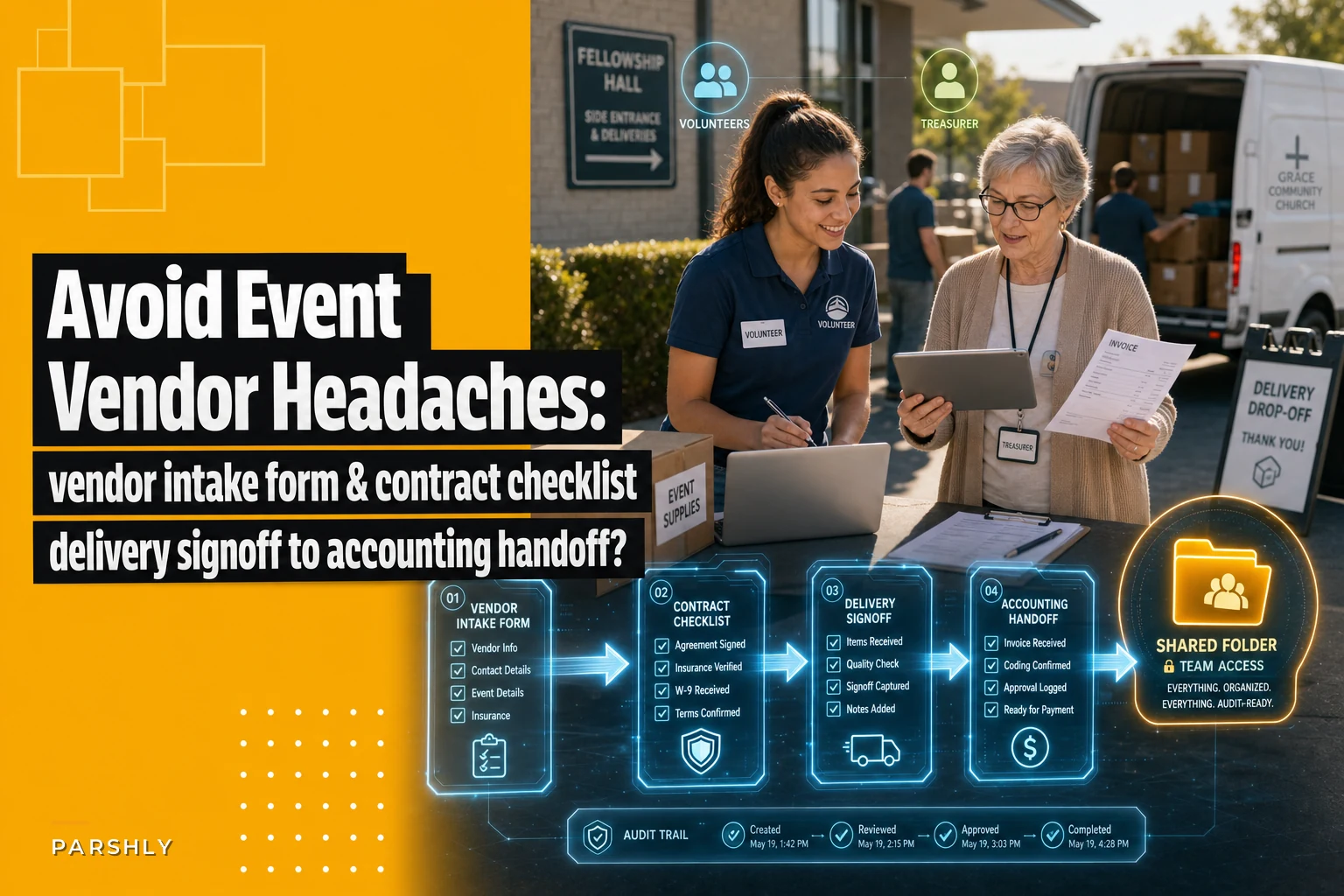

Most church vendor problems don't show up during planning. They show up at 7:45am on event day, when the rental company drops off 90 chairs instead of 150, and nobody on the setup team can find a single piece of paper saying what was actually ordered. The person who handled it is on vacation. The email thread is buried in someone's personal Gmail. And now you're on the phone with a vendor who is politely insisting you only paid for 90.
That gap — between "we talked to a vendor" and "we have something we can actually hold them to" — is where small churches bleed money, time, and goodwill. This post walks through a lean church vendor contract workflow built around four documents: a vendor intake form, a minimal contract checklist covering insurance and indemnity basics, a delivery acceptance signoff, and an accounting handoff template. Nothing fancy. Just enough structure to stop the recurring headaches without turning your volunteer event coordinator into a part-time procurement officer.
Where the money and the stress actually leak
If you trace a typical church event vendor problem backward, you almost always land on one of three failures:
-
Nobody wrote down what was agreed to, so there's no reference when reality doesn't match expectations.
-
The vendor's insurance was never verified, so a slip-and-fall or property damage incident becomes the church's problem.
-
Payment got approved before anyone confirmed the goods or service actually showed up as promised.
These aren't exotic. A fall festival with six vendors — a caterer, a rental company, a face painter, a petting zoo, a photographer, and a food truck — can hit all three in a single Saturday. And because church events run on volunteer energy and borrowed time, the person booking the petting zoo is often not the person who signs the check, who is not the person standing at the loading dock at 8am.
The intake form, contract checklist, and signoff don't exist to make things bureaucratic. They exist so that three different people, on three different days, are all working from the same facts.
The vendor intake form: capture it once, at first contact
The single most useful habit you can build is capturing vendor details the moment someone decides to use a vendor — not two weeks later when you're chasing a W-9. The intake form is deliberately short. If it takes more than five minutes to fill out, volunteers will skip it.
Simplify your church’s day-to-day operations.
Parshly helps you organize events, track donations, and engage your congregation—all in one place.
- Centralized member management
- Donation tracking & reporting
- Volunteer scheduling & notifications
No credit card required
If it takes more than five minutes to fill out, volunteers will skip it.
Here's what belongs on it:
Vendor basics
-
Legal business name (not just "Dave's BBQ" — the name on the invoice)
-
Contact name, cell phone, and email
-
Website or social handle (surprisingly useful for verifying a real business)
What you're buying
-
Description of goods/services in plain language
-
Quantity and specifics (150 white chairs, 10 six-foot tables, delivery + pickup)
-
Agreed price, deposit amount, and balance due date
-
Setup/delivery window and teardown/pickup window
Payment and tax
-
W-9 on file? (yes/no — this matters at year-end for 1099s)
-
Payment method and who approves it
-
Deposit paid? Date and amount
Risk flags
-
Do they bring equipment onto church property? (tents, generators, inflatables, cooking equipment)
-
Do they interact directly with children or vulnerable adults?
-
Certificate of insurance received? (yes/no/date)
That last block is what separates a real church vendor contract workflow from a glorified contact list. The risk flags tell you which vendors need a closer look and which ones you can wave through.
One pattern worth noting: the vendors who cause the most trouble are rarely the big catering company with a standard contract. It's the small, informal, cash-friendly vendor — the friend-of-a-congregant who does bounce houses on weekends — who shows up with no insurance, no written terms, and a generator running next to a tent full of kids. The intake form's job is to make sure those vendors get the same two minutes of scrutiny as everyone else.
A minimal contract checklist: insurance and indemnity without a lawyer on retainer
Small churches don't need a 12-page master services agreement for a taco truck. But "no contract at all" is how you end up liable when something goes wrong. The goal is a minimum viable contract — enough to establish who's responsible for what.
For most church events, you want written confirmation of these items. A signed email counts. A formal one-page agreement is better.
| Contract element | Why it matters | Minimum you need |
|---|---|---|
| Scope & price | Prevents "that wasn't included" disputes | Written list of what's delivered + total cost |
| Payment terms | Protects against surprise balances | Deposit %, balance due date, refund terms |
| Cancellation policy | Weather and low attendance happen | What you're refunded if you cancel X days out |
| Certificate of Insurance (COI) | Shifts liability for vendor-caused harm | General liability, usually $1M per occurrence |
| Additional insured | Extends their coverage to the church | Church named as "additional insured" on their COI |
| Indemnity / hold-harmless | Vendor takes responsibility for their own negligence | One clause stating vendor indemnifies the church |
| Certificate holder | Ensures you get notified of changes | Church listed as certificate holder |
A few things worth understanding, because they're where churches consistently get tripped up:
The COI and "additional insured" are not the same thing. A vendor can hand you a certificate of insurance proving they have coverage. That's good. But it only protects the church if you're named as an additional insured on their policy — which extends their liability coverage to you for claims arising from their work. Ask for both. Reputable vendors do this all the time and can usually have their agent email an updated COI within a day or two.
Indemnity language doesn't have to be scary. A single sentence works: "Vendor agrees to indemnify and hold harmless [Church Name], its staff, and volunteers from any claims, damages, or liabilities arising from Vendor's negligence or performance under this agreement." That one line shifts baseline responsibility back to the party who caused the problem.
Match the insurance requirement to the risk. A photographer with a camera needs less scrutiny than an inflatable company anchoring a 20-foot slide in your parking lot. For anything involving fire, electricity, heights, heavy equipment, vehicles, or direct contact with kids, the COI and additional-insured status are non-negotiable. For lower-risk vendors, you can be more flexible — but still get the scope and payment terms in writing.
When a formal contract genuinely isn't worth it
If you're paying a congregant $75 to run a coffee station using the church's own supplies, you don't need indemnity clauses. Over-engineering low-stakes relationships just teaches volunteers to ignore the whole process. Save the full checklist for vendors who (a) bring their own equipment, (b) operate near children, or (c) you're paying more than a few hundred dollars.
Delivery acceptance signoff: the step everyone skips
This is the part that quietly causes the most financial leakage. The vendor delivers. Someone from the church is standing there. But nobody formally confirms that what arrived matches what was ordered — and no record is made before the balance gets paid.
The delivery acceptance signoff fixes this with about ninety seconds of work at drop-off. It lives on one page (or your phone) and gets completed by whoever is physically receiving the goods or service.
The signoff should capture:
-
Vendor name and event date
-
What was ordered (pulled straight from the intake form)
-
What actually arrived (counts, condition, completeness)
-
Discrepancies (short on chairs, damaged table, late by 90 minutes)
-
Receiver's name and signature
-
Photo evidence for anything damaged or short
This matters for two reasons. First, it creates a timestamped record before the final payment goes out, which gives you real leverage in a dispute. Second, it moves the "did we get what we paid for?" decision to the person who can actually see the delivery — not the treasurer approving an invoice three days later with no idea whether 150 chairs actually showed up.
A realistic failure mode: the setup volunteer notices the rental company only delivered 8 tables instead of 10, mentions it to someone, and then the event swallows the moment. Two weeks later the full invoice gets paid because nobody remembers the shortfall and there's no record. That's $40–$60 gone, quietly, per event. Across a full year of events, a church running this loosely loses a few hundred dollars to unrecorded shortfalls and damaged-item disputes it can't win — plus the harder-to-measure cost of vendors who learn the church doesn't check.
The signoff isn't about distrust. Good vendors want discrepancies noted at delivery, because it protects them too — it proves the issue existed at drop-off and wasn't caused by the church afterward.
The accounting handoff: close the loop so finance isn't guessing
The last document is the bridge between the event team and whoever keeps the books. Without it, the treasurer gets an invoice with no context and has to reverse-engineer whether it should be paid, from which budget line, and whether the goods actually arrived.
A clean handoff template includes:
-
Vendor legal name and W-9 status (critical for 1099 tracking at year-end)
-
Event name and date
-
Total agreed cost, deposit already paid, and balance due
-
Budget line / ministry to charge
-
Delivery signoff attached? (yes/no — this is the payment gate)
-
Approved by (the person authorized to greenlight payment)
-
Any discrepancies to resolve before full payment
The rule that makes this work: no balance payment without an attached delivery signoff. That single gate prevents the most common and most expensive mistake — paying in full for something that arrived short, late, or damaged. It's the same control discipline that protects churches on the income side, where an end-to-end secure donation workflow keeps giving from being misrecorded or misallocated. Vendor payments deserve the same "verify before you post" rigor.
For multi-vendor events especially, this handoff prevents the budget from quietly blowing up. If you're coordinating vendors across more than one site, the logistics get even messier — the multi-site event logistics playbook pairs naturally with this, because a vendor delivering to the wrong campus is its own special headache.
A real scenario: the fall festival that stopped leaking money
A church of roughly 220 attendees ran an annual fall festival with six to seven vendors each year. For a long time, their process was a shared Google Doc and a lot of texting. Two recurring problems: they paid full invoices on a couple of occasions where deliveries came up short, and one year their inflatable vendor had no liability coverage — which only surfaced when the church's own insurer asked for the COI after a minor injury claim.
They didn't buy software or hire anyone. They built the four documents above into a single shared folder per event: intake form, contract checklist, delivery signoff, accounting handoff. The treasurer set one rule — no balance paid without a completed signoff attached.
The first year with the new workflow, two shortfalls got caught at delivery (about $110 in rental chairs and a damaged table), the inflatable vendor was required to provide a COI naming the church as additional insured before booking confirmed, and the year-end 1099 process took an afternoon instead of a frantic week because every vendor's W-9 status was already recorded at intake. No dramatic transformation — just steady, boring reliability, which is exactly what you want from vendor management.
Where the paperwork quietly becomes a system
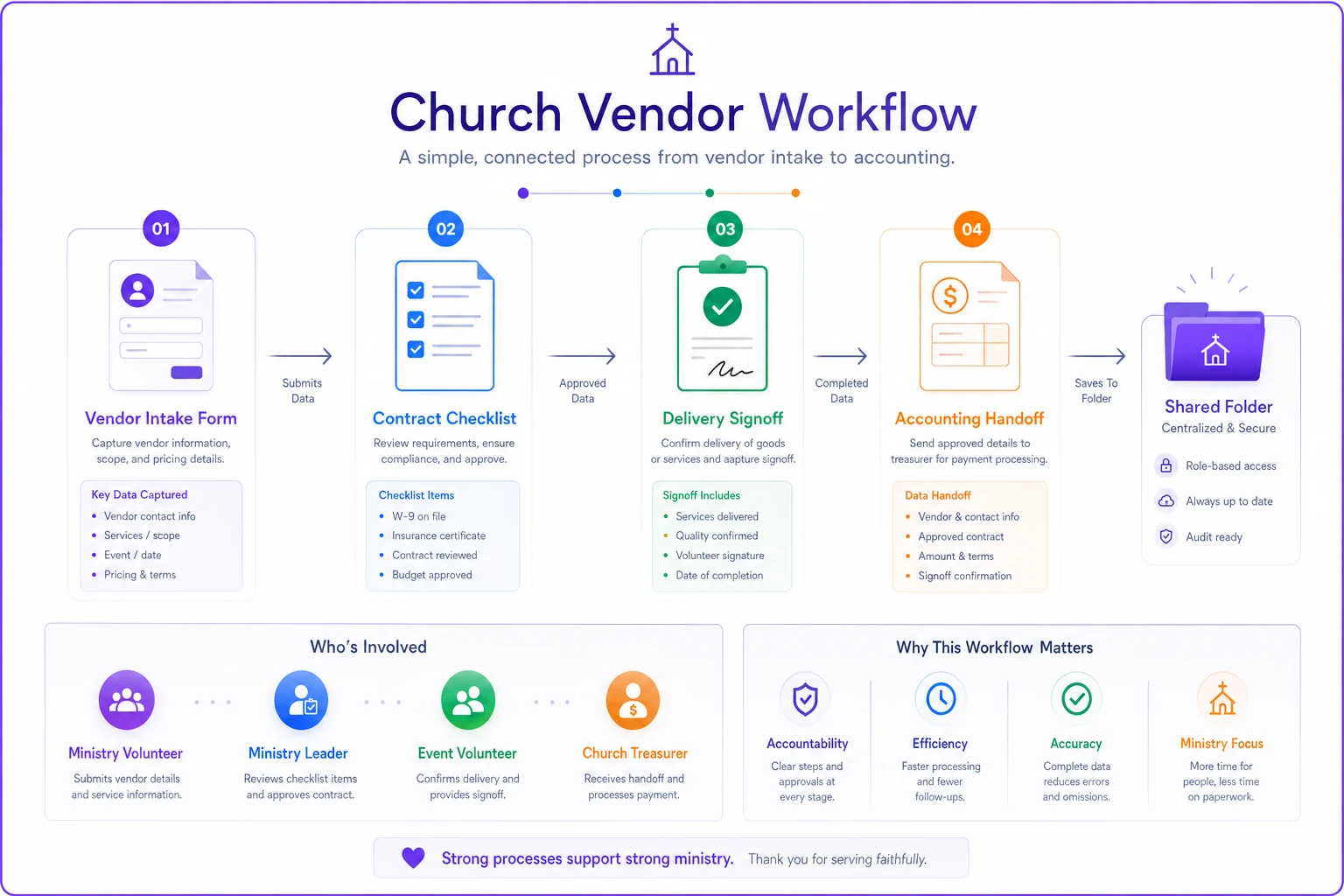
Four documents per event sounds like a lot until you realize they're mostly the same fields flowing from one to the next. The intake form feeds the contract checklist, which feeds the delivery signoff, which feeds the accounting handoff. Data is entered once and carried forward.
Here's a simple visual of that flow.
This is the point where churches running several events a season start to feel the limits of loose spreadsheets. When the same vendors return year after year, you want their COI expiration dates, W-9 status, and past discrepancies to persist — so you're not re-collecting everything from scratch each time. Operational software with light automation earns its place here: vendor records that track insurance expiration dates and flag them before they lapse, a signoff step that can't be bypassed before payment is approved, a handoff that pulls from the intake form instead of being retyped. The documents are the thing that matters; software just keeps them from scattering across inboxes and personal drives.
But don't start there. Start with the forms. A church that consistently fills out four one-page documents per event has already solved most of its vendor headaches — software or not.
The short version
The recurring vendor problems small churches face aren't really about bad vendors. They're about missing records at the three moments that matter: when you agree, when goods arrive, and when you pay. A vendor intake form captures the agreement while it's fresh. A minimal contract checklist makes sure insurance and indemnity are handled before anyone sets foot on your property. A delivery signoff confirms reality before money moves. And an accounting handoff makes sure finance pays the right amount from the right budget line — with a signoff attached to prove it.
Build those four, make the signoff a hard gate on payment, and most of the 7:45am chair-counting arguments simply stop happening.
Ready to transform your church management?
Join 500+ churches using Parshly to enhance community engagement, streamline administration, and grow their ministries.