

Most churches handle accommodations by word of mouth. Someone mentions to a greeter that their mother uses a wheelchair now, the greeter tells the deacon, the deacon forgets, and on Sunday there's a scramble to move chairs while the family waits awkwardly in the aisle. Nobody meant for it to go that way. The information just never landed anywhere it could actually be used.
That gap — between what people quietly tell you and what your volunteer team actually knows on event day — is where most church accessibility workflows fall apart. It's not a lack of compassion. Churches are usually overflowing with willingness. The problem is that accommodation info tends to live in someone's memory, a text thread, or a sticky note, and none of those hold up at a Christmas Eve service with 600 people and 40 volunteers.
This post is narrow on purpose. We're not covering ramps, ADA code, or facility design. We're covering the operational piece: how you intake accommodation requests confidentially, tie them to your event roster, assign the right volunteers, and notify only the people who need to know — without broadcasting anyone's medical or personal situation to a group chat.
Why the informal approach quietly fails
The failure isn't dramatic. It's a slow erosion most leaders don't notice until a family stops coming.
Here's the pattern. A member shares an accommodation need with whoever they trust — often a pastor or ministry leader they already have a relationship with. That person genuinely cares and mentally files it away. But that leader isn't the one setting up chairs, running the sound board, or standing at the entrance on event morning. So the need has to travel through two or three handoffs to reach the volunteer who can actually act on it.
Each handoff loses fidelity. "She needs a seat near the front where she can hear well" becomes "put her up front" becomes "reserve a chair somewhere." By the time it reaches the setup team, the specific accommodation — proximity to the speaker, an aisle seat for a service dog, space for a walker — has been flattened into something vague and often wrong.
There's a confidentiality problem baked into the informal method too. To get information moving, people over-share. A volunteer coordinator trying to explain why a particular seat is reserved ends up telling three volunteers about someone's hearing loss or anxiety disorder. The person being accommodated never agreed to that. They told one trusted leader and assumed it would stay contained.
A typical example: a mid-size church running a special Easter service reserves a front section for "special needs." On the day of, ushers don't know who it's for, so they either leave it empty — turning away people who could've used it — or fill it with early arrivals, leaving the actual families with nowhere to go. Both outcomes are worse than doing nothing, because they signal to affected families that the church talked about accommodations but didn't actually plan for them.
What a real intake step should capture
The fix starts with a structured intake that's separate from your general event registration. Not a giant form — a short, dignity-preserving one that asks only what your volunteers need to act on, and nothing that turns into gossip.
Simplify your church’s day-to-day operations.
Parshly helps you organize events, track donations, and engage your congregation—all in one place.
- Centralized member management
- Donation tracking & reporting
- Volunteer scheduling & notifications
No credit card required
-
Which event(s) the request applies to — a single service, a series, or ongoing
-
The functional need, described in action terms
seating near the front, an ASL interpreter, a quiet room for sensory breaks, aisle access, large-print materials
-
Where in the space it applies — sanctuary seating, children's area, parking, restrooms
-
Preferred contact method and whether they want to be greeted about it or handled discreetly
-
Consent scope — who is allowed to know, and at what level of detail
-
A free-text field for anything that doesn't fit the boxes
That consent scope line is the piece almost everyone skips, and it's the most important one. Someone requesting a quiet room for an autistic child may be fine with the children's ministry lead knowing the details but not want it mentioned to the general volunteer pool. Capturing that preference up front is what lets you route information without violating trust.
Capture the consent scope explicitly on the intake so routing decisions can respect privacy.
After you have the intake locked down, the next challenge is making sure that information doesn't just sit in a folder somewhere — it has to connect to something operational.
Tying requests to the event roster
An intake form sitting in a folder does nothing. The value shows up when each accommodation is linked to a specific event and surfaces automatically for the volunteers working that event.
Think of it as three connected lists that most churches keep completely separate:
-
The event roster — what's happening, when, and the space layout
-
The accommodations list — who needs what, tied to specific events
-
The volunteer assignments — who's serving and in what role
When these three aren't connected, coordination depends on one person holding it all in their head. When they are, the setup team automatically sees "reserve two aisle seats, front-left section" without ever seeing the name or reason unless their role requires it.
This is where a workflow or event-management platform earns its keep — not because it's sophisticated, but because it can attach an accommodation record to an event and expose only the operationally relevant slice to each role. The usher sees "reserved seating, section B." The interpreter coordinator sees the ASL request. Nobody sees more than their job needs. That role-based visibility is the same discipline you'd apply to a secure children's check-in workflow with guardian matching and release controls — the information is available to exactly the people responsible, and invisible to everyone else.
Keeping these three lists in sync doesn't require anything exotic. It just requires that someone owns the connection between them, and that ownership doesn't shift week to week.
Volunteer assignment rules that protect confidentiality
The operational tension here is real: you need volunteers to execute accommodations, but you don't want to hand out private details freely. The way through is role-specific assignment rules that decide, in advance, who sees what.
Break your volunteers into visibility tiers:
| Role | What they can see | What they cannot see |
|---|---|---|
| Setup/logistics team | Physical requirements (reserved seating, space for equipment, room prep) | Names, reasons, medical context |
| Direct-support volunteer (assigned to a person) | The specific need and how to help | Other people's accommodations |
| Ministry lead | Full context for their ministry area only | Requests outside their area |
| Accommodations coordinator | Everything, including consent scope | — |
| General volunteers | Nothing accommodation-related | All of it |
The piece most churches miss: a volunteer doesn't need to know why to do their job well. The setup crew doesn't need to know a family has a child with epilepsy to know they should keep the front-left seats clear and the lighting steady. Strip the "why" from the operational instruction and you've solved most of the confidentiality problem automatically.
For direct-support roles — someone assigned to greet and guide a specific family, or an interpreter — you do share more, but only with that one volunteer, and ideally only after confirming the family consented to being personally accompanied. Some people want that support. Others find it mortifying to be singled out. The consent scope from intake tells you which.
The same role-clarity thinking applies to how you position people during the service itself. When you already have a front-of-house staffing heatmap with staggered shifts and floaters, slotting an accommodations-aware volunteer into the right spot becomes a placement decision rather than a last-minute scramble.
The dignity‑first notification protocol
Notifications are where good intentions go sideways. The instinct is to make sure everyone knows so nothing gets missed — which is exactly how private information leaks into a 40-person volunteer group text.
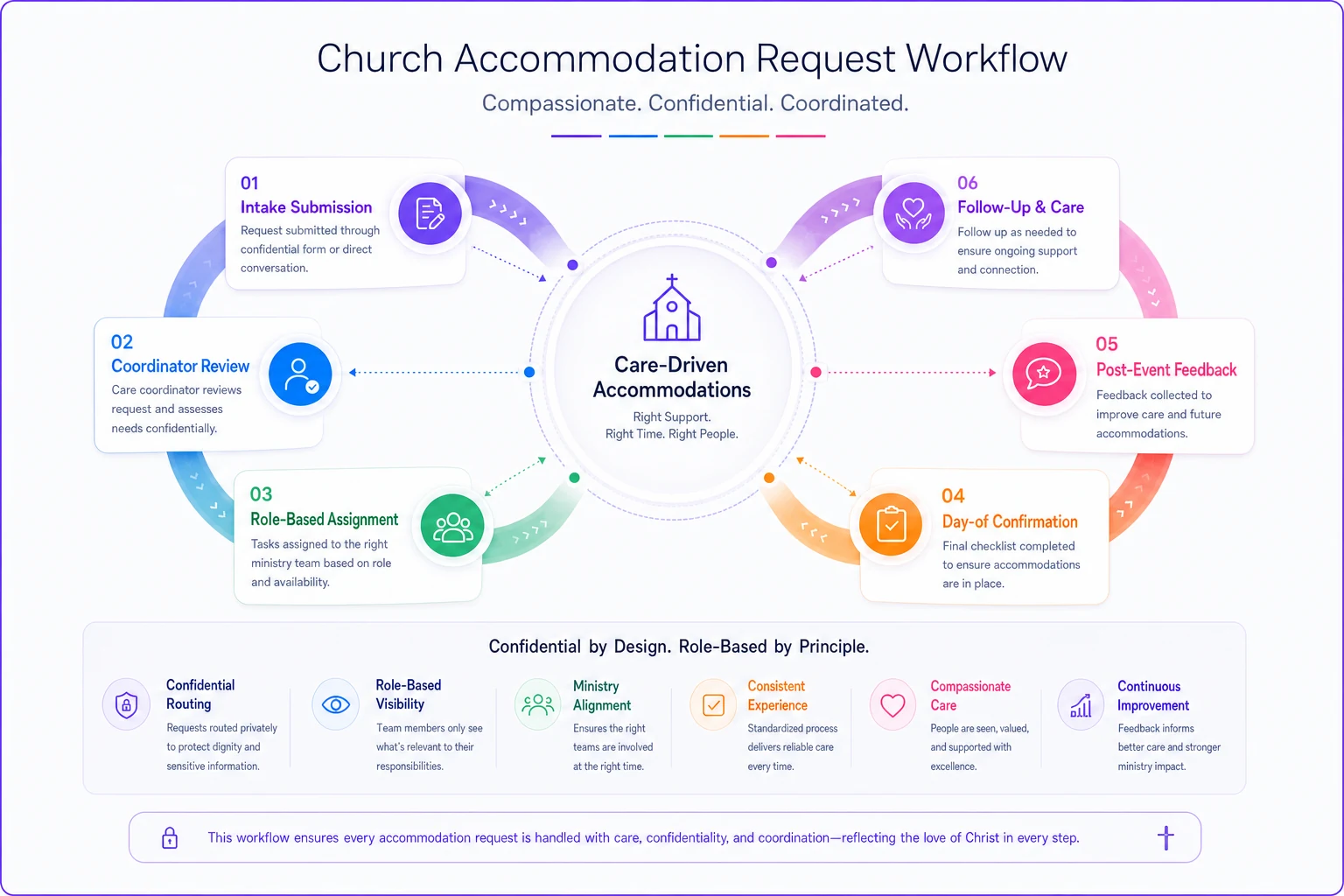
Below is a visual of the workflow.
-
Intake closes a set number of days before the event (48–72 hours works for most churches), giving the coordinator time to process requests without a same-day scramble.
-
The coordinator reviews each request against the consent scope and translates it into role-specific tasks.
-
Setup instructions go to the logistics team as neutral tasks
"Reserve seats A1–A2, aisle access, front-left." No names.
-
Direct-support assignments go privately to the one volunteer handling that person, with a brief on the need and how the family wants to be approached.
-
A day-of confirmation goes to the coordinator only — a checklist confirming each accommodation is physically in place before doors open.
-
A quiet post-event note lets the coordinator flag anything that didn't work, feeding back into the next event.
The discipline here is resisting the urge to CC. Every extra person on a notification is another point where private context escapes. If someone doesn't have a task, they don't get the message.
One more piece people forget: give the person requesting the accommodation a confirmation too. A short, warm note — "We've got a seat reserved for you near the front, and Karen will meet you at the east entrance" — does more for retention than almost anything else. It tells them the request didn't disappear into a void. That single message is often the difference between a family coming back and a family quietly deciding church logistics aren't worth the stress.
A real scenario
A church running roughly 450 in weekend attendance kept losing track of accommodation requests across their two Sunday services and mid-week events. Requests came in through the pastor, the greeter team, and the office, and nothing was centralized. On any given weekend, two or three families with genuine needs would arrive to find nothing arranged.
They moved to a single intake form tied to their event calendar, with consent scopes and role-based visibility. The volunteer coordinator became the one owner of the accommodations list. Setup teams started receiving neutral, name-free instructions the Friday before each service.
Within about two months, the day-of scramble essentially disappeared. The coordinator estimated they'd been mishandling somewhere around 8–10 requests a month — that dropped to nearly zero, with occasional last-minute requests being the only exception. Two families who had drifted away came back after being personally followed up with — not because of any grand outreach, but because someone finally remembered their need before they had to ask again. Staff time spent chasing details also dropped noticeably, since the information lived in one place instead of scattered across five people's inboxes.
When this level of structure makes sense — and when it doesn't
If your church runs one service a week with the same 15 volunteers who all know everyone, a formal intake and notification protocol might be more machinery than you need. A trusted coordinator and a shared note could genuinely be enough. Don't build a system to solve a problem you don't have.
-
Multiple services or events where different volunteer teams rotate
-
Special events (Easter, Christmas, conferences) that pull in volunteers who don't know the regulars
-
Enough attendance that no single person can hold every need in memory
-
Any history of accommodation requests slipping through the cracks
-
Growing sensitivity around who knows what — especially with mental health, medical, or family situations
The one group that should not skip structure regardless of size: churches handling accommodations that involve children, medical devices, or anything where a missed detail creates a safety issue. There, the confidentiality and reliability of a real workflow isn't optional.
The point most churches miss
Accommodations aren't primarily a logistics challenge — they're a trust challenge that happens to have logistics attached. When someone tells you they need help participating, they're handing you something private and hoping you'll honor it. Fumbling the logistics doesn't just create an awkward Sunday. It tells that person their need is a burden your systems can't hold.
Getting the intake, routing, assignments, and notifications right isn't about being organized for its own sake. It's about making sure that the willingness your church already has actually reaches the person who needs it — quietly, reliably, and without ever making them feel like a problem to be managed. That's entirely doable with a workflow that keeps the right information in front of the right people and out of everyone else's view.
Getting the intake, routing, assignments, and notifications right isn't about being organized for its own sake. It's about making sure that the willingness your church already has actually reaches the person who needs it — quietly, reliably, and without ever making them feel like a problem to be managed. That's entirely doable with a workflow that keeps the right information in front of the right people and out of everyone else's view.
Ready to transform your church management?
Join 500+ churches using Parshly to enhance community engagement, streamline administration, and grow their ministries.