



Most small‑group programs don't fail because the groups are bad. They fail at the seams — the moment someone signs up and nobody follows through, or the moment a leader steps down and the whole group quietly evaporates. The content inside the group is usually fine. It's the operational handoffs around it that leak people.
If you've got a staff of one, two, or a volunteer coordinator who's also doing three other jobs, you already know this. The problem isn't that you don't care. It's that nobody owns the boring middle — the tracking, the ramp, the clean exit — and so everyone defaults to "we'll figure it out."
This is a walkthrough of the whole lifecycle with the specific failure points called out, plus a leader handoff packet, three KPIs that actually survive a tiny staff, and tracking templates that don't require a dashboard tool to maintain.
The lifecycle most churches never actually map
Almost nobody writes this down: a small group goes through distinct phases, and each phase has a different owner and a different risk. When you don't name the phases, you can't tell where you're losing people.
The four stages look like this:
| Stage | What's happening | Primary owner | Main failure point |
|---|---|---|---|
| Intake | Someone expresses interest and gets placed | Coordinator | Interest sits unanswered 5+ days |
| Active | Group meets, builds rhythm | Group leader | No visibility; staff has no idea how it's going |
| Handoff | Leader change, co‑leader steps up, or apprentice takes over | Coordinator + outgoing leader | Context walks out the door with the old leader |
| Merge/Exit | Group ends, merges, or multiplies | Coordinator | Members orphaned, no re‑placement |
Notice that the coordinator owns three of the four stages. That's the real staffing reality in small churches — the leader owns the "active" phase, which is the part that mostly runs itself, and the thinly‑staffed coordinator owns every transition, which is the part that actually breaks.
Most programs obsess over recruiting new leaders and starting new groups. The leak is almost always in intake response time and handoff context loss. Fix those two and your group count stabilizes without launching a single new group.
Where intake quietly dies
A typical breakdown: a visitor fills out a "I'm interested in a small group" card on Sunday. It goes into a pile, or an inbox, or a form submission that pings a shared email nobody owns. By Wednesday the coordinator sees it. By the following Sunday they've tried to match the person to a group, but now it's been nine days and the person has mentally moved on.
Simplify your church’s day-to-day operations.
Parshly helps you organize events, track donations, and engage your congregation—all in one place.
- Centralized member management
- Donation tracking & reporting
- Volunteer scheduling & notifications
No credit card required
This usually happens when intake has no clock attached to it. There's no agreed "respond within X days" standard, so every request gets whatever urgency the coordinator has left after the week's fires.
What tends to happen across a lot of small programs is that the first touch — just a human reply acknowledging the request — matters more than the perfect placement. A quick "Hey, I got your info, I'm looking at two groups that might fit, I'll have a specific intro for you by Thursday" buys you a week of goodwill. Silence spends it.
The fix is embarrassingly simple and almost never implemented:
-
One owner, one inbox. Every intake request lands in exactly one place with exactly one named person responsible. Not a team. A person.
-
A 48‑hour acknowledgment standard. First reply within two days, even if it's just "I've got you, working on a match."
-
A placement deadline of 10 days. From request to "you're introduced to a leader" in under two weeks.
-
A visible stuck list. Any request older than 10 days without placement is flagged and reviewed weekly.
That stuck list is the whole game. If you can see what's aging, you can rescue it. If intake lives in someone's head and a form inbox, you can't.
The handoff is where you lose your institutional memory
Leaders step down. They move, they have a baby, they burn out, they take a work transfer. This is normal and you should plan for it as a certainty, not a surprise.
The expensive part isn't replacing the leader. It's that when a leader leaves, a specific kind of knowledge leaves with them that no system ever captured:
-
Which member just went through a divorce and shouldn't be cold‑called by the new leader
-
Who hasn't shown up in six weeks and why
-
Which two people carry the group when the leader's out
-
The unspoken reason the group meets at 7
15 instead of 7:00
-
Who's being quietly developed as the next apprentice
Here's what this typically looks like: a leader of a 12‑person group moves away. The handoff is a two‑line text — "Here's the roster, they're great, good luck." The new leader inherits names and nothing else. Within two months, attendance drops to seven. Three people who were in a fragile season felt dropped, and nobody knew to follow up because the context never transferred. The group didn't fail because the new leader was bad. It failed because the handoff moved data but not understanding.
The leader‑ready handoff packet
Section 1 — Group basics
-
Meeting rhythm, location, start time (and any reason it's non‑obvious)
-
Current member count and childcare arrangement
-
Communication channel the group actually uses (group text? an app? email nobody reads?)
Section 2 — The people picture
-
Core members who carry the group
-
Members in a sensitive season (coded carefully — "needs gentle follow‑up," not clinical detail)
-
Anyone drifting (attendance thinning, worth a check‑in)
-
The apprentice or next potential leader, if any
Section 3 — The handoff knowledge
-
What's working that the new leader should protect
-
What the outgoing leader would change if they stayed
-
Any commitments made to members that are still open
Section 4 — Logistics loose ends
-
Who holds the keys, the supplies, the shared docs
-
Any recurring expense or reimbursement in flight
Keep the sensitive‑care notes appropriately careful — this should align with whatever pastoral care confidentiality standards you already run. The packet should signal "follow up gently with Maria," not expose private detail to every future leader who touches the group.
The coordinator's job during handoff is to make sure this packet exists before the outgoing leader is gone, not after. The worst handoffs happen when someone's already left and you're reconstructing context from memory.
Require the outgoing leader to complete the one‑page packet before their final meeting.
The worst handoffs happen when someone's already left and you're reconstructing context from memory.
Three KPIs that actually survive a tiny staff
You don't need a reporting suite. You need three numbers you can pull in fifteen minutes a month. The trap most churches fall into is picking KPIs that require constant data entry nobody keeps up with — so the metric decays and you quietly stop looking at it.
These three were chosen specifically because they're cheap to maintain and they map to the real failure points above.
1. Intake‑to‑placement time (median days) How long from "I'm interested" to "I'm introduced to a leader." Track the median, not the average — one weird six‑week case shouldn't distort your read. Target under 10 days. When this climbs, your intake owner is overloaded or the inbox has no clock.
2. Active group ratio Of your total groups, how many met at least twice in the last month? This is your honest group count. A church will say it has 14 groups when really 9 are meeting and 5 are "technically still a group." This number tells you the truth and keeps you from celebrating ghosts.
3. Handoff completion rate Of leader transitions in the last quarter, how many had a completed handoff packet before the old leader left? Target 100%, because the cost of a bad handoff is a shrinking group three months later. This is the leading indicator that protects your active group ratio down the line.
Notice what's not here: total attendance, spiritual growth self‑assessments, satisfaction surveys. Those aren't bad, they're just expensive to maintain and they don't tell a tiny staff where to act. These three point straight at a next action. If you want to think more broadly about how these roll up into leadership reporting, the approach in building board‑ready dashboards with minimal KPIs pairs well with this — pick the few numbers that drive decisions and ignore the rest.
Low‑overhead tracking that one person can actually keep up
The uncomfortable truth about tracking in small churches: the fancier the system, the faster it dies. A beautiful setup that requires fifteen minutes of entry per group per week will be abandoned by week four. A rough system that takes two minutes survives.
A single sheet with one row per group covers almost everything:
-
Columns Group name · Leader · Stage (intake/active/handoff/exit) · Last met date · Member count · Apprentice (y/n) · Handoff packet (y/n) · Notes
-
Update cadence once a month, coordinator spends 20 minutes updating last‑met dates and stage
-
The one rule if "last met" is more than 5 weeks old, the stage flips to a review flag automatically in your head, and it goes on the stuck list
That's it. From that one sheet you can derive all three KPIs. Active group ratio is a filter on the stage column. Handoff completion is a filter on the packet column. Intake time lives on a second tab with a request date and a placement date — two columns, subtract them.
A simple monthly workflow:
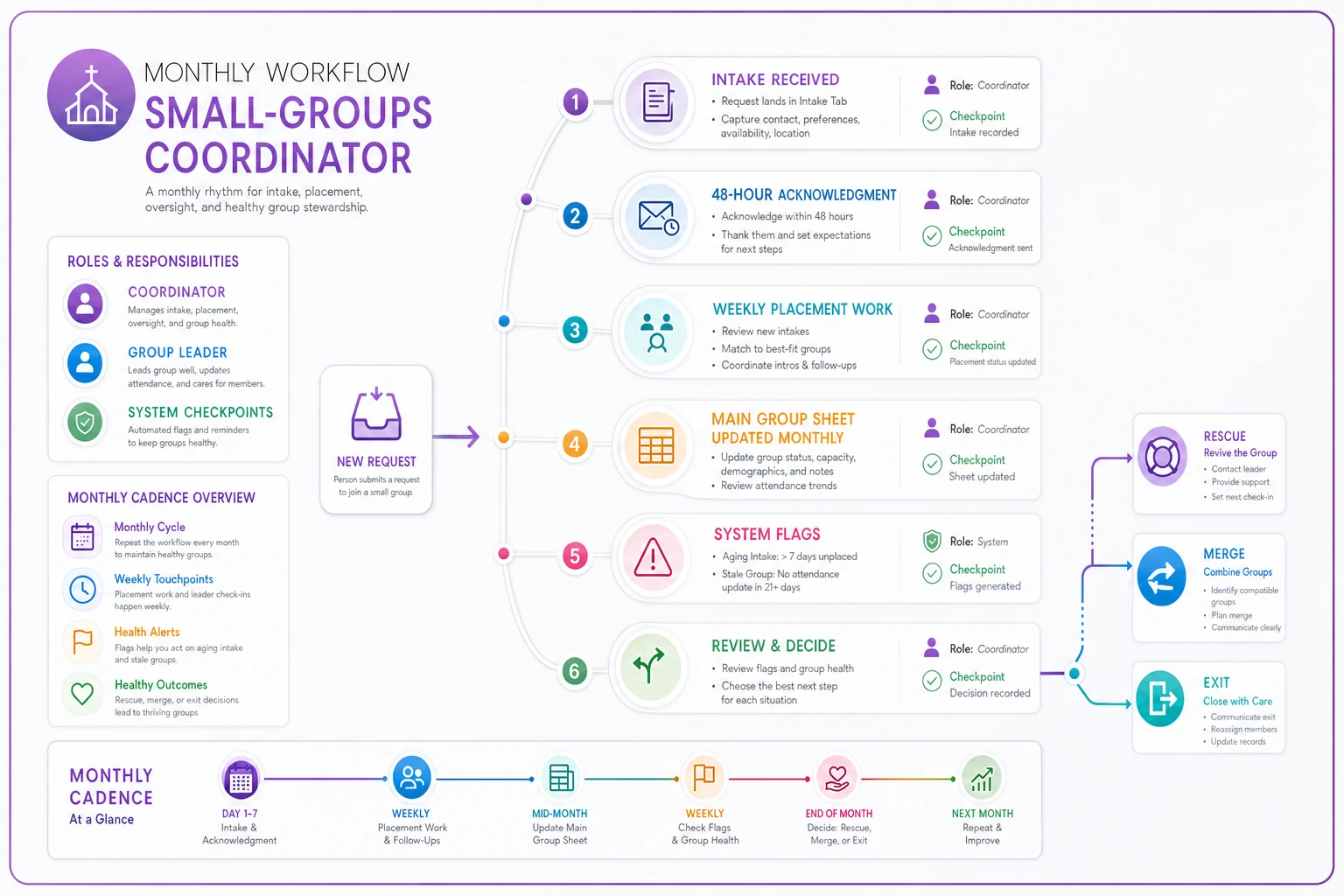
As the program grows past 15–20 groups, a spreadsheet starts to strain — not because it can't hold the data, but because the manual last‑met updates and intake reminders become their own part‑time job. That's the point where a proper group management system earns its keep, mostly by handling the nagging: auto‑flagging stale groups, timestamping intake, prompting for the handoff packet when a leader status changes. The lifecycle logic stays identical. You're just automating the reminders so a thin staff stops being the bottleneck. If you're deciding when that transition is worth it, the thinking in when to build a stage‑based engagement system with owners and handoffs applies directly here.
When to merge, and when to let a group end well
Merging and exiting are the stages nobody plans, and so they happen badly — a group just fizzles, members drift, and nobody gets re‑placed.
Merge makes sense when two groups have both shrunk to 4–5 members, meet at compatible times, and have compatible leaders (one of whom is ready to step back). A merge of two small struggling groups into one healthy group of 9 is a win, not a failure — as long as you do it on purpose and nobody feels dissolved.
A clean exit makes sense when a group has run its natural course — a short‑term study ends, a season closes, a leader's done and there's no apprentice. The mistake is letting it trail off. A group that formally ends with members re‑placed into other groups keeps those people in the system. A group that just stops meeting orphans them.
Who should not force a merge: if either group has strong relational cohesion and is simply small by design — a men's early‑morning group of five that's met for years — leave it alone. Small isn't the same as failing. The merge decision is about health and trajectory, not headcount.
The one operational rule for both: nobody exits a group without being offered a next placement. When a group ends or merges, every displaced member goes back into intake as a warm request, not a cold one. That's how you stop the slow bleed where ending groups quietly drain your total membership.
A quick real scenario
A church running around 11 groups with a single part‑time groups coordinator had a recurring pattern: intake requests took two to three weeks to answer, and two groups a year would quietly dissolve after a leader left. Their "group count" on paper was 11; honestly only 7 or 8 were consistently meeting.
They did three things. They put every intake request into one owner's hands with a 48‑hour acknowledgment rule. They built the one‑page handoff packet and made it a requirement before any leader transition. And they started pulling the three KPIs off one spreadsheet each month. Within a couple of months, intake‑to‑placement dropped to roughly a week. The next two leader transitions kept their groups intact because context actually transferred. And the honest active‑group number became visible — which let them merge two struggling groups on purpose instead of watching them fade. Nothing fancy happened. They just stopped losing people at the seams.
The part worth remembering
The groups themselves were rarely the problem. The transitions were — the unanswered intake, the context that walked out with a departing leader, the group that ended without anyone catching the members on the way out.
A tiny staff can't run a heavy system, and it doesn't need to. One clear owner per stage, a one‑page handoff packet, three cheap KPIs, and a single sheet updated monthly will hold a small‑groups program together far better than a dashboard nobody maintains. Start with the handoff packet if you only do one thing. The next time a leader leaves — and one will — you'll keep the group instead of rebuilding it from scratch.
Ready to transform your church management?
Join 500+ churches using Parshly to enhance community engagement, streamline administration, and grow their ministries.