

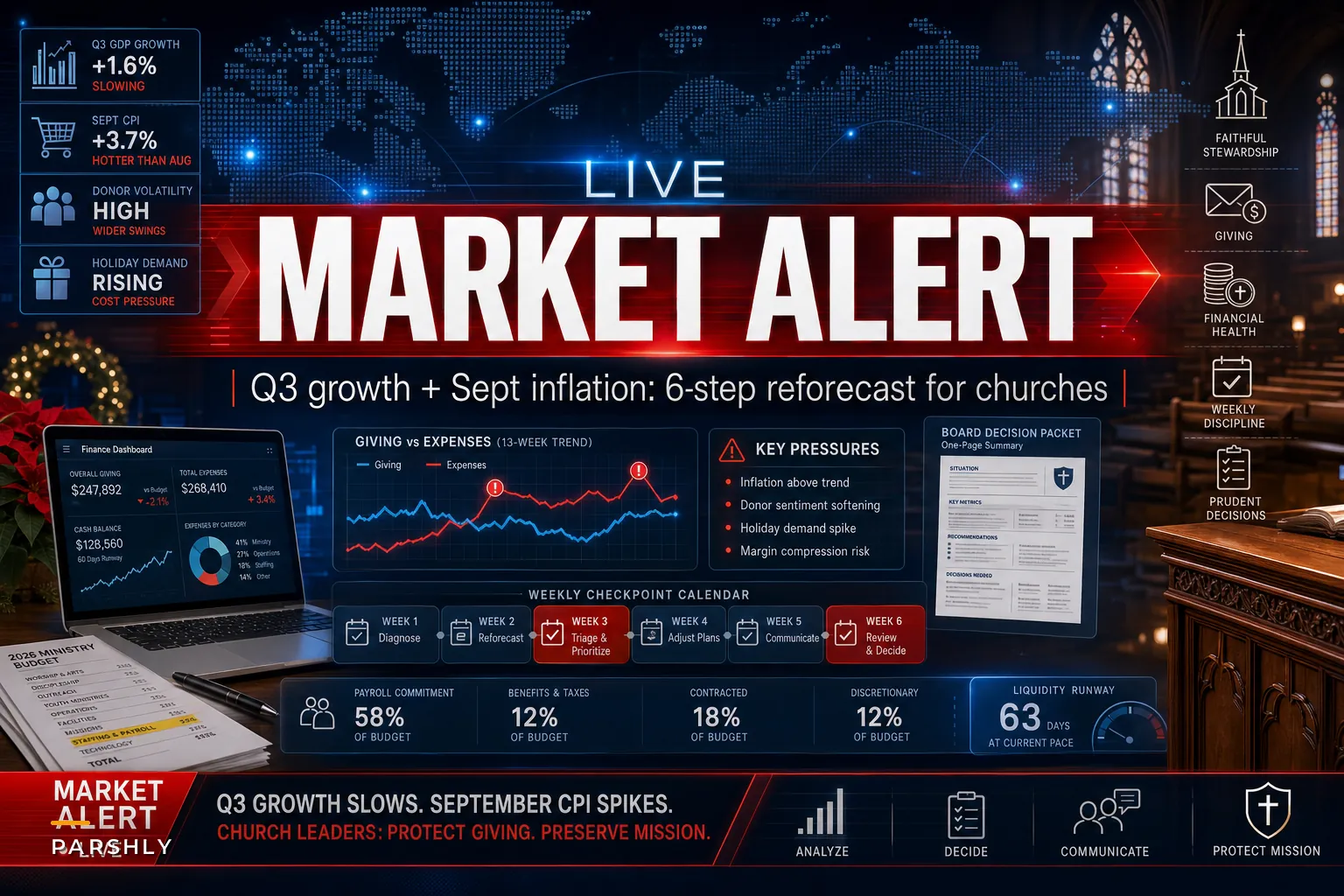

The numbers that landed on October 29 were genuinely confusing for anyone running a budget. The Commerce Department reported that U.S. economic growth accelerated in the third quarter, driven by strong consumer spending and heavy investment in AI. On the same day, a separate report showed inflation heated back up in September even as households kept spending. The Fed, meanwhile, pointed to economic strength while leaving the rate path murky.
For a church treasurer, that combination is annoying in a specific way. A clear recession tells you to cut. A clear boom tells you to invest. This is neither. People still have money and are still spending it, but the things your church buys — power, insurance, supplies, contractor time — are getting pricier again, and nobody can tell you whether borrowing costs ease in Q1 or not.
The goal here isn't to predict the economy. It's to build a reforecast that holds up whether giving comes in soft, flat, or a little hot through December. Below is a six-step process built for exactly that kind of uncertainty.
Why "the economy is strong" doesn't translate to "giving will be strong"
A lot of boards fall into the same trap. GDP is up, spending is up, so the assumption becomes: our members have money, December giving will be fine, let's hold the budget.
That reasoning skips a step. Household giving doesn't track GDP — it tracks discretionary comfort, and discretionary comfort gets squeezed when prices climb even if income is technically keeping pace. When grocery, fuel, and holiday costs tick up in September and October, the giver who normally rounds a year-end gift up to $2,000 quietly rounds it down to $1,500. Nobody announces it. It just shows up in your December batch as a softer-than-expected number.
The pattern worth watching: inflation tends to compress the middle of your giving base more than the top or bottom. Your largest donors usually hold steady because the price pressure doesn't change their decision. Your smallest, most committed givers also hold steady because it's a fixed priority for them. It's the mid-tier household — the $50-to-$200-a-month folks — who adjust first, and that's often the segment carrying the most weight in a mid-size congregation's monthly total.
A single top-line number nudged up or down won't cut it here. The reforecast has to look at giving by segment, because the segments don't move together.
Step 1 — Re-baseline giving by segment, not by total
Pull your last three Decembers and your trailing twelve months, then split givers into bands. Something simple works fine:
Simplify your church’s day-to-day operations.
Parshly helps you organize events, track donations, and engage your congregation—all in one place.
- Centralized member management
- Donation tracking & reporting
- Volunteer scheduling & notifications
No credit card required
-
Anchor givers — top ~10% by total contribution
-
Core recurring — scheduled/automated gifts, any amount
-
Mid-tier variable — households that give regularly but adjust amounts
-
Occasional / seasonal — mostly Christmas and Easter
Then look at each band's behavior during the last period when prices moved against households — not during a calm year. You're trying to answer one question: which band actually flexed last time money got tighter?
In most mid-size churches, core recurring givers are the steadiest line on the page because the gift runs on autopilot. That's exactly why recurring giving is worth protecting aggressively — it's the one number you can forecast with real confidence. The mid-tier variable band is where your scenario range lives.
A realistic re-baseline for a church running around $95k–$110k in a typical December might look like this:
| Giving band | Share of Dec total | Forecast confidence | Scenario range |
|---|---|---|---|
| Anchor givers | ~35% | High | ±5% |
| Core recurring | ~30% | Very high | ±2% |
| Mid-tier variable | ~25% | Low | −15% to +5% |
| Occasional/seasonal | ~10% | Medium | −10% to +10% |
| Blended | 100% | — | roughly −7% to +3% |
That blended range is the useful output. It tells the board that a flat-to-slightly-down December is the realistic planning center, with modest upside — not a single hopeful number to anchor everything around.
Step 2 — Rebuild the expense side around what inflation actually touches
The spending side of a church budget is not uniformly exposed to inflation. Lumping everything together hides where the pressure really is. Separate expenses into three buckets by how fast they move:
-
Fast-moving, price-sensitive — utilities, facility supplies, food/hospitality, event materials, fuel/mileage reimbursements
-
Contract/vendor-linked — software, security monitoring, janitorial, landscaping, insurance renewals
-
Fixed or semi-fixed — payroll, stipends, debt service, lease
The September inflation uptick hits bucket one immediately and bucket two at renewal. A typical example: a church that budgeted around $1,400/month for winter utilities and $600 for hospitality supplies can see those creep 6–10% without anyone flagging it, because each individual invoice looks "about normal." Over a quarter that's a few hundred dollars of unplanned drift — small on its own, but it compounds across every other line doing the same thing.
The mistake to avoid: cutting program budgets first because they're visible and easy to touch, while slow leaks in utilities and vendor renewals go unexamined. Those slow leaks are usually bigger than the program line you're tempted to cut.
Step 3 — Stress-test payroll and stipends before you commit to December
Payroll is the hardest line to flex mid-year, which is exactly why it needs the most careful handling under uncertainty. You don't want to freeze a raise you can actually afford, and you really don't want to commit to one you can't sustain.
Run three payroll scenarios against your Step 1 giving range:
-
Hold scenario — current comp, no changes. What's the cash position if giving lands at the bottom of your blended range?
-
Modest-adjust scenario — cost-of-living bumps for the lowest-paid staff only. Inflation hits your hourly childcare and facilities people hardest; they feel September's price pressure most directly.
-
Deferred-decision scenario — hold adjustments but set a specific trigger date and giving threshold in Q1 that unlocks them.
The deferred-decision approach is underused and genuinely smart in a mixed economy. Instead of saying "no raises," you say "raises are approved contingent on first-quarter giving hitting X." That protects staff trust, protects cash, and gives the board a clean decision rule instead of an emotional December debate.
If you're weighing capital projects or anything tied to borrowing, the murkiness in the rate outlook matters here too. The Fed signaling economic strength while muddying the policy path means you shouldn't assume cheaper financing is coming in Q1. Price any project at today's rates, not hoped-for ones.
Step 4 — Protect program delivery with a tiered cut list
Nobody wants to build this list, but everyone's glad they did when December gets soft. Deciding in advance what gets trimmed — and in what order — is calm, strategic work when you do it in October. Doing it under pressure in January is reactive and tends to damage the wrong ministries.
-
Tier 1 — Protected no matter what core worship, children's safety staffing, pastoral care, anything tied to a legal or safety obligation.
-
Tier 2 — Flexible timing facility upgrades, new program launches, discretionary training and conferences. These get delayed, not killed, when cash is tight.
-
Tier 3 — First to pause nice-to-have events, non-essential printed materials, optional subscriptions, discretionary travel.
The point most boards miss: the goal isn't to cut Tier 3 to save money. The goal is to make Tier 1 untouchable so that a soft December never quietly erodes children's check-in staffing or pastoral capacity because those were the easiest things to shave. Naming the protected tier first is what actually protects it.
Step 5 — Set the data up so you can see the shift in real time
A reforecast is only useful if you can tell, mid-December, whether you're tracking toward the top or bottom of your range — while there's still time to react. Most churches can't do that, because giving data, expense actuals, and payroll commitments live in three different places and only get reconciled at month-end. By the time the January statement reveals a soft December, every decision window has already closed.
This is where having giving, fund balances, and expense tracking in one connected system stops being a convenience and becomes a real planning tool. When a platform can flag that mid-tier recurring giving is running 8% behind last year on December 12th, you still have two weeks and a year-end appeal to respond. Automated reconciliation and alerting don't replace judgment — they just compress the gap between "something changed" and "we noticed," which during an uncertain quarter is the whole game.
-
Recurring giving vs. same week last year
-
Mid-tier band pace against your scenario range
-
Fast-moving expense actuals vs. budget (the utilities/supplies creep from Step 2)
-
Cash position against your lowest giving scenario
Four numbers, once a week. That's enough to know which scenario you're actually living in. Keeping this cadence short and consistent matters more than the format — a quick weekly review in a shared doc beats a thorough monthly report that nobody reads until it's too late.
If your giving platform supports date-based alerts, set one for mid-tier recurring giving dropping below your scenario floor so you get notified well before month-end.
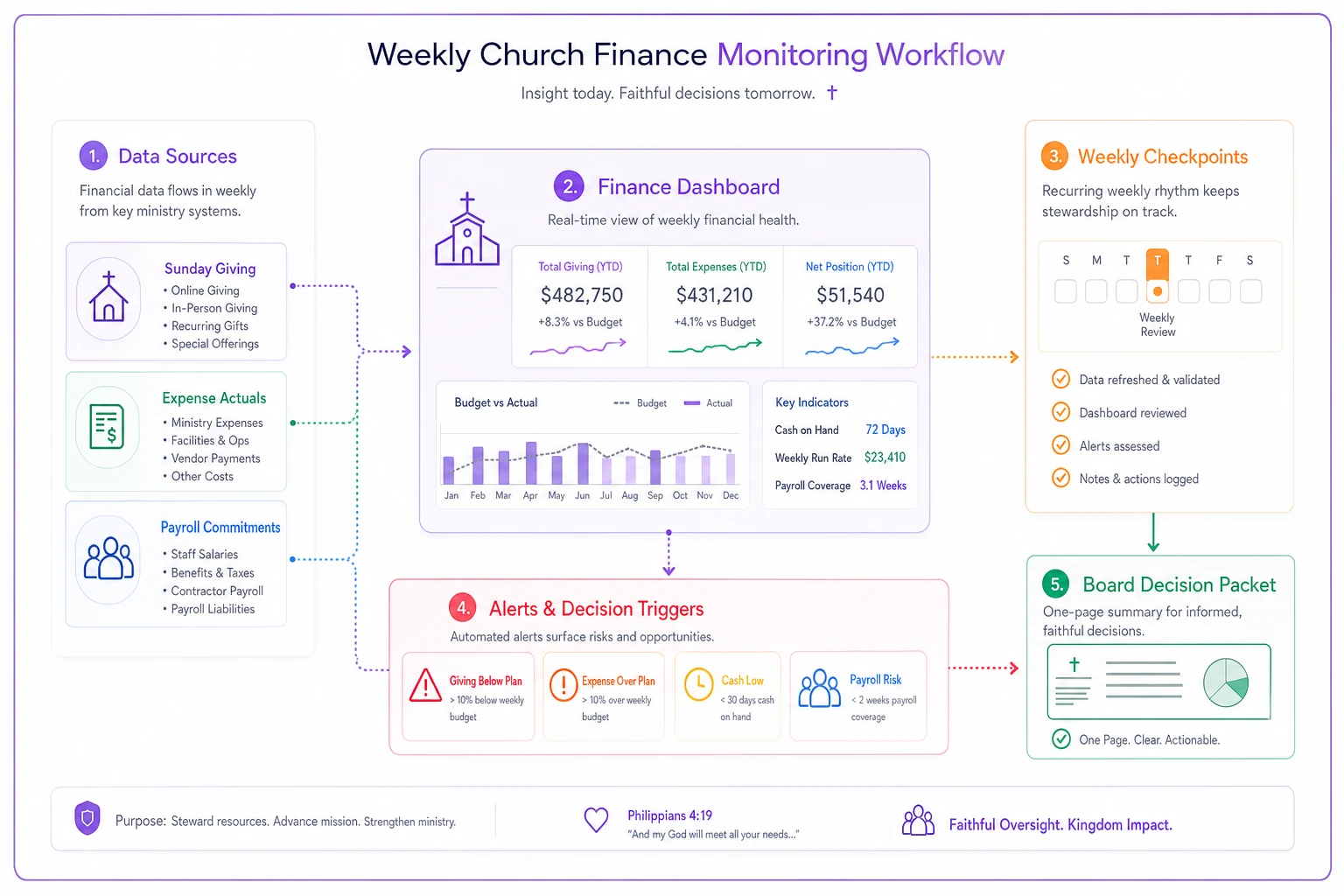
Use this flow to make weekly checks routine and give yourself time to act if the mid-tier band slips.
Step 6 — Give the board a decision, not a data dump
This is where good reforecasts go to die. A board handed twelve pages of spreadsheets will default to optimism because that's the comfortable read. A board handed one page with three scenarios and a recommended decision rule will actually govern.
Bring them:
-
The blended giving range from Step 1 (not a single number)
-
The expense pressure summary from Step 2
-
The three payroll scenarios with your recommendation
-
The tiered protection list, pre-approved
-
The Q1 trigger that unlocks deferred decisions
That packet turns an anxious "how bad is it?" meeting into a thirty-minute governance conversation with clear rules already attached.
A realistic scenario
A congregation of around 400, running roughly $100k in a normal December, went into this fall assuming a flat budget because "the economy's fine." Instead of holding that assumption, the treasurer re-baselined by segment and found the mid-tier variable band had already softened about 9% across September and October while anchor and recurring giving held steady.
That early read changed three decisions. They moved a planned $12k facility lighting upgrade from December to a Q1 trigger. They approved cost-of-living bumps for two part-time childcare staff only, deferring the rest. And they drafted a year-end appeal aimed specifically at the recurring-giving band to shore up the steadiest part of the base.
December landed down about 4% from the prior year — inside their planned range, not a surprise. Because the facility project was deferred rather than funded from a soft month, cash stayed healthy enough that the deferred raises cleared their Q1 trigger in February. Nothing dramatic happened. That was the point.
When this level of reforecasting is overkill
If your church runs mostly on automated recurring gifts with a small, stable donor base and no debt, a lighter version works fine — re-baseline, set one trigger, move on. The full six steps earn their keep when you have a meaningful mid-tier variable band, seasonal giving spikes you depend on, payroll decisions pending, or any project tied to borrowing. The more of those apply, the more the current uncertainty can actually hurt you.
The more of those apply, the more the current uncertainty can actually hurt you.
A mixed economy — real growth, warmer prices, an unclear rate path — is genuinely harder to budget for than a clear downturn, because the instinct is to assume strength means safety. For most congregations it doesn't. It means the top of your giving base holds while the middle quietly flexes and your fast-moving costs creep up at the same time.
The six steps above are built to absorb that ambiguity: forecast by segment, separate your expense exposure, stress-test comp before committing, protect your essential programs on purpose, watch the right four numbers weekly, and hand the board a decision instead of a spreadsheet. If you want a broader framing of how to stabilize budgets, fundraising, and facility plans when rate signals stay murky, the post-Fed checkup walkthrough pairs well with this reforecast and covers the longer-horizon planning side.
The congregations that come through the holidays in good shape won't be the ones who guessed the economy right. They'll be the ones who built a plan that didn't need a correct guess.
Ready to transform your church management?
Join 500+ churches using Parshly to enhance community engagement, streamline administration, and grow their ministries.