

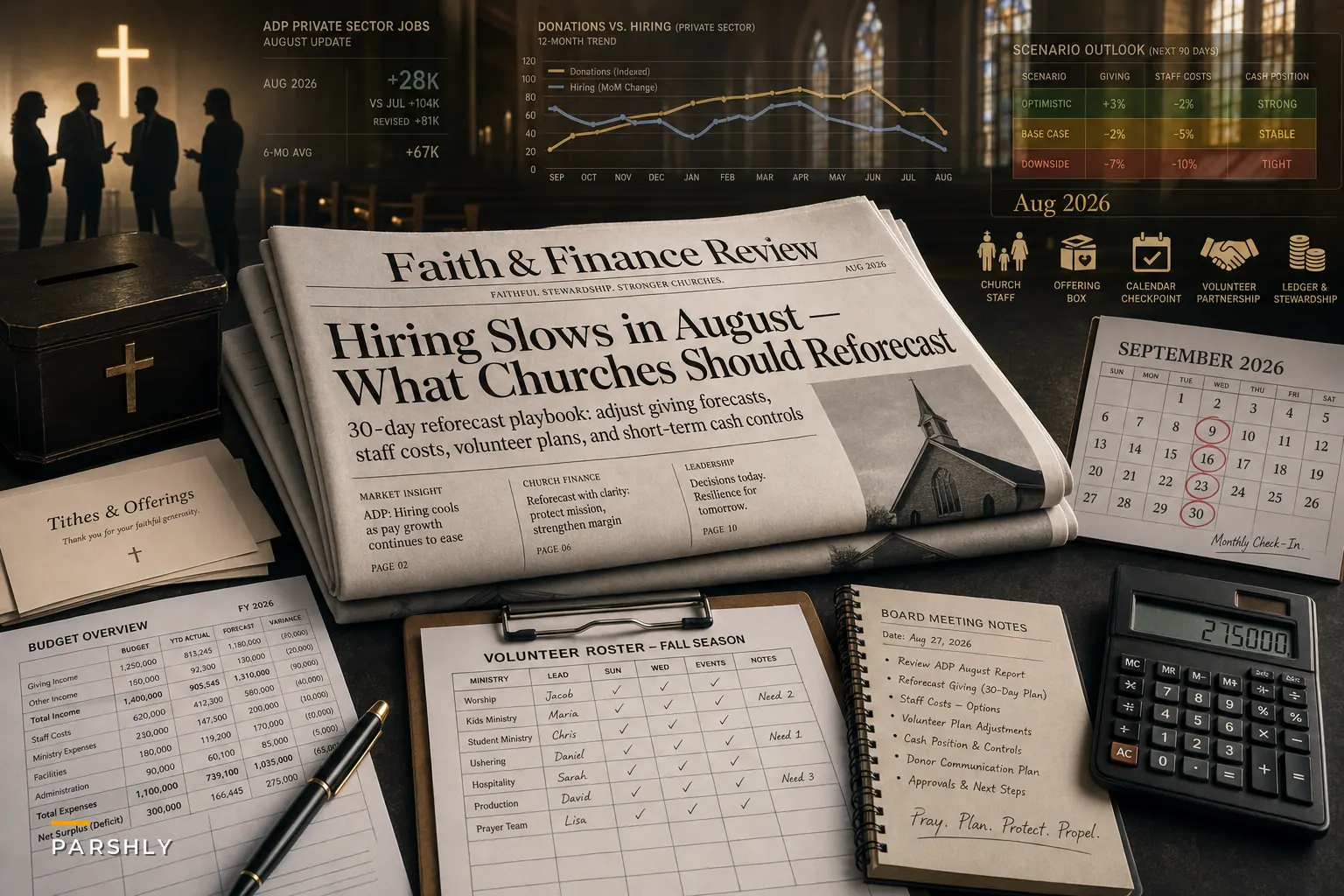
The ADP report that dropped on September 2 wasn't dramatic on the surface — private-sector hiring came in at +38,000 for August. That's the weakest monthly pace since January, and it landed well below what most forecasters expected. According to ADP's National Employment Report, the weakness clustered in manufacturing and professional services, while sectors like health care, education, construction, and leisure kept hiring.
For most church leaders, a jobs report is background noise. This one's worth a closer look, though — and for reasons that have almost nothing to do with the headline number.
Why a Slow Hiring Month Shows Up in Your Offering Plate Three Months Later
Giving doesn't drop the week a soft jobs report comes out. That's the trap. Church finances tend to react on a lag, which is exactly why leaders miss the signal until it's already in the actuals.
Here's the mechanic. When hiring slows and pay growth cools — which Reuters noted alongside the ADP numbers — households don't immediately cut their giving. What happens first is quieter. People stop increasing their pledge. A family that was planning to bump their monthly gift decides to hold flat. Someone who lost overtime hours quietly drops from weekly to biweekly. A two-income household becomes a one-income household for a few months, and their recurring gift pauses without a phone call or an explanation.
None of that shows up as a crisis. It shows up as a budget running 4–7% behind plan by November, and nobody can point to a single cause.
The composition of the slowdown matters too. Professional services softness tends to hit mid-to-higher-income earners — often the same people carrying a disproportionate share of a congregation's giving. In a lot of churches, the top 15–20% of givers cover more than half the general fund. If even a handful of those households feel squeezed, the effect on your total is larger than the number of affected people would suggest.
The Real Problem This Exposes: Most Church Budgets Are Built as a Single Fixed Line
The deeper issue isn't the economy. It's that most church budgets are built once a year, approved, and then treated as fixed until the next cycle. One revenue number, one staffing plan, one set of program commitments — all resting on the assumption that giving lands close to projection.
Simplify your church’s day-to-day operations.
Parshly helps you organize events, track donations, and engage your congregation—all in one place.
- Centralized member management
- Donation tracking & reporting
- Volunteer scheduling & notifications
No credit card required
That works fine in a stable year. It breaks the moment income momentum shifts, because the budget has no built-in way to flex. When actuals start slipping, leaders face a bad menu: cut something abruptly, dip into reserves, or wait and hope. All three create tension with the board and the staff.
What separates churches that handle a cooling economy well from those that scramble isn't reserve size. It's whether they've defined trigger points and pre-decided responses before the pressure hits. Most haven't. They reforecast emotionally, in December, under stress.
Build a Tiered Reforecast Instead of a Single Guess
Rather than revising your one revenue number, build three versions of the back half of your fiscal year. This isn't complicated — you can do it in a spreadsheet in an afternoon — but it changes how you make every decision from here to year-end.
| Scenario | Giving assumption (vs. plan) | What you pre-commit to | What stays frozen |
|---|---|---|---|
| Steady | Within 2% of plan | Proceed as budgeted | Nothing |
| Soft | 4–7% below plan | Delay discretionary spend, pause new hires | Non-essential program launches |
| Strained | 8–12% below plan | Trim variable costs, revisit contract hours | New capital, non-critical facility projects |
The point of the table isn't the exact percentages — adjust those to your own history. The point is that each scenario has a decision already attached to it. When your November giving comes in at 6% behind, you don't call an emergency meeting. You look at the table, see you're in "Soft," and execute the plan you already agreed to when everyone was calm.
A church running roughly $600k–$700k in annual general fund giving should know, right now, what the "Soft" scenario means in real dollars: something like $25k–$40k less than planned across the fall. That number is much easier to manage in September than to discover in December.
Staffing Is Where Good Intentions Cost the Most
Payroll is usually 45–55% of a small church's budget, so it's where reforecasting has the most leverage — and where leaders hesitate the longest. Nobody wants to touch staff. Fair. But there's a wide middle ground between "everyone stays exactly as-is" and layoffs.
-
Open positions you were about to fill. A 60–90 day hold on a non-critical hire is the single least painful lever you have. Use it first.
-
Contractor and variable hours. Guest musicians, part-time childcare staff, seasonal help — these flex naturally and quietly.
-
Overtime and comp patterns around big fall events. Often there's 5–10% of trimmable cost hiding in event weekends nobody scrutinizes.
-
Vacancy timing. If someone's leaving anyway, decide now whether the role gets backfilled immediately or held for a quarter.
A 60–90 day hold on a non-critical hire is the single least painful lever you have — use it before moving toward staff cuts.
The mistake that comes up again and again: churches protect every staff line right up until reserves are nearly gone, then make a sudden, painful cut that damages trust far more than a measured adjustment made early would have. Small moves in September beat big moves in January.
Protect Giving by Focusing on Retention, Not New Asks
When money gets tight, the instinct is to launch a giving campaign. That's usually the wrong move in a soft economy — a hard ask into financial anxiety reads as tone-deaf and can quietly push people away.
The higher-return work is retention. It's cheaper to keep a lapsing recurring giver than to recruit a new one, and it's far more dignified. Watch for the early signals: a recurring gift that fails and doesn't get updated, a regular monthly giver who suddenly skips, a pledge that hasn't moved in months while everything around it has.
The response isn't a pledge card. It's a genuine touch — a note of thanks, a "we're praying for you," a call from a pastor with zero financial subtext. Most church databases can flag a lapsed recurring gift automatically, so the right person gets a heads-up within days instead of finding out at the quarterly review. That kind of quiet, well-timed follow-up does more for your revenue than any fall appeal.
Volunteer Plans Feel the Squeeze Too — Just Differently
The connection leaders miss: financial strain and volunteer availability move together. When a household picks up extra hours, takes a second job, or absorbs a spouse's job loss, their volunteer capacity shrinks before their giving does. You'll feel it in the roster before you feel it in the offering.
A jobs slowdown is also a signal to check your volunteer coverage assumptions for the fall. Rebuild your key ministry rosters with a realistic buffer, and identify the roles where a single no-show actually stops the service — check-in, sound, nursery. Those are the ones to over-staff now, while you have runway to recruit and train.
Watch too for volunteers who go quiet. A reliable person who suddenly can't commit isn't flaky; they're often under strain they won't announce. That's a pastoral care flag, not a scheduling problem, and treating it that way keeps people connected instead of quietly drifting out.
A Simple 30-Day Reforecast Sequence
If you do nothing else this month, work through this in order:
-
Pull your last three years of fall giving and calculate what a 5% and a 10% shortfall looks like in actual dollars for September through December.
-
Build the three-scenario table above with numbers that fit your church, and get the board to pre-approve the responses now — before you need them.
-
List every discretionary and delayable expense for the rest of the year. Tag each as protect, delay, or trim.
-
Review open positions and variable hours. Decide holds and backfill timing.
-
Flag your lapsing recurring givers and assign real people to reach out — pastorally, no ask.
-
Rebuild your critical-role volunteer rosters with buffer and start recruiting for the gaps now.
-
Set a monthly check-in to compare actuals against the scenarios and move between tiers as needed.
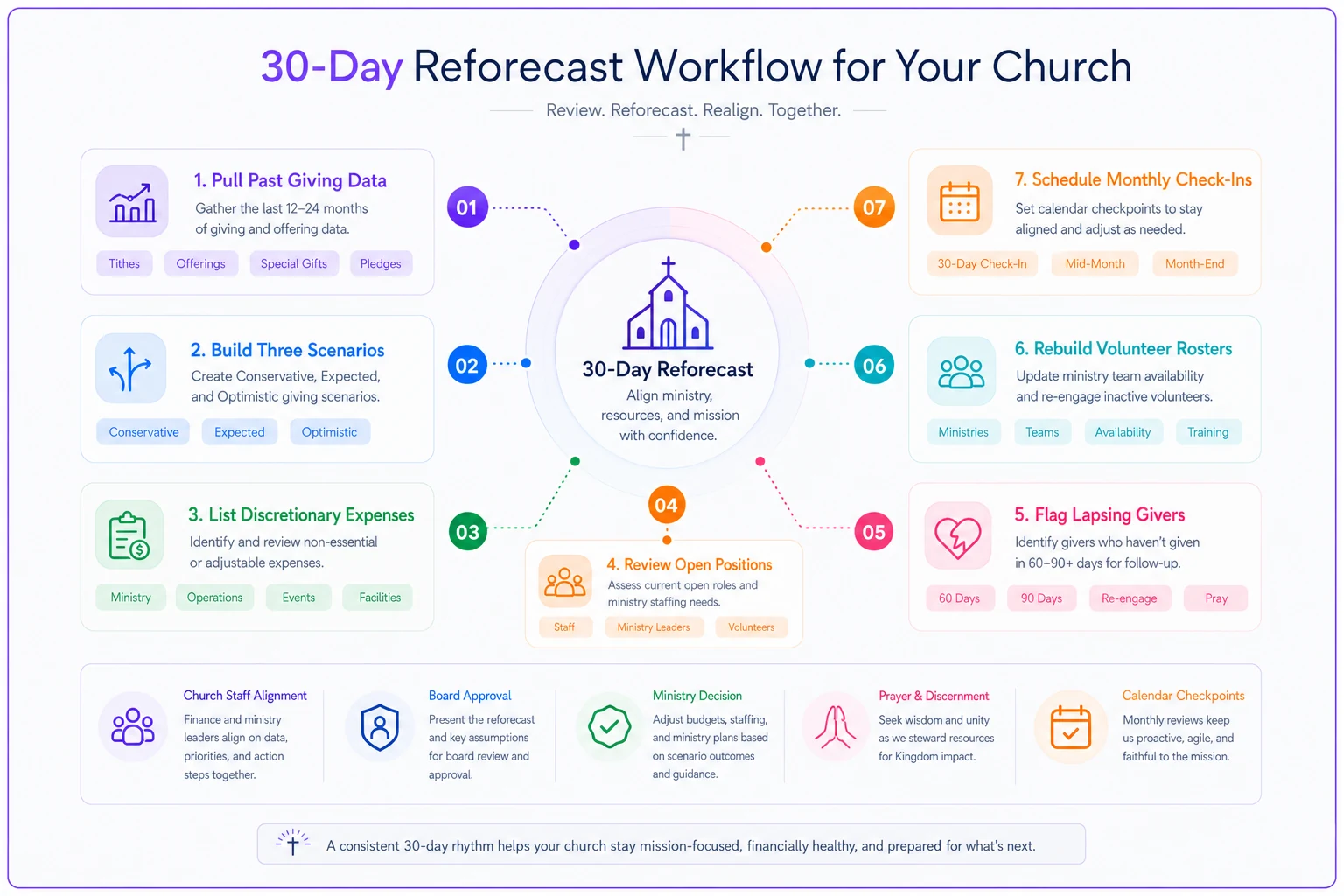
This visual summarizes the 30-day sequence above and makes it easy to walk the board through the steps.
A Realistic Scenario
Consider a suburban church running about $640k in annual general fund giving, with payroll at roughly 52% of budget. Through the summer, giving tracked within 1–2% of plan. Then a few things stacked up quietly: two families paused recurring gifts after job changes, and general monthly giving softened a couple of points across the board. By late October, the church was running about 6% behind plan — call it $18k–$22k for the fall.
The version of this church that hadn't reforecast would find that in the December financials and scramble — freezing spending abruptly, sparking an awkward board meeting, maybe dipping into reserves earmarked for the roof.
The version that built the scenario table in September already knew 6% put them in "Soft." They'd delayed a mid-level hire in October, trimmed some event overtime, and quietly re-engaged the two lapsed givers — one of whom restarted their gift after a pastor's call that had nothing to do with money. Same shortfall. Completely different December. No emergency, no reserve raid, no trust erosion with the staff.
The difference was never the economy. It was having the decisions made before the numbers arrived.
Where This Fits in Your Broader Planning
A single jobs report shouldn't drive your strategy, and this one shouldn't either. Treat it as a prompt to do the reforecasting discipline that's genuinely useful in any environment. If you want to go deeper on tightening budgets and protecting fundraising when the broader economic picture shifts, the post-Fed budgeting and fundraising checklist walks through the financial-protection side in more detail and pairs well with everything above.
The churches that stay steady through a cooling economy aren't the ones with the biggest reserves or the best fundraising pitch. They're the ones that built flexibility into the plan before they needed it — a tiered forecast, pre-decided responses, retention over hard asks, and volunteer coverage with real buffer. That work is boring and unglamorous, and it's almost entirely done in September rather than December. Which is exactly why so few churches actually do it, and why the ones that do rarely find themselves scrambling.
The churches that stay steady through a cooling economy aren't the ones with the biggest reserves or the best fundraising pitch. They're the ones that built flexibility into the plan before they needed it — a tiered forecast, pre-decided responses, retention over hard asks, and volunteer coverage with real buffer. That work is boring and unglamorous, and it's almost entirely done in September rather than December. Which is exactly why so few churches actually do it, and why the ones that do rarely find themselves scrambling.
Ready to transform your church management?
Join 500+ churches using Parshly to enhance community engagement, streamline administration, and grow their ministries.