

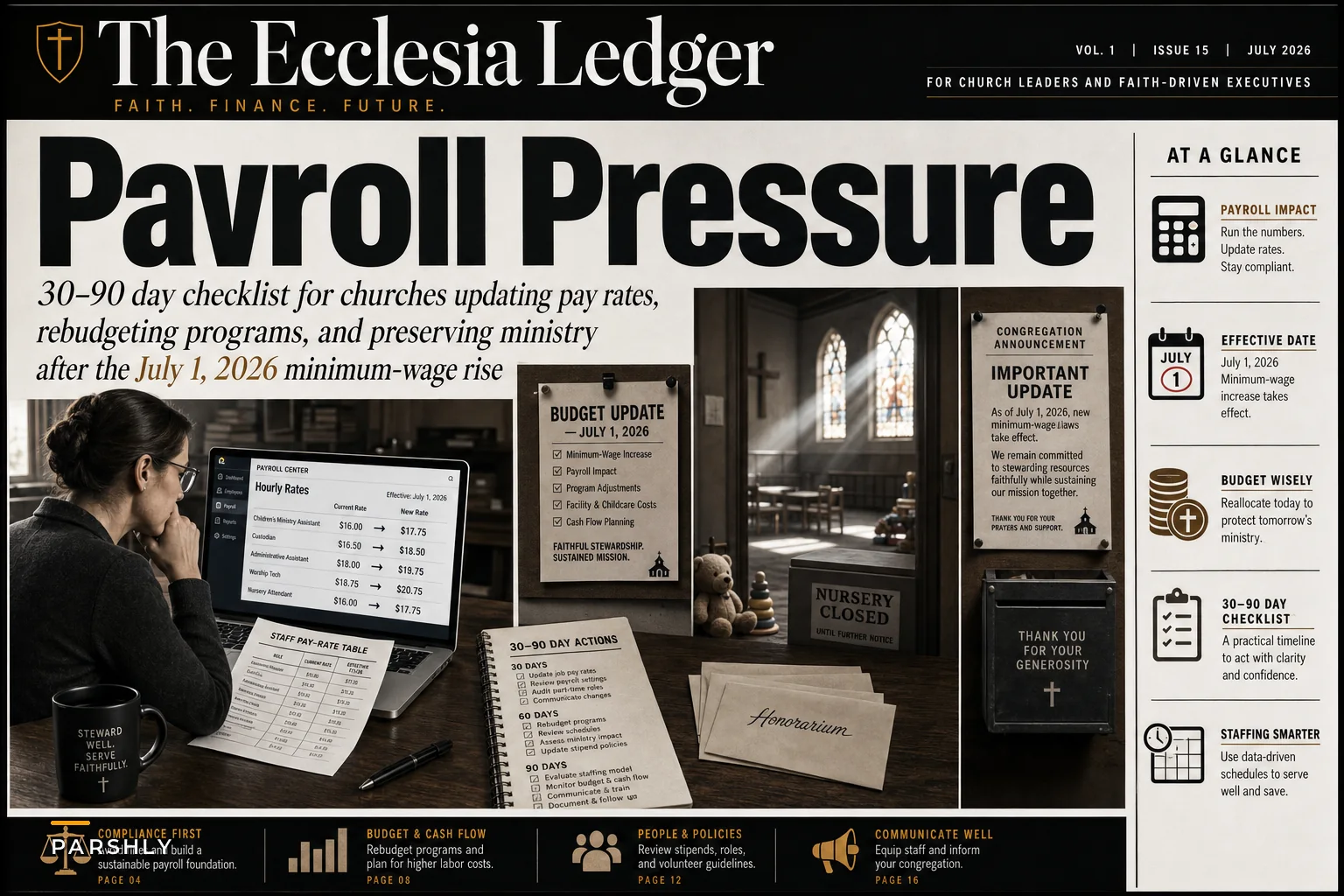

The minimum wage increase July 2026 churches are dealing with right now wasn't exactly a surprise. Seventeen states and localities raised their minimums on July 1st, and most church administrators had been watching these changes move through state legislatures for months. What caught everyone off guard was the actual operational impact when that first payroll run hit.
A mid-sized church in Illinois told me their childcare payroll jumped $1,400 in a single pay period. Not annually—two weeks. Their facilities team costs went up another $800. They'd budgeted for increases, but watching those numbers leave the bank account felt different than a spreadsheet projection from January.
The real challenge isn't just the higher wages. It's the ripple through your entire operational structure. When entry-level childcare workers jump from $12 to $15 an hour, suddenly your lead teachers at $16 feel underpaid. Your custodial supervisor at $17 starts getting recruitment calls. Before you know it, you're looking at wage compression across every hourly position, and that carefully planned 3% personnel budget increase looks laughable.
The compression problem nobody talks about in church operations
Most churches structure hourly staff in rough tiers. Entry positions—childcare assistants, event setup crew, basic admin support—usually sit near minimum wage. Experienced hourly folks are maybe $3-5 above that. Supervisory roles another $2-3 higher.
When minimum wage jumps $2 or $3 in one shot, that whole structure collapses. A church in California dealt with this last year when their minimum went to $16. Childcare leads making $17.50 suddenly earned barely more than brand new hires. The facilities manager at $19 started fielding offers from warehouses paying $22.
You can't just bump everyone up proportionally either. A church with 15 hourly employees tried maintaining the same percentage gaps between roles. Payroll shot up 31% in one quarter. They had to cut youth program budget and delay a roof repair that really couldn't wait.
The smarter move requires surgical precision—identifying which roles actually need compression relief versus which can absorb the squeeze temporarily. Not every position needs immediate adjustment.
Building your immediate response checklist
Week 1: Payroll system updates
Simplify your church’s day-to-day operations.
Parshly helps you organize events, track donations, and engage your congregation—all in one place.
- Centralized member management
- Donation tracking & reporting
- Volunteer scheduling & notifications
No credit card required
Your first move is purely technical. Get into your payroll system and update every affected position to the new minimum. Sounds obvious, but churches often have employment structures that complicate this.
Check these specific areas:
-
Regular hourly employees (straightforward)
-
Stipended positions that might actually be hourly when you calculate hours worked
-
"Volunteer" positions that receive any compensation beyond reimbursement
-
Contract workers who might legally be employees
-
Youth workers on summer contracts
The stipend issue trips up churches constantly. You're paying someone $500 a month to run sound on Sundays. Seems fine until you calculate 15 hours every weekend—that's $8.33 an hour, well below the new minimum. The Department of Labor's state minimum wage database doesn't care that you call it a stipend.
Run a quick hours-to-stipend conversion for every stipend before processing payroll to catch misclassified roles early.
Week 2: Compression analysis
Pull every hourly employee's current rate and build a simple spreadsheet:
| Position | Current Rate | New Minimum | Gap | Compression Issue? |
|---|---|---|---|---|
| Childcare Assistant | $12.00 | $15.00 | -$3.00 | Requires increase |
| Childcare Lead | $15.50 | $15.00 | $0.50 | Yes - severe |
| Facilities Assistant | $13.00 | $15.00 | -$2.00 | Requires increase |
| Facilities Supervisor | $17.00 | $15.00 | $2.00 | Yes - moderate |
| Admin Assistant | $14.00 | $15.00 | -$1.00 | Requires increase |
| Bookkeeper (hourly) | $22.00 | $15.00 | $7.00 | No |
Any position with less than a $2 gap needs attention. Positions with $2-3 gaps should be monitored. Anything above $3 can probably wait, unless you're already seeing retention issues.
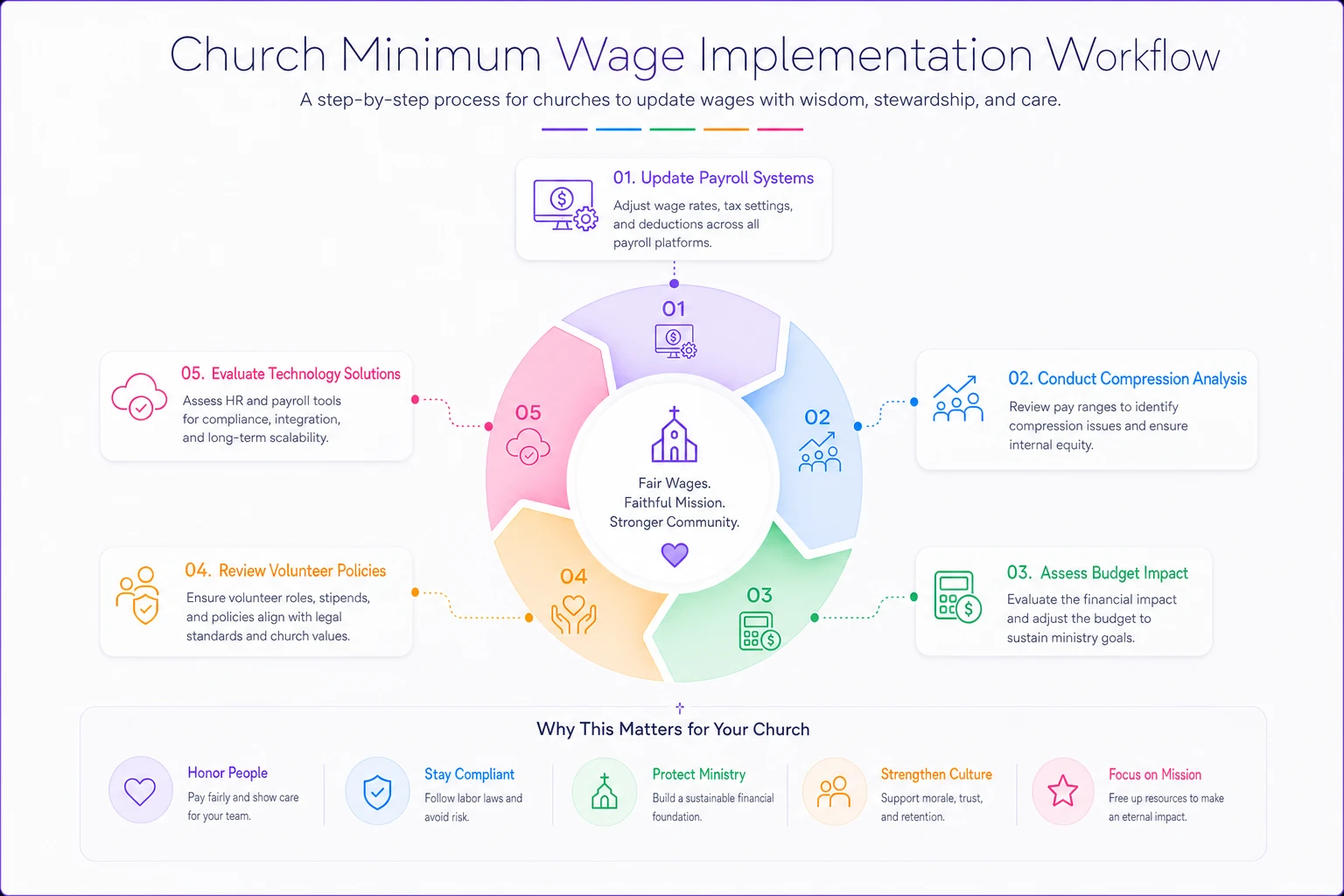
This flow shows the immediate steps to review and act on payroll, compression, and budgeting.
Week 3: Budget impact assessment
This is where administrators usually make their first mistake. They calculate the direct cost increase and stop there. A $3/hour increase for 10 employees working 20 hours a week looks like $600 per week, $31,200 annually. Manageable, maybe.
-
Employer payroll taxes (add 7.65% minimum)
-
Workers' comp premium increases (varies by state)
-
Potential overtime impact if people work more to earn more
-
Compression adjustments for other roles
-
Increased costs for temporary or seasonal help
That $31,200 suddenly looks more like $42,000-45,000 once everything factors in. For a church with a $400,000 annual budget, that's over 10% of total expenses.
The volunteer policy trap you're about to walk into
Higher minimum wages create a weird psychological shift around volunteer work. When entry-level pay hits $15 or $16 an hour, volunteers start doing different mental math about their time.
Someone volunteering in childcare every Sunday for three hours is now effectively donating $45-48 worth of labor instead of $36. Some feel good about that. Others start wondering why they're working for free when the church clearly values that role at $15+ an hour.
Churches in higher-minimum states report increased volunteer turnover in roles that mirror paid positions—childcare hardest hit, followed by facilities and event support. The volunteers most likely to stay are those in roles without paid equivalents: greeters, small group leaders, worship team members.
One church solved this with a policy matrix:
Paid positions:
-
Require specific schedule commitments
-
Have defined performance standards
-
Include tasks volunteers cannot do (handling cash, accessing member records, working alone with children)
-
Involve more than 8 hours weekly commitment
Volunteer positions:
-
Flexible scheduling
-
General service standards
-
Limited to specific approved tasks
-
Usually under 8 hours weekly
The 8-hour threshold isn't arbitrary. Churches that blur this line often face claims that volunteers are actually employees entitled to minimum wage. It's happened to churches I know personally, and back-pay settlements ranged from $15,000 to $40,000.
Creating sustainable staffing models
The churches handling these increases best aren't just paying more for the same structure—they're redesigning roles and workflows entirely.
A church in Washington state facing a $16.28 minimum restructured their childcare program completely. Instead of 8 part-time workers covering scattered shifts, they consolidated to 3 full-time positions with benefits and 2 part-time floaters. Full-time positions cost more per person but eliminated constant scheduling chaos, reduced training costs, and improved program quality. Parents noticed the consistency almost immediately.
They also applied a staffing heatmap approach to their worship services, mapping exactly when they needed maximum coverage versus when they could run lean. That let them stagger shifts more effectively and reduce total hours without compromising service quality.
Another church started bundling responsibilities. Instead of separate part-time roles for childcare, facilities, and admin support, they created hybrid positions—one person doing childcare Sunday morning, facilities work Tuesday and Thursday, admin support Wednesday afternoon. Workers got more hours and income; the church reduced total headcount.
The technology offset nobody's talking about
Churches facing payroll pressure are discovering what small businesses figured out years ago—technology can offset labor costs, but only if you're strategic about it.
The wrong approach: trying to replace people with software. I've seen churches buy expensive check-in kiosks thinking they'll eliminate greeter positions, only to need someone standing next to the kiosk helping confused members anyway.
The right approach targets the time-wasting tasks eating up paid hours. A church administrator spending 6 hours a week manually entering donation data at $18/hour costs the church around $5,600 annually. Donation management software that automates bank reconciliation and donor acknowledgments might run $2,400/year but frees up those hours for actual ministry work.
Common automation opportunities:
Financial operations:
-
Donation entry and reconciliation (saves 5-8 hours weekly)
-
Payroll processing for complex church structures (saves 3-4 hours biweekly)
-
Expense report processing (saves 2-3 hours weekly)
Communications:
-
Event reminder texts (saves 2-3 hours per event)
-
Volunteer scheduling confirmations (saves 4-5 hours weekly)
-
Member database updates (saves 3-4 hours weekly)
The math usually looks something like this: $300-500 monthly on operational software saves 25-30 labor hours monthly. At $15 minimum wage, that's $375-450 in direct labor cost, plus avoided overhead.
Restructuring volunteer appreciation programs
With higher minimum wages shifting how volunteers think about their time, annual banquets and thank-you cards aren't cutting it anymore.
Tangible benefits that aren't wages:
-
Free childcare during volunteer shifts
-
First priority for event registration
-
Discounted or free church facility rentals for personal events
-
Professional development opportunities (conferences, training)
-
Mileage reimbursement for church-related travel
Skills-based recognition:
-
Certificates of volunteer hours for professional portfolios
-
LinkedIn recommendations from pastoral staff
-
References for job applications
-
Skills workshops led by professionals in the congregation
A church in Oregon implemented a "volunteer benefits package" that includes gym facility access, priority registration for church events, and a monthly lunch with pastoral staff. Cost: roughly $50 per volunteer annually. They saw volunteer retention increase around 40% year-over-year. The specifics will vary, but the principle holds—people respond to benefits that feel personal, not performative.
Budget reallocation strategies that actually work
Most churches try absorbing wage increases by trimming program budgets evenly—everyone takes a 5% cut. This feels fair but usually backfires. Programs operate at different efficiency levels, and across-the-board cuts often break previously functional operations.
A better approach: zero-based analysis of program ROI. One church went through every program asking three questions:
-
How many people does this actually serve?
-
What happens if we pause it for six months?
-
Can volunteers run this entirely?
Their Wednesday night dinner program served 45 people but required two paid staff members for 6 hours each week—about $18 per meal served. They shifted to monthly potlucks run entirely by volunteers, saving $14,000 annually.
Their youth ministry's Instagram management consumed 5 paid hours weekly and reached maybe 100 people. A college student volunteer took it over, saving $3,900 annually.
Meanwhile, their children's ministry serving 200+ families got a budget increase. Some programs can't run on volunteer labor alone, and pretending otherwise just degrades service quality.
Common mistakes to avoid right now
Delaying the inevitable. Wage compression gets worse over time, not better. Experienced staff won't suddenly become okay with earning barely above minimum wage.
Converting employees to contractors. The IRS and state labor departments are actively watching for this. If someone works set hours, uses church equipment, and you control how they do their work, they're an employee. Misclassification penalties start at $50 per form and go up quickly from there.
Cutting hours to offset wages. Reducing a childcare worker from 20 to 15 hours weekly to maintain the same labor cost seems logical—until parents arrive to locked doors because your skeleton crew called in sick. Marginal cost savings aren't worth degraded service.
Ignoring exempt employee morale. Your salaried pastoral staff might not get minimum wage increases, but they're watching hourly workers get 20% raises while their own salaries stay flat. Address this proactively or start losing pastoral staff to churches that do.
Practical steps for the next 30 days
Start with payroll compliance—get everyone to at least minimum wage immediately. Penalties for non-compliance start right away and compound.
Run your compression analysis and identify the 2-3 most critical positions needing adjustment, usually supervisory roles sitting just above minimum-wage positions. Fix these first to prevent immediate departures.
Schedule one-on-ones with every affected employee. They already know about the increase and they're wondering what it means for them personally. Uncertainty breeds anxiety, and anxious employees leave. Even if you can't offer raises immediately, clear communication about timelines helps more than silence.
Document your volunteer versus employee distinctions in writing. Train staff leaders on the differences. This prevents expensive misclassification claims later.
Start evaluating operational software that can offset labor costs—tools that combine multiple functions like donation management, event registration, and volunteer scheduling. The goal isn't replacing people. It's freeing them from repetitive tasks so they can focus on ministry.
Talk to your most reliable volunteers about what appreciation actually means to them. It's often not what leadership assumes.
Looking ahead six months
Churches that navigate this well will come out operationally stronger. Clearer role definitions, better volunteer-employee boundaries, more efficient workflows. The forced examination of every payroll dollar usually surfaces inefficiencies that have been sitting there for years.
Wage pressure is also pushing churches toward software adoption that should've happened a long time ago. Manual processes that seemed acceptable when labor was cheap become obviously wasteful at $15+ an hour. That drives better data management, improved financial controls, and more strategic resource allocation—things that benefit the organization well beyond the current wage cycle.
Your congregation probably includes business owners navigating identical challenges right now. They're dealing with minimum wage increases, compression, and operational efficiency in their own companies. Tap into that expertise. Solutions that work for small businesses often translate directly to church operations with minor adjustments.
More states are indexing minimums to inflation, which means regular annual increases going forward. Building sustainable models now prepares you for continued wage pressure over the next decade—not just this July.
Churches that try to maintain old operational structures against 2026 wage requirements will struggle. Those that build clear policies, efficient workflows, and smarter use of technology will manage fine despite the higher labor costs. The question isn't whether to adapt—it's how fast you can move while keeping ministry at the center.
Ready to transform your church management?
Join 500+ churches using Parshly to enhance community engagement, streamline administration, and grow their ministries.