


The phone call at 2 AM about a member attempting suicide. The text about domestic violence during Sunday service. The email about a marriage falling apart that sits unread for three days.
Every pastoral communication decision carries weight. Not just operational weight — spiritual weight. Most churches handle these moments with whatever channel feels fastest, not what's actually most effective for the situation.
After building operational platforms for dozens of churches that handle everything from prayer requests to crisis interventions, one pattern keeps showing up: the difference between a pastoral response that helps and one that fails usually comes down to channel selection. Not the message itself. Not even the response time. The channel.
The hidden complexity of pastoral communication urgency
Most churches think urgency is binary — either something needs immediate attention or it can wait until Tuesday's staff meeting. But pastoral urgency operates on at least four different dimensions that churches rarely consider together.
Time sensitivity ranges from "someone is in physical danger right now" to "this family needs counseling within the next few weeks." A suicide threat demands instant response. A struggling marriage needs careful scheduling. Using the wrong channel for either destroys your ability to help.
Privacy requirements shift based on who else might see the communication. The teenager texting about pregnancy can't have that message pop up on the church iPad that volunteers use. The financial assistance request shouldn't go through the main office email that three people monitor.
Escalation potential determines whether you need a paper trail or immediate voice contact. The member threatening to leave needs documentation. The domestic violence situation needs immediate verbal de-escalation. Mix these up and you either lack necessary records or miss the chance to intervene.
Response capability varies by who's actually available to respond through each channel. Your senior pastor might check texts instantly but ignore emails for days. Your care pastor might monitor the prayer line religiously but never look at Facebook messages.
Churches typically handle around 15-20 urgent pastoral situations monthly. Without a clear framework, staff make channel decisions based on personal preference or panic, not pastoral effectiveness.
Why standard communication advice fails churches completely
Corporate communication frameworks assume rational actors making business decisions during business hours. Churches deal with emotional crises at unpredictable times involving volunteers with varying tech skills and availability.
Simplify your church’s day-to-day operations.
Parshly helps you organize events, track donations, and engage your congregation—all in one place.
- Centralized member management
- Donation tracking & reporting
- Volunteer scheduling & notifications
No credit card required
Take the standard advice about email for non-urgent matters. That breaks down when your 75-year-old prayer team leader only checks email weekly but responds to phone calls immediately. Or when the single mom in crisis can only text because she's at work and can't take calls.
Business communication also assumes clear ownership. In churches, pastoral care might involve the senior pastor, associate pastors, deacons, prayer teams, and lay counselors — all with different communication preferences and availability windows. A text to one person means seven others don't know about the crisis. An email to all means nobody feels personally responsible to respond.
The emotional weight changes everything too. Business messages convey information. Pastoral messages carry pain, fear, shame, and desperation. The channel itself communicates care level. A text response to a suicide threat feels dismissive. A phone call about routine prayer requests feels intrusive.
Most churches end up with informal rules like "text for quick questions, call for emergencies, email for everything else." These broad guidelines crumble under real pastoral complexity.
Building your pastoral communication decision matrix
The most effective churches use a scoring system that weighs multiple factors simultaneously. Here's the framework that actually works:
| Factor | SMS | Phone Call | In-Person | |
|---|---|---|---|---|
| Immediate danger (score x3) | 2 | 4 | 0 | 5 |
| Privacy needed (score x2) | 1 | 3 | 2 | 5 |
| Documentation required (score x2) | 3 | 1 | 5 | 2 |
| Emotional complexity (score x1) | 1 | 4 | 2 | 5 |
| Responder availability (score x1) | 4 | 3 | 2 | 1 |
Score each factor for your specific situation. The channel with the highest total score is your primary method. The second highest becomes your backup.
This matrix only works if you've already segmented your congregation by communication patterns. The retired engineer responds differently than the teenage student. The stay-at-home parent has different availability than the shift worker.
Use this workflow to score factors, pick a primary channel, and choose a backup — repeatable steps make training easier.
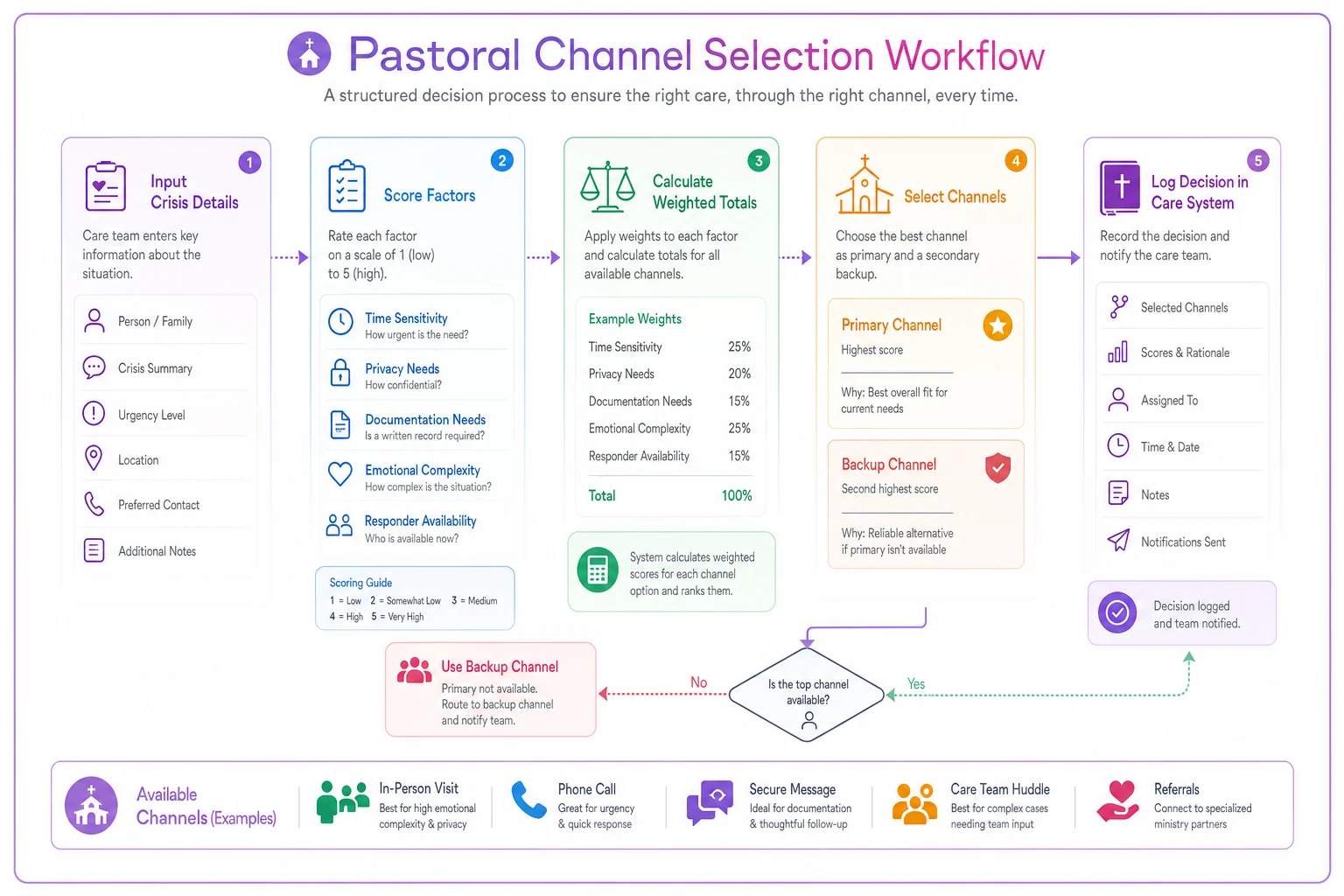
Pilot the matrix with your most common crisis types before making it policy.
The retired engineer responds differently than the teenage student. The stay-at-home parent has different availability than the shift worker.
Audience segmentation that reflects pastoral reality
Forget demographic segmentation. For pastoral communication, you need behavioral segmentation based on crisis patterns and communication preferences.
The Silent Strugglers make up around 40% of most congregations. They never reach out directly. Only communicate through third parties or when directly asked. Often dealing with shame-based issues like addiction, financial problems, or marriage struggles. Primary channel: Phone calls (feels more private) Backup: In-person (can read non-verbals) Avoid: Group texts or emails (fear of exposure)
The Crisis Cyclists represent roughly 20% of congregations. Regular urgent needs, often with escalating severity. They know the pastoral care system well. Sometimes overwhelm responders with frequency. Primary channel: SMS (allows boundaries) Backup: Scheduled calls (prevents emergency fatigue) Avoid: Immediate in-person (can become dependent)
The Acute Emergencies are around 5% of your congregation. Rare contact but extreme severity. Suicide attempts, domestic violence, sudden death. Need immediate, sustained response. Primary channel: Phone call (immediate voice contact) Backup: In-person (if call fails) Avoid: Email or SMS (too slow, impersonal)
The Steady Supporters make up about 35% of congregations. Regular prayer requests, ministry updates, celebration sharing. Not usually urgent but want connection. Primary channel: Email (can batch responses) Backup: SMS for acknowledgment Avoid: Phone calls (wastes crisis response capacity)
Your segmentation might differ, but you need clear categories with defined channel preferences before any crisis hits.
Sample scripts that match channel capabilities
Each channel has built-in constraints that shape what you can effectively communicate. Your scripts need to work within these limits, not fight against them.
SMS Scripts (160 character chunks, assume delayed response)
Initial contact for sensitive situation: "Hi [Name], Pastor [Name] here. I got your message and want to help. Are you safe right now? Reply Y if yes, N if you need immediate help, or CALL if you prefer to talk."
Escalation to voice: "This sounds really difficult. Can we talk by phone? I'm available now or can call at a time that works better for you. Just let me know."
Setting boundaries with crisis cyclers: "I care about what you're going through. Let's schedule a call tomorrow at 2 PM to discuss properly. If this is an emergency requiring immediate help, please call 911."
Phone Call Frameworks (assume emotional overflow, poor recall)
Opening for crisis calls: "Hi [Name], this is Pastor [Name]. I'm glad you reached out. Before we talk, are you somewhere safe where we can speak privately?"
Suicide risk assessment: "I hear that you're in tremendous pain right now. I want to help. Can you tell me - have you thought about hurting yourself? Do you have a plan? Do you have means to carry it out?"
Closing with next steps: "Let me repeat back what we've agreed: [summarize plan]. I'll call you again [specific time]. If things get worse before then, you'll [specific action]. Is that correct?"
Email Templates (assume time delay, multiple readers)
Acknowledging serious concern: "Dear [Name], I received your message about [general situation, no details]. This is clearly weighing heavily on you, and I want you to know that we take your concerns seriously. I'd like to discuss this with you personally. Would you be available for a phone call [give 2-3 specific time options]? If these don't work, please suggest times that would. If this becomes urgent before we connect, please don't hesitate to call me directly at [number]. Praying for you, Pastor [Name]"
Coordinating care team response:
-
[Name]
Prayer coverage starting immediately
-
[Name]
Prepare resources for [type of support]
-
[Name]
Check our referral list for [type of professional help]
Please acknowledge receipt and let me know your availability for a brief coordination call today. Responder privacy reminder: No details in replies. Use code name [assigned code] if discussing.
Escalation rules that prevent pastoral disasters
Escalation isn't just about moving up the chain of command. It's about shifting channels when the current one fails to meet pastoral needs. Most churches lack clear triggers for these shifts.
Time-based escalation triggers:
-
No SMS response in 30 minutes → Phone call
-
No phone answer in 3 attempts → Contact emergency contact
-
No email response in 24 hours → SMS check-in
-
No contact in 48 hours for known crisis → Welfare check
Content-based escalation triggers:
-
Any mention of self-harm → Immediate phone call
-
Domestic violence disclosure → Phone call + safety planning
-
Child abuse allegation → Phone call + mandatory reporting
-
Substance use crisis → Phone or in-person based on severity
Pattern-based escalation triggers:
-
Third crisis text this week → Schedule in-person meeting
-
Repeated middle-of-night contacts → Boundary-setting call
-
Escalating urgency language → Shift to voice immediately
-
Multiple family members reaching out → Coordinate family meeting
Your escalation map needs to be documented, not just understood. Every staff member and key volunteer needs access to the same triggers and protocols.
Privacy protection across channels
HIPAA doesn't apply to churches, but pastoral confidentiality carries similar weight. Each channel creates different privacy vulnerabilities that most churches never consider.
SMS privacy gaps: Messages display on lock screens. Family members share phones. Phone bills show numbers texted. Deleted messages often recover from backups. Teen messages might route to parent phones. Prevention: Use code phrases for initial contact. Shift sensitive details to calls. Never text specific problems, only general categories. Consider app-based messaging with disappearing messages for youth ministry.
Email privacy failures: Shared church accounts mean multiple readers. Auto-forwarding rules expose messages. Prayer request systems often lack access controls. Cloud backups persist indefinitely. Protection: Separate pastoral care addresses with single access. Clear subject lines that reveal nothing specific. Encryption for highly sensitive situations. Regular audit of who has access to what.
Phone call vulnerabilities: Speaker phone in cars. Family members within earshot. Call logs on shared phones. Voicemails accessible by others. Safeguards: Always verify privacy before sensitive discussion. No voicemails with details. Follow up calls with secure written summary. Establish "safe to talk" codes.
Technology infrastructure most churches actually need
Churches typically operate with consumer-grade tools trying to handle professional-grade crises. A church of 200 members needs more sophisticated pastoral communication infrastructure than most realize.
Minimum viable setup for churches under 500:
-
Dedicated pastoral care phone (not personal pastor phone)
-
Separate SMS system with archiving capability
-
Pastoral care email with restricted access
-
Basic ticketing system for tracking responses
-
Secure note-taking system accessible by care team
For churches over 500, add:
-
On-call rotation system with automatic routing
-
Conversation threading across channels
-
Automated acknowledgment system
-
Integration between communication and member database
-
Audit trail for all pastoral interactions
AI-powered operational software transforms pastoral care from reactive to proactive. Instead of manually tracking who responded to what crisis through which channel, modern platforms automatically route messages based on urgency, maintain conversation history across channels, and flag concerning patterns before they become crises.
The right software doesn't replace pastoral care — it ensures no cry for help goes unheard and no follow-up gets forgotten. When a teenager texts about depression, the system can automatically alert the youth pastor, schedule a follow-up reminder, and document the interaction for continuity of care.
Measuring what matters in pastoral communication
Most churches measure nothing about their crisis communication effectiveness. The ones that do typically track the wrong metrics — response time instead of resolution quality, message volume instead of member outcomes.
-
Time to first human response (not automated acknowledgment)
-
Percentage of crises that escalate appropriately
-
Follow-up completion rate within 72 hours
-
Member satisfaction with channel choice (survey after resolution)
-
Staff burnout indicators (middle-of-night response frequency)
-
Handoff success rate between responders
One church tracking these metrics noticed their Tuesday night prayer team handled 60% of crisis texts but only 20% had authority to take action. They restructured their response team and cut resolution time by half.
When channel choice becomes pastoral malpractice
Some channel mistakes are inefficient. Others are actively harmful. Churches need to recognize the difference.
Harmful channel choices that damage pastoral care include group texts for individual prayer requests (privacy violation), email for suicide threats (dangerous delay), public social media for private struggles (exposure trauma), voicemail for crisis situations (abandonment feeling), and text breakups with troubled members (relationship damage).
One church learned this after responding to a domestic violence situation via email. The abuser checked the shared email account, saw the escape planning, and escalated violence. They now have strict protocols: domestic violence always triggers immediate phone contact with safety assessment.
Building your church's channel decision guide
Stop leaving channel choice to chance or personal preference. Document your decision matrix, train your team, and update based on actual outcomes.
Start with a simple one-page guide:
-
Assess urgency level (immediate, today, this week)
-
Identify privacy needs (public, confidential, highly sensitive)
-
Check responder availability (who's on call, through what channel)
-
Select primary and backup channels using your matrix
-
Document why you chose that channel (for learning)
Review monthly: What worked? What failed? What patterns emerged?
Most churches discover their instincts are backwards — using SMS for complex emotional situations that need voice, calling for simple scheduling that email handles better, avoiding documentation for situations that desperately need paper trails.
The ministry multiplication effect
Proper channel selection doesn't just improve individual crisis response. It multiplies pastoral care capacity across your entire congregation.
When you match channel to need, several things happen. Response quality improves because pastors aren't fighting against channel limitations. Staff burnout decreases because boundaries become enforceable. Member trust increases because they feel heard through their preferred channel. Documentation improves because appropriate channels naturally create records.
But the biggest change is proactive care becoming possible. When crisis communication runs smoothly, pastoral staff have capacity to reach out before problems escalate. The same systems that handle urgent incoming messages can manage preventive outreach campaigns.
Churches using integrated communication platforms report identifying at-risk members 3-4 weeks earlier than before. That's the difference between marriage counseling and divorce proceedings, between financial planning and foreclosure, between depression support and hospitalization.
The churches thriving post-2020 didn't just survive the communication complexity — they built systems that turned multichannel chaos into coordinated care. Their secret wasn't better pastors or bigger budgets. It was treating pastoral communication channels as a strategic ministry decision, not an operational afterthought.
Your congregation's crises won't wait for you to figure this out. Every day without clear channel protocols is another opportunity for a cry for help to go unheard, a crisis to escalate unnecessarily, or a pastor to burn out from communication chaos.
The question isn't whether your church needs a pastoral communication decision matrix. It's whether you'll build one before or after the next crisis exposes the gaps in your current approach.
Ready to transform your church management?
Join 500+ churches using Parshly to enhance community engagement, streamline administration, and grow their ministries.